
The Call of God Is Always to Loving Synergy
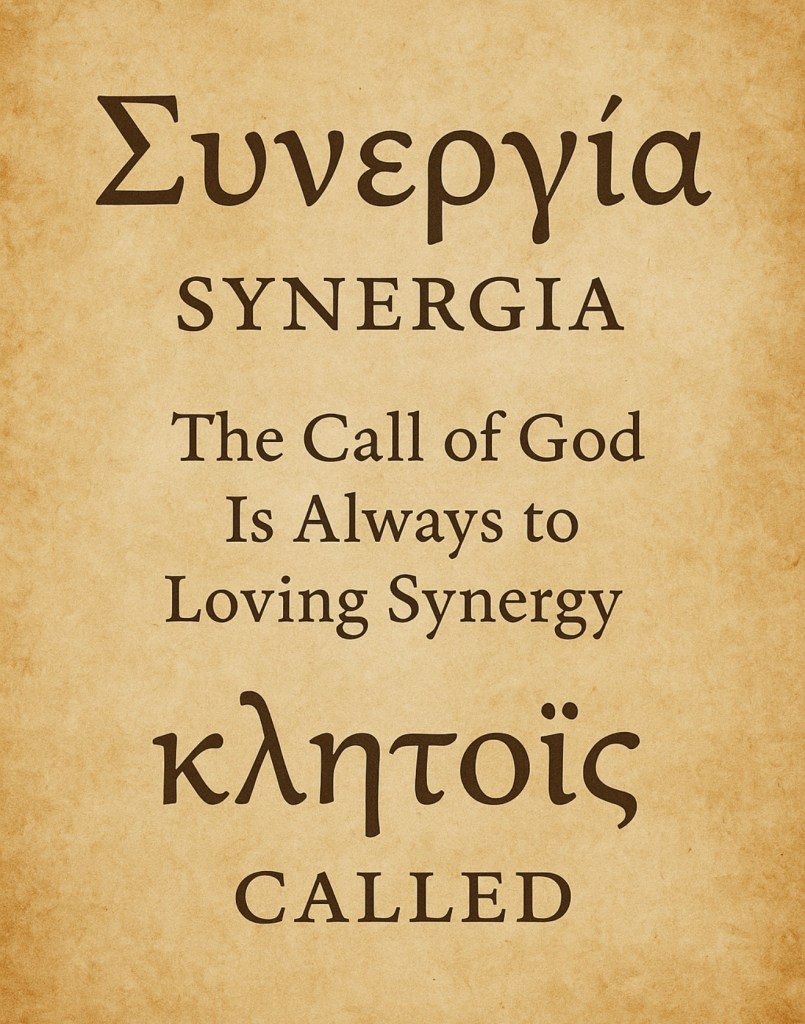
Synergia & Klēsis: When God Calls Us to Work With Him
There are moments in Scripture where a single word opens a window into the very heart of God. Romans 8:28 contains one such word. Read hurriedly, it comforts. Read with attention to its Greek, it astonishes. It doesn’t merely reassure us that God “has things in hand.” It reveals that God calls us — and that His call is to work with Him in love.
This post will follow that discovery. We’ll listen to the Greek. We’ll watch how synergei sits in the sentence and how klētois (those “called”) fits in the flow. Then we’ll trace kaleō/klēsis through a handful of New Testament uses that show a pattern: God’s call is always to participation, to fellowship, to cooperative love. Finally, we’ll bring it home: the theology that arises from these words is not a cold determinism but a warm invitation — the Gospel of Synergia.
📖 Romans 8:28 — Read the Greek, Hear the Invitation
Most English Bibles render Romans 8:28 something like:
“And we know that all things work together for good for those who love God, who are called according to his purpose.”
That translation comforts, but it can also flatten the sentence. The Greek makes the subject and the texture of the action much clearer. Paul writes:
οἴδαμεν δὲ ὅτι τοῖς ἀγαπῶσιν τὸν θεὸν πάντα συνεργεῖ ὁ θεὸς εἰς ἀγαθόν, τοῖς κατὰ πρόθεσιν κλητοῖς οὖσιν.
Notice the center: πάντα συνεργεῖ ὁ θεὸς — panta synergei ho theos. The verb is synergei (συνεργεῖ): to work together with, to cooperate. And the acting subject is ho theos — God. This is not an abstract “all things” that somehow collaborate; this is God working together with those who love Him.
Then Paul adds the phrase that nails down the character of the cooperation: τοῖς κατὰ πρόθεσιν κλητοῖς οὖσιν — tois kata prothesin klētois ousin — “to those called according to (or in accord with) His purpose.” The calling is not a label attached from afar; it is an invitation into a purpose. The purpose is already relational language: prothesis — a set-out intention, laid before us — and klēsis/klētoi — the call, the summons into that intention.
So when we pause at this verse, translating carefully with these things in mind we get a rendering that reads with the force of vocation:
“Furthermore, we understand that, in accordance with the purpose He has called them to, God is working together with those who love Him to bring about the good of all things.”
That phrasing places calling and working together in immediate proximity: God’s call is the very context in which God works with us. The call defines the kind of working that happens. God calls us — and God calls us to partnership.
💫 Klēsis — The Call That Invites Into Fellowship
The Greek verb translated “called” (klētois, from kaleō) shows up repeatedly across the New Testament, and each time it points toward the same family of ideas: invitation, movement into participation, entrance into fellowship. A quick look at the pattern reveals how consistently kaleō/klēsis is used to summon people into God’s life and work.
Consider these biblical contours of the call:
Called into fellowship (koinōnia): The call is not abstract. It is a summons into relationship. “Called into the fellowship of His Son” (1 Cor. 1:9) makes that explicit — the call creates a shared life.
Called to freedom and service: The call brings freedom that is meant to be expressed in loving service (Gal. 5:13). Liberation is not license; it is empowerment for love.
Called into kingdom activity: To be called into God’s kingdom is to be called into action, into walking worthy of the calling (1 Thess. 2:12).
Called according to purpose: Paul’s language in Romans — kata prothesin kletois — pairs calling with God’s purpose; the call is an invitation into God’s intended work.
Called into transformation and light: The call moves us from darkness to light, from death to life, from passivity into participation (1 Peter 2:9).
Every instance draws the same outline: God’s call is not a decree in a vacuum. It is a summons into a relationship and a mission.
🔗 Synergia & Klēsis—Two Sides of the Same Invitation
Place synergei and klētois side by side in Romans 8:28 and you see how naturally they belong together. God calls (klēsis) — not to be a spectator — but to work together (synergei) in the purpose He has set forth.
When we let the Greek speak, we discover a crucial point that changes how we picture the Christian life:
The call is the context of co-laboring. The invitation is not to passivity but to cooperation. God’s purpose is not an inscrutable decree but the horizon we are invited into. The theological grammar of the New Testament is relational: God acts in communion with people, and people respond by participating in that action.
That is the heart of the Gospel as vocation: God’s initiative meets our response in a mutual, loving labor toward restoration. It is the logic of agape. It is the logic of synergy.
🕊️ The Shock of the Missing Word: Monergism
Here’s something few ever notice:
While synergeō appears multiple times in the New Testament, there is no Greek word for the idea of monergism—no monergia, no monergeō, no monergos.
That absence matters.
This “Golden Chain” of verses that often is held up as proof on monergism does not even contain that word. Instead it is framed in the verse before by Synergia.
The apostles never describe God’s saving action or his call as something done menergistically alone.
The grammar of scripture itself is relational. The New Testament imagination of redemption is one of partnership, not isolation.
Across the New Testament text, the idea of monergism is not mentioned. In cases like Romans 8:28-30 when many may think it should be mentioned or is what is being talked about it is now but instead what is often used (as seen in Romans 8:28) is synergia/synergism (the word that means the opposite of monergism) used in a pattern that repeats multiple times throughout the New Testament (see 1 Corinthians 3:9, 2 Corinthians 6:1 for some of its other uses).
So the language of Scripture points in one direction: God does not work monergistially alone but instead works synergistically with his image bearing humans.
❤️ Scripture’s Pattern: Calling Always Moves Us Toward Participation
Similarly, if we trace kaleō/klēsis through the New Testament the pattern is unmistakable: the divine call always, in practice, moves people into participatory faith. Here are a few resonant examples (each could be unpacked in its own post):
Called into fellowship (1 Corinthians 1:9): The call gathers people into the koinōnia of Christ — a shared life, not merely a theological status.
Called to freedom that serves (Galatians 5:13): The call to freedom is immediately tethered to love and service; it’s freedom used for the flourishing of others.
Called into God’s kingdom and glory (1 Thessalonians 2:12): This language implies walking with God — living within God’s project and aims.
Called with a holy calling (2 Timothy 1:9): The calling is rooted in God’s purpose and grace — an enacted invitation, not a fate sealed without human participation.
Called from darkness into light (1 Peter 2:9): The language of calling describes a transformation that requires response and ongoing participation.
Each usage sketches the same portrait: God’s call is to a living, responsive, cooperative existence.
🔗 Casting the “Golden Chain” in the Light of the call to Synergy
We have been focusing in on Romans 8:28. The next verses (Romans 8:29–30) are often called “the Golden Chain,” and are frequently used to defend monergism—the view that God alone acts in salvation.
But when read in the light of the call of synergei ho theos (v. 28), the entire chain is recast in relational, cooperative terms.
The “called” ones of verse 28 continue into verses 29–30, showing that God’s calling is not a decree of isolation but an invitation into synergistic love.
The focus isn’t on control, but communion.
It’s not about fate, but about faithful participation.
In short, verse 28 frames the chain that follows:
Every act of God described in salvation history is relational, flowing from His desire to work with humanity, not apart from it.
The point is not to unpack the entire meaning of those verses here. That is beyond the scope of this blog post. However what we are saying is this: whatever else Paul intends in vv. 29–30, the verse that directly precedes them (v. 28) reframes the horizon. It says the shape of God’s saving work is cooperative. The calling is the key to understanding how the chain functions in real life: as invitation, not as coercion.
🔥 What This Means Theologically — A Loving, Persuasive Case
So, if you let these Greek words speak for themselves, several robust theological consequences follow — not as polemical weapons, but as faithful implications of the language Paul chose.
Divine sovereignty is not best pictured as isolation. Sovereignty as domination is a theological option but not the only grammatical option the New Testament gives. The biblical vocabulary emphasizes a God who sovereignly invites, empowers, and partners. Human freedom matters — not as an obstacle to God but as the arena of cooperation. The call assumes a response. It invites: we can answer in love, and in answering we participate in God’s work. Sanctification and mission are cooperative. The same Spirit who empowers God’s initiative empowers our response. Paul’s letters describe a two-handed economy: God works in us and through us. Redemption is cosmic and vocational. The good God aims for is the flourishing of creation. The call is not merely about individual salvation; it’s about forming co-heirs who will steward and heal the world. Love is the interpretive key. If God is agape, then the logic of God’s action will reflect the logic of love: invitation, sacrifice, empowerment, and shared flourishing.
These are not trivial adjustments. They change how a person prays, serves, pastors, and lives. They change how a community organizes its mission. They reshape hope: not as passive endurance that waits for a divine stamp of approval, but as active participation in the work God has already set forth.
🌎 Practical Consequences — Living the Call to Synergy
What does this sound like in a lived church and discipleship?
Prayer becomes partnership. We don’t only ask God to move; we ask how God wants to move with us. We listen for where our hands and hearts can be instruments of His will. Ethics becomes co-labor. Our choices matter. They aren’t ineffective minutiae; they are the means God uses to bring about good. Mission is cooperative. The church’s work is not about convincing God to act but joining God already at work in the neighborhoods, systems, and people who are groaning for renewal. Suffering is not meaningless. When pain occurs, the promise isn’t that pain is merely useful because God’s machine is perfect. Rather, it’s that God is present, working together with those who love Him to bring redemption out of rupture. Formation is mutual. Spiritual growth is not God overriding our wills; it’s God’s grace working in us as we yield — a synergistic dance of Spirit and soul.
❤️ Conclusion — The Gospel of Synergia
Romans 8:28, carefully read in its Greek, does something more than comfort. It reorients. It declares that God’s way with us is to call — and to call us into working with Him. The words synergei and klētois belong together because God’s call is inseparable from the reality of cooperative love.
We are summoned into a vocation that is essentially relational and cooperative. The good God intends — the healing of creation, the flourishing of souls, the march toward shalom — is accomplished not by divine coercion but through divine invitation and human response. That is the rhythm of the Gospel: God reaches; we respond. God empowers; we participate. God invites; we join and now we can say along with Paul
“we understand that, in accordance with the purpose He has called them to, God is working together with those who love Him to bring about the good of all things.”
This is Synergia & Klēsis: the call of God is always an invitation into loving partnership. It is good news not because it absolves us of responsibility, but because it dignifies us with participation—calling us to be co-laborers in the divine work of love.
For as the Apostle John also puts this:
“We love because he first loved us” – 1 John 4:19
Takeaway: The call is not merely information about our status. It is an invitation into the work of God. God love and calls; God works with; we respond in love to bring about his loving kingdom on earth as is it in heaven for the good of all creation. That is the gospel’s heartbeat.
Romans 8:28, then, is not about a distant decree, but about divine synergy — the God who calls, loves, and works with us for the good of all creation.
 The Logos of Agape