Word 4: Tselem
Mistranslated: The Image of God ≠ A Bestowed Moral Status
Hebrew: צֶלֶם (tselem) – image, representation
Greek Equivalent: εἰκών (eikōn) – image, icon, visible manifestation
“Then God said, ‘Let us make humanity in our tselem, according to our demut… and let them rule.’”
— Genesis 1:26
❌ MISUNDERSTOOD: Two Words, One Meaning?
Most modern readers—and even many pastors and theologians—collapse tselem (“image”) and demut (“likeness”) into one vague idea: that we vaguely resemble God, morally or spiritually.
But in their original Hebrew context, and in both Jewish and early Christian thought, tselem and demut are distinct yet deeply complementary.
Tselem is our given identity—the divine architecture built into us from the beginning. Demut is our intended destiny—the moral and relational likeness we’re meant to grow into.
When we flatten these terms, we reduce the drama of human purpose.
We miss the why of freedom, and the how of God’s love.
🏛️ Tselem in Its Ancient Context: Image as Sovereignty
In the ancient Near East, a tselem wasn’t a flat reflection—it was a statue of authority:
A representative image placed in a king’s territory to declare:
“I am the one who reigns here—even if I’m not physically present.”
When Genesis 1 says all humans are made in God’s tselem, the message is radical:
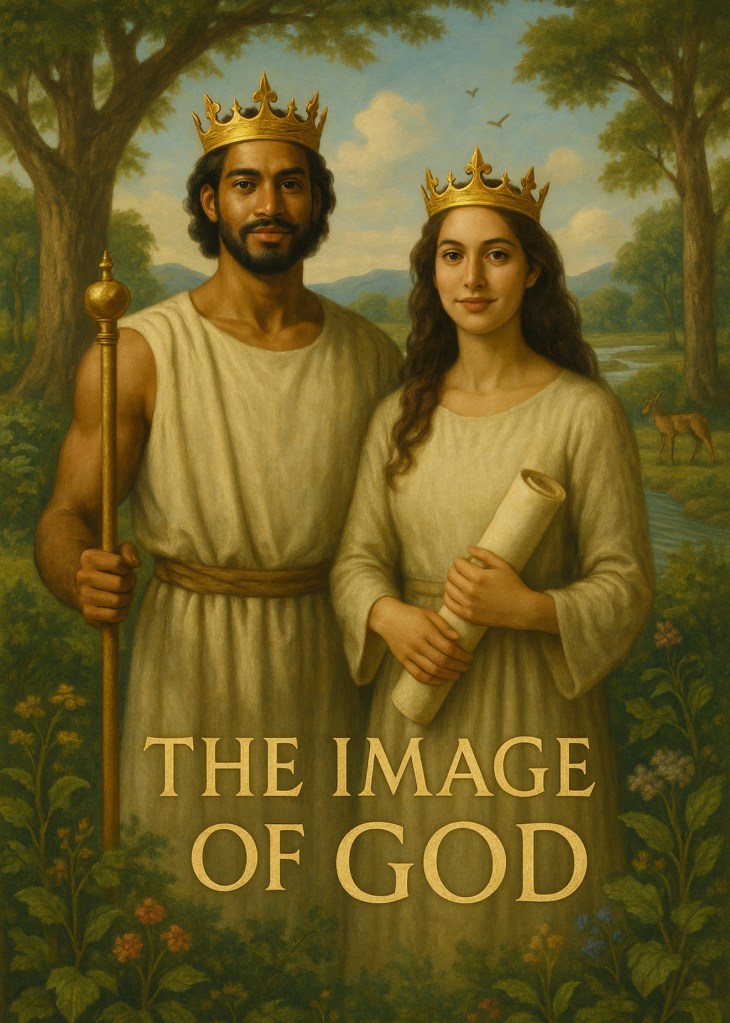
Every human being—not just kings—is a royal image bearer.
We are made to represent God’s reign on earth.
This isn’t just about value—it’s about delegated authority.
Image means we are given real responsibility, real freedom, and real sovereignty—not over each other, but over the world, in alignment with God’s wisdom, reflecting his very own Logos.
It all starts with Logos, this is a foundational trait of who God is as a wise and loving creator and sustainer of life and it is that very trait that is the starting point and function of the image.
As Gregory of Nyssa, while contemplating the image of God in humanity, wrote:
“You sees in yourself word (logos) and understanding, an imitation of the very Mind and Word (Logos) of God”
And of course it has to start there, being conscious beings, able to discern and dileberate and make ones own choices based on such reason, wisdom, and logic is a pre-requisite of having any real relationships or making any real choices of consequence at all. There is a reason why this remains a mystery of science. Science has been able to describe and explain a lot of things but how humans became reasoning beings, conscious of ourselves and how our decissions in this world impact the world around us can not be explained via natural means or evolution. It is the Divine spark, the image of God within us. This is why later Gregory continues to dwell on this thought and notes that:
As St. Gregory of Nyssa put it:
“Our nature was created to be royal from the first… self-governed… swayed by its own will. To whom else does this belong than to a king?… For as… artificers fashion a tool in the way suitable to its use, so the best Artificer (God) made our nature as it were a formation fit for the exercise of royalty, preparing it at once by superior advantages of soul, and by the very form of the body, to be such as to be adapted for royalty: for the soul immediately shows its royal and exalted character, far removed as it is from the lowliness of private station, in that it owns no lord, and is self-governed, swayed autocratically by its own will; for to whom else does this belong than to a king? And further, besides these facts, the fact that it is the image of that Nature (of the Logos of God) which rules over all means nothing else than this, that our nature was created to be royal from the first.”
This is sovereignty by design.
But not a cold, controlling sovereignty—it’s the loving relational rule God shares with His children.
👑 Reframing Sovereignty:
Logos as God’s Reign, Tselem as Shared Rule
In Scripture, God’s sovereignty is not arbitrary dominance or control—it’s the freedom and creativity of Logos.
It is ordered wisdom, the reasoned architecture of creation itself.
Logos is the logic and wisdom of God—the structure by which agape creates, sustains, and governs.
So when God makes humans in His tselem, He gives us a share in this Logos:
The capacity for reason
The freedom to choose
The call to co-create
The invitation to rule with Him
This is why Genesis 1 moves directly from image to dominion:
“Let us make humanity in our image… and let them rule.”
And this is where we must reclaim a misunderstood word:
Sovereignty.
Too often hijacked to mean sheer control, sovereignty in Scripture means the wise, loving, and life-giving reign of God through Wisdom/Logos.
And God’s eternal agapē overflows—He does not hoard sovereignty, but grants it and creates those in his image of which he chooses to share his soveriegnty with.
Like parents who long to raise children who will one day help carry the family legacy, God made humans to bear His image—and to grow into the kind of mature character (demut) that can reign with Him.
Our desire to share life, responsibility, and legacy with our children is itself a reflection of the divine tselem in us.
As Michael Heiser once said:
“Where there is no free will, there is no imaging of God.”
🧠 Image = Freedom + Reason + Responsibility
Tselem isn’t about a static trait.
It’s about a relational architecture—a divine design with purpose:
To be able think, as God thinks
To choose, in freedom just as God thnks and chooses freely
To be able to govern, hopfully with wisdom as God does
To create and put things in order for purpose and freedom out of Agape love as God does.
To bear God’s image is to be empowered for divine partnership because this is the desire of the agape of God.
This is the first great gift of love and grace—not moral perfection, but meaningful freedom which can lead to relationship and love.
But such freedom entails risk.
We can love—or we can fall.
We can rule wisely—or rebel.
🌿 Tselem as Capacity for Order and Flourishing
To be made in tselem is to be given not only identity, but a particular kind of potential—God’s own architecture for wise and loving co-rule. In Genesis 1, God brings order out of chaos not by brute force, but through logos—through measured wisdom, separation, naming, and blessing. He forms spaces, fills them with life, and calls them good.
This is not just power—it is patterned, purposeful creativity by His very own Logos.
It is sovereignty shaped by wisdom, always aimed at life and flourishing.
And in Genesis 2, God invites humanity into this very way of being. When He brings the animals to the human, the text says:
“He brought them to the man to see what he would name them.”
— Genesis 2:19
Here, naming is not a trivial task.
It is an act of logos—an extension and invitation of to take part in God’s creative order process.
To name is to take part in the creation process, to discern, to identify, to participate in the forming of meaning and structure within the world.
So to bear tselem is to be entrusted with this same capacity—to structure, name and define, create, and steward the world in ways that mirror divine logos. It means:
We can imagine futures that do not yet exist. We can name and shape our surroundings. We can build communities, tell stories, form justice, and cultivate beauty. We can bring order to chaos—not for control, but for the flourishing of all.
Tselem means we are wired for logos—relational and rational creativity meant to bring about flourishing.
But this capacity alone is not enough.
Tselem gives the blueprint, but not the finished form.
Tselem provides the tools, but not the moral component.
To see and order the world as God does requires growth into demut—the likeness of divine love.
So tselem does not guarantee we will order life rightly.
But it guarantees that we can.
And that is the sacred risk and invitation of bearing God’s image.
🧬 Why Would God Risk This?
Because Agapē is at the Center of who God is and therefore at the center even of divine Sovereignty.
The only reason God would make creatures who can freely choose is because His sovereignty is shaped by agape.
He rules not by force, but by wisdom and invitation.
And just like the inner relationship of the Trinity—where authority is shared in loving communion—so too God invites humanity his royal image bearers equiped with logos into that circle.
Sovereignty is not dominance.
It is shared rule, shaped by agapē, structured by Logos, and delegated through tselem.
🛡️ Tselem Is Not Likeness—But It’s the Foundation for it.
Here’s where we prepare to move forward in the series.
Tselem is the image—the shared logos and freedom to rule. Demut is the likeness—the character, virtue, and love required to rule rightly.
As St. Basil put it:
“Man is created in the image, but entrusted to build the likeness through his own free choice… God gives man the prerequisites but expects man to play a role in creating himself.”
And Irenaeus saw this trajectory fulfilled in Christ:
“When the Logos of God became flesh, He confirmed both these:
He showed the image truly…
And re-established the likeness, by assimilating man to the invisible Father through the visible Logos (who became human flesh).”
🔑 Word Summary: Tselem
Literal Meaning: Image, physical or functional representation of divine authority
Biblical Role: Human beings are royal partners—free, rational, logical and reasoning agents, called to steward creation as God’s representatives
Theological Meaning: Tselem is the shared sovereignty of God, given through Logos and because of agape love. It is our freedom to rule, reason, and respond relationally to God himself
In Our Words: Tselem is our identity as divine image bearers—freely created with as conscious beings who bear logos, dignity, and hae placed within us a royal vocation. It is God’s invitation to share in His wise and loving reign—a sovereignty that reflects the logic of love.
🔜 Next Up: Demut
If tselem is the structure, demut is the shape.
If image is freedom, likeness is what we do with it.
Next, we’ll explore the dynamic journey into Christlike love—and how we become what we were always meant to be.
 The Logos of Agape
[…] Mistranslated Series: Word 4 – Tselem – Image of God […]
LikeLike