Word 8: “Sin”
Why This Word Misses the Mark—And What the Bible Actually Says Instead
Greek Terms:
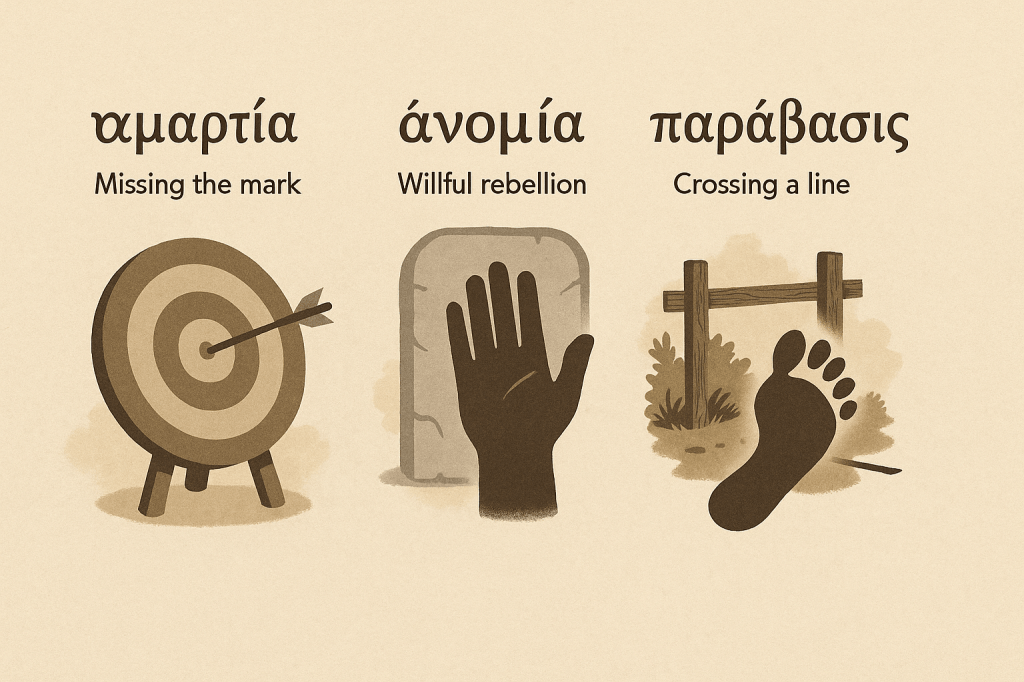
Hamartia (ἁμαρτία) – “Missing the mark,” like an arrow that strays from its intended target.
Paraptōma (παράπτωμα) – “A misstep” or “a fall,” like stumbling off a path meant to guide us.
Anomia (ἀνομία) – “Lawlessness” or “being outside the loving instruction (Torah) of God.”
Hebrew Counterparts:
Chata (חָטָא) – To miss or fail to reach the goal of right relationship and loving trust.
Avon (עָוֹן) – Twisting or distorting what is good; a bentness in our moral alignment.
Pesha (פֶּשַׁע) – Rebellion or willful breaking of covenant; a relational betrayal of love.
❌ The Problem with “Sin”
Let’s start with this simple question:
What does “sin” mean in everyday English?
Answer: Nothing.
No one uses the word “sin” outside religious spaces. It’s entirely sequestered to church or cultural religious jargon. That makes it a poor translation—because it means whatever a particular religious community wants it to mean. That’s a red flag.
But this wasn’t the case in the world of Scripture.
Words like hamartia, anomia, and parabasis—all of which English Bibles flatten into “sin”—weren’t “religious terms” at all. They were everyday words, rich with meaning. But our modern translation into a single, fuzzy religious term strips them of their depth.
We need to make two key critiques here:
- We shouldn’t use religious-only words in translation if the originals were everyday, common words.
- We shouldn’t use the same English word (“sin”) to translate multiple Greek and Hebrew words that mean entirely different things.
The result of this flattening?
We’ve obscured the diagnosis. And when we mistranslate the disease, we also misunderstand the cure.
💥 The Three Words Behind “Sin”
Let’s look at each of the most common biblical terms translated as “sin”—and give them back their real-world meanings:
🏹 Hamartia — Missing the Mark / Failing to Live Your Purpose
Everyday English Meaning: misfire, breakdown, derailment.
In the ancient world, hamartia meant an archer missing their target. Biblically, it means we’ve failed to live in alignment with our calling as image-bearers. It’s not about violating a rule—it’s about failing to grow into the likeness of God’s love. Agape is the target. Anything short of that is hamartia.
📍 Result: We’ve left the path. Shalom begins to fracture. Shabbat is interrupted.
⚠️ Anomia — Willful Defiance / Rejection of Rightful Order
Everyday English Meaning: rebellion, sabotage, anarchy
From a- (without) + nomos (order/custom), anomia means chaos through rejection of rightful rule. This is not accidental—it’s an active rebellion against the Kingdom of God and His loving wisdom. It’s when humans enthrone rival gods: domination, self-exaltation, fear, empire.
📍 Result: The reign of God is dismissed. Creation becomes unruled, unstable.
🚫 Parabasis — Trespassing / Crossing Forbidden Lines
Everyday English Meaning: violation, overreach, boundary-breaking
Parabasis is stepping beyond what has been given. It’s not just getting lost—it’s pushing past what’s holy, just, or life-giving. Many modern expressions of this are rooted in power grabs, entitlement, and exploitation.
📍 Result: Sacred space is trampled. Life becomes polluted. Shabbat is desecrated.
🧩 Why These Distinctions Matter
When we lump these all under “sin,” we:
1. Treat everything as the same kind of failure
2. Hide the root causes of human rebellion
3. Flatten cosmic, systemic disruption into private moral guilt
4. Misrepresent God’s solution—reducing it to guilt relief rather than Kingdom restoration
Instead of grasping the scope of the tragedy, we settle for a courtroom metaphor. But the Gospel is a Kingdom proclamation—not just a legal pardon.
💔 The Tragedy of Hamartia
Here’s the real center of the biblical story:
Humans were made to reflect God’s likeness—His agape, His logos, His dynamic love and wisdom.
That’s our purpose. That’s the “target.”
So when the New Testament writers use hamartia, they’re saying:
We didn’t just mess up morally.
We missed the whole point of being human.
That’s tragic. Because it means:
We’ve derailed from our telos (our end, our aim). we’ve broken the rhythm of Shabbat, we’ve stepped off the path toward wholeness (shalom), and we’ve stopped maturing in agape
And since love is dynamic—not a fixed destination, but a growing relationship—hamartia isn’t about failing a static standard. It’s about ceasing to grow in love.
That means the “mark” is always relational, personal, alive. The more we miss it, the more we fall short of becoming whole.
🔁 Summary of words often transated “Sin”
But What It Really Means:
Hamartia – Misfire / Failure to Grow / Falling short of our calling to love
Anomia – Rebellion / Sabotage / Willfully rejecting God’s order
Parabasis – Trespass / Overreach / Violating sacred space or design
Theological Meaning:
“Sin” is not just behavior—it’s the fracture of Shabbat, the derailment of our vocation to mature in love, and the rise of rival kingdoms in God’s creation.
In Our Words:
Sin is when we fail to become who we were created to be—image-bearers of agape. It’s not just what we do, but what we refuse to become.
🧩 Reflective Summary: The Shattering of Shabbat
If Shabbat marked the beginning of harmony—God dwelling with creation in loving communion—then what we’ve traditionally called “sin” represents its fracture. But as we’ve explored, the English word sin does not do justice to the weight or meaning of the original terms. Words like ḥamartia, parabasis, and anomia speak not of legal infractions, but of broken relationship, missed purpose, and rejected love.
This rupture—this rejection of agape and wisdom—is not simply the breaking of a rule. It is the breaking of Shabbat itself: the loss of God’s restful, indwelling presence. This makes it the perfect opening for the second chiasm in our series, directly mirroring the beauty of Shabbat from the first. Where Shabbat symbolizes God’s dynamic reign through love, this moment of rejection represents the unraveling of that reign.
And yet, this rejection doesn’t leave a vacuum. It establishes something else. When we refuse the reign of God’s agape, we don’t fall into nothingness—we enthrone a different kingdom. A counterfeit basileia begins to take shape, not by accident, but as the natural outworking of turning away from the Kingdom we were created for.
🔜 Coming Next: Basileia — When Rejection Becomes Reign
Our next word—Basileia—will show how sin is never neutral. In rejecting the reign of agape, we don’t fall into nothingness. We establish something else. The kingdoms we build in its place are marked not by love, but by power, pride, and fear.
 The Logos of Agape
[…] Mistranslated Series: Different types of “Sin” […]
LikeLike