Word 12: Metanoia
Greek: μετάνοια (metanoia) – change of mind, heart
Hebrew (LXX): שׁוּב (shuv) – to turn, return
Not Just Repentance—But a Return to Who You Really Are
“The time is fulfilled, and the kingdom of God is at hand; metanoeite and believe the euangelion.”
— Mark 1:15
❌ Mistranslated & Misunderstood
The Greek word metanoia is almost always translated repentance—but this translation has been deeply distorted by centuries of religious misuse.
When people hear “repent,” they often picture:
• Emotional regret
• Personal guilt
• Trying harder to be morally good
• A one-time religious experience
But in the world of Jesus and the early church, metanoia meant something far more powerful and profound.
🧠 What Metanoia Actually Meant
In Greek, metanoia comes from:
• Meta – beyond or after
• Noia (from nous) – mind, perception, understanding
So at its root, metanoia means:
“A transformation of mind”—a complete rethinking of how you see and understand reality.
It’s not just about morality—it’s about perception.
A paradigm shift. A spiritual awakening. A new way of seeing.
Jesus isn’t saying:
“Feel really bad and promise not to sin.”
He’s saying:
“Wake up—God’s kingdom is breaking in. Return to the truth. See the world differently.”
👑 Metanoia and the Arrival of the Kingdom
Jesus places metanoia right next to His proclamation of the euangelion—the announcement that God’s reign is returning:
“The time is fulfilled. The kingdom of God is at hand. Metanoeite…”
In this context, metanoia is the natural response to God’s world-altering news.
It means:
• Realizing that reality is being reshaped
• Rethinking your place in that reality
• Turning away from false narratives that formed your worldview
• Opening yourself to God’s wisdom, God’s design, and God’s reign
It’s like waking from a dream and seeing the world in true light.
⚠️ Why “Repentance” Isn’t Enough
The English word repentance has roots in a decent idea—it means “to turn.”
But the modern usage has narrowed the meaning to something far smaller:
• Feeling remorse
• Confessing sins
• Improving personal behavior
That’s part of what might come after metanoia—but it’s not what metanoia is.
If we reduce metanoia to moral regret, we gut it of its revolutionary power.
Metanoia isn’t about obsessing over past behavior.
It’s about stepping into a new vision of reality—
One where God reigns, and everything changes.
It’s not just “turning from sin”—
It’s returning to the truth, to God, and to yourself.
🏰 Metanoia and the Battle of Kingdoms
Throughout the New Testament, metanoia isn’t just a private, spiritual moment—it’s a public, cosmic turning point.
It’s the response to the clash of kingdoms.
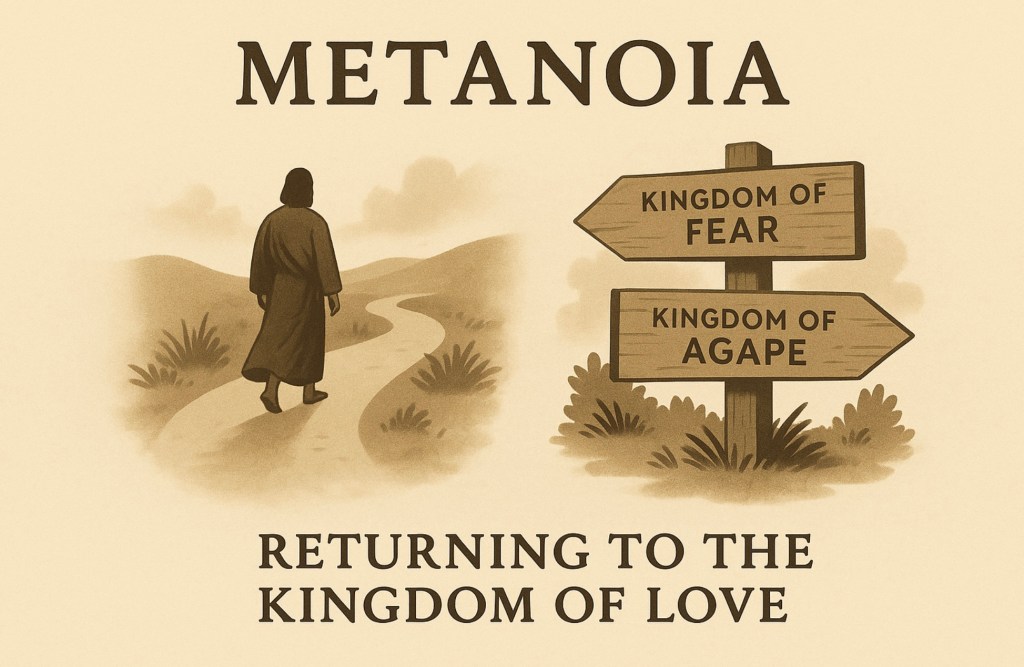
Jesus came proclaiming the euangelion—the world-shifting announcement that God’s reign, the Kingdom of Agape, was breaking in.
But He did so in a world already under the grip of rival reigns:
• Kingdoms of fear and death
• Systems of domination and exclusion
• Empires built on violence, scarcity, and shame
And we—ignorantly yet selfishly—had contributed to those systems.
We were spiritual orphans, cut off from our true Father.
Not realizing our origin. Not knowing our home.
In this context, metanoia doesn’t just mean “feel bad for doing wrong.”
It means: Return. Change sides.
Leave the kingdoms of darkness and come home to the Kingdom of Love.
To experience metanoia is to awaken from the lies of the old kingdoms and remember what’s always been true:
You were made for more.
You were made for Love.
You were made for the Kingdom.
That’s why Paul later writes in Romans 12:
“Do not be conformed to this age, but be transformed by the renewing of your mind…”
He’s calling us to metanoia—to reject the distorted patterns of this present world and to return to God’s design, God’s truth, and God’s way.
👑 The Kingdom of Love Is Unlike Any Other
And yet… talk of kingdoms can be frightening.
Many have only ever known kingdoms that conquer, exploit, or control.
But the Kingdom Jesus brings is utterly different.
Its law is love.
Its justice is mercy.
Its power is found in self-giving.
And its King conquers not by force—but by laying down His life.
Jesus, the Christos, saw us not as rebels to destroy but as children to rescue.
He died not to demand our guilt, but to demonstrate our worth.
That’s what makes this euangelion utterly unique.
It is the voice of a Father calling His lost children home.
And that is what metanoia is about.
✝️ The Final Word: Metanoia Is Homecoming
Metanoia is not just a change of behavior.
It’s not guilt. It’s not groveling.
It is a return to your true identity.
It is leaving behind the kingdoms of fear and stepping into the Kingdom of the Beloved Son.
It’s rediscovering what has always been true:
You were made for agape. You were made for home.
Jesus isn’t scolding when He says metanoeite.
He’s inviting.
He’s holding out His hand.
He’s whispering the voice of the Father:
“You were dead, but now you live.
You were lost, but now you are found.
Come home.”
🚪 Metanoia Is a Threshold Word
Metanoia stands at the threshold of the Kingdom.
It’s not just about stopping something bad.
It’s about beginning to see things rightly.
It’s the moment your heart and mind crack open to what is really real.
To what God has always intended.
To the world as it was meant to be.
💡 Metanoia Is Awakening
The call to metanoia is a call to:
• Rethink your assumptions
• Let go of false gods and illusions
• Reimagine your place in the story of the world
• Be reshaped by the wisdom of the King
It’s not behavior modification—it’s soul renovation.
Jesus isn’t inviting us to feel bad.
He’s inviting us to see clearly.
To return fully. To wake up to who we are, and where we belong.
🧠 Word Summary: Metanoia
• Literal Meaning: A transformed mind; a changed perception or way of seeing
• Biblical Function: The response to God’s returning reign—a shift from old thinking to kingdom vision
• Theological Meaning: The internal turning point that reorients a person’s life toward God’s reality
• In Our Words:
Metanoia isn’t feeling sorry—it’s waking up to the truth.
It’s the mind and heart being re-formed by the breaking-in of God’s reign.
It’s the return to the Father, to Love, to Home.
🔜 Next Word: Pistis
But how do we live once we’ve returned?
What kind of relationship does the Kingdom call us into?
Is faith just belief—or is it something more?
Next: Pistis—a word that might change how you see faith forever.
 The Logos of Agape
[…] Mistranslated Series: Word 12 Metanoia – Repentance? […]
LikeLike