Word 17: Orgē
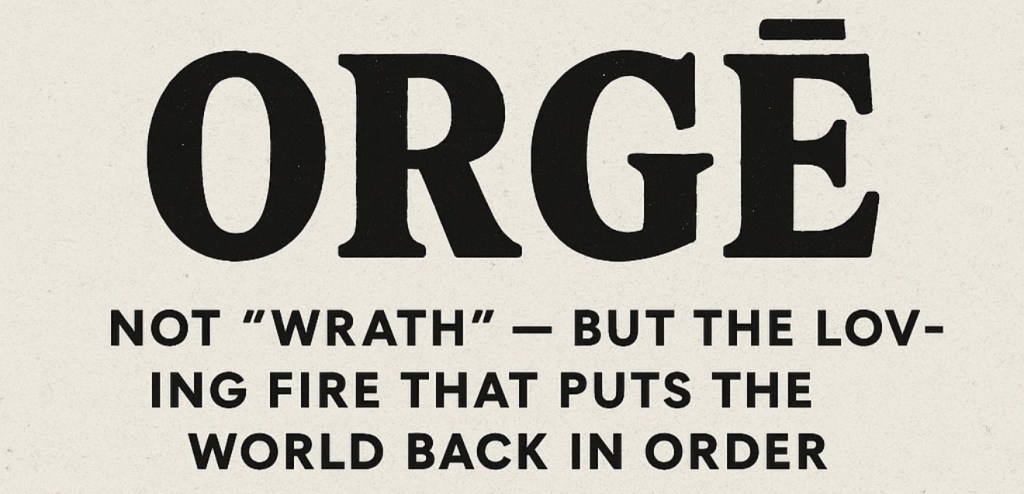
Not “Wrath”—But the Loving Fire That Refines and Puts the World Back in Order
- Greek: ὀργή (orgē) – passion, impulse to restore order
- Hebrew: עֶבְרָה (evrah) – passion kindled to restore order; ALSO – קִנְאָה (qinah) – zeal, passionate desire
(used of God’s righteous jealousy and redemptive refining fire)
“For the orgē of God is being revealed from heaven against all disorder…” —Romans 1:18
❌ Mistranslated, Misunderstood, and Misused
If there’s one Greek word that has terrified generations of Christians and distorted our vision of God’s character, it’s orgē—usually translated “wrath.”
Say “the wrath of God” and most people picture:
• Divine rage,
• Eternal punishment,
• An angry judge with a cosmic gavel.
“Wrath” (orgē) has long been one of the most abused words in Christian theology. When people hear it, they imagine God as a furious tyrant, red-faced with rage, poised to hurl sinners into eternal torment. This picture has shaped preaching, piety, and even politics.
But that vision is not what the word orgē originally meant. And just as importantly: it’s not what God’s justice actually looks like that is revealed in Jesus Christ.
The Greek word orgē does not mean an outburst of divine temper. It points instead to God’s steady, settled passion against sin — not because God is easily offended, but because sin deforms, corrupts, and destroys the goodness of creation. Orgē is the fire of God’s love refusing to be indifferent while His children are enslaved to violence, idolatry, and death.
In fact, when we understand orgē rightly, we discover that it isn’t the opposite of God’s love—it’s what love does when things are out of order.
🧩 Orgē Comes from “Order”—Literally
Here’s what few people realize:
Orgē shares a root with our English words like organize, organic, and order.
That’s the key.
Orgē is not about retribution—it’s about reordering.
It’s not rage—it’s restoration.
It’s the passionate, organizing energy of agapē love refusing to let the world remain broken.
So when God expresses orgē, He is not losing His temper.
He is confronting everything disordered—everything that fractures love, justice, and peace—and working to set it back in its proper place.
It may feel like discipline.
It may be painful.
But when it’s God’s orgē, it is always motivated by love, and it is always aimed at healing what’s gone wrong.
⸻
📖 Orgē in Scripture: Two Key Movements
1. God Hands Them Over
— The Redemptive Fire of Consequence
(Romans 1 & 11)
In Romans 1, Paul says God’s orgē is being revealed… but how?
“God handed them over to the desires of their hearts…”
—Romans 1:24, 26, 28
This is orgē in action—not as smiting, but as letting people experience the disorder they’ve chosen, in hopes they will come to their senses.
God doesn’t coerce. He releases.
He allows our false gods and disordered loves to play out—not as punishment, but as pedagogy.
This handing over is not abandonment. It’s a teaching moment.
And it’s temporary.
Because by Romans 11, Paul insists:
“They have not stumbled so as to fall beyond recovery, have they? By no means!”
“God has handed all people over to disobedience, so that He may have mercy on all.”
—Romans 11:11, 32
This is the heart of orgē:
A discipline that confronts disorder for the sake of restoration.
A divine letting-go that leads to divine mercy.
Like a loving parent letting a child learn from their mistakes—not to destroy them, but to draw them back.
Orgē is always aimed toward healing, return, and wholeness.
2. The Day of Orgē
— When All Is Set Right
Scripture often speaks of “the day of wrath.” Many hear this and think of it as the ultimate explosion of God’s pent-up anger, as if God has been waiting millennia to finally blow up at humanity. But that is a distortion. The Day of Orgē is not about God losing control — it is about God taking full control.
🔥 The Day of Orgē is not the day God finally lets loose and acts like us at our worst. It is not divine rage exploding after being pent up for millennia. That image belongs to pagan gods and petty tyrants, not the Father revealed in Jesus. The Day of Orgē is the day when all illusions are stripped away, when humanity sees that God has always been love, and that love will not stop until everything broken is made whole. It is the day when every violent throne topples, every lie is exposed, and every tear is wiped away. Far from being a day to dread, it is the day creation longs for — the day when love’s fire consumes all that is less than love.
When Paul says in Romans that the wrath of God is revealed from heaven against all ungodliness and unrighteousness, he is not saying God is lashing out in fits of divine fury. He is saying that God’s passionate opposition to all that destroys life is already breaking into the world — exposing injustice, confronting idolatry, dismantling oppression.
(Romans 2:5, Revelation, the Prophets)
Scripture speaks often of a Day of Orgē—a coming moment when God will decisively reorder creation.
“But because of your stubbornness and unrepentant heart, you are storing up orgē for yourself on the day of orgē, when God’s righteous judgment will be revealed.”
—Romans 2:5
The “Day of the Lord” isn’t when God explodes in fury—it’s when He passionately restores the world by confronting everything that resists His reign of love.
This is why the Gospel matters so much.
When we align with the Kingdom—through metanoia (repentance), pistis (loyal trust), and the euangelion (royal announcement)—we are reordered in advance.
We fall in line with the coming order.
We are no longer resisting the reorganization of creation—we are participating in it.
So the Day of Orgē becomes not a terror, but a long-awaited homecoming.
And this is exactly Paul’s point in Romans 5:9–11. “Since we have now been justified by his blood, how much more shall we be saved from God’s coming orgē through him! For if, while we were God’s enemies, we were reconciled to him through the death of his Son, how much more, having been reconciled, shall we be saved through his life!” Our reconciliation means that we no longer brace ourselves against God’s setting-things-right—we rejoice in it. What once felt like judgment now feels like salvation. The very fire that consumes rebellion is the same fire of love that welcomes us home. Through Christ, we don’t dread the Day of orgē—we long for it, because it is the day love finishes what it started and sets all thing back in loving order as they were all intended to be.
The Cross and Orgē
Many have taken the word orgē — mistranslated as “wrath” — and placed it at the very center of the cross. They say God’s wrath was poured out on Jesus, that the Father’s fury fell on the Son instead of on us. But this is a distortion of the gospel. There is not a single passage in Scripture that describes the cross in this way. Not one.
Go look and try to find any passage that ties what happened on the cross being linked to God’s venting of wrath, either on us or on Jesus on our behalf and you may be astonished to find that you will come up wanting because there are none. There are plenty of hymns, songs and sermons that assert this but when it comes to scripture passages you will find they don’t exist.
🔥 To say that the cross is the place where God vents His wrath is to slander the very heart of God. It turns the Father into an angry deity who must punish someone before He can forgive. It fractures the Trinity, as if the Son saves us from the Father. And it empties the cross of its true power — the victory of God’s self-giving love over sin, death, Satan, and the accusing conscience of humanity. The cross is not where God punishes Jesus. The cross is where Jesus, in perfect union with the Father and Spirit, absorbs the full weight of evil and breaks its power once and for all.
And this matters, because Scripture is clear: even after the cross, orgē is still coming. Why? Because orgē is not punishment discharged and used up at Calvary. It is God’s ongoing, passionate love that will not rest until all things are set right. The cross defeated the enemies of humanity, but the world is still waiting for the fire of God’s love to reorder creation — to discipline, correct, and restore until everything broken finds its proper place in Him. That is why the New Testament speaks of God’s orgē as a future reality. It is not something to fear unless we cling to what is dying. For those who love and trust God, it is the day we long for: the day when love’s passion finishes what the cross began, and the world is made whole.
🔥 Orgē Is Agapē on the Move
Let’s be clear: orgē is not opposed to grace.
It is charis applied forcefully.
It is what happens when love says, “Enough.”
Enough injustice.
Enough violence.
Enough lies and idols and broken systems that devour the weak.
It’s not an outburst—it’s a deliberate and merciful restructuring of what has gone wrong.
And when orgē is complete, the result is always the same:
Peace. Wholeness. Shalom.
⸻
🔄 Where It Fits in the Larger Story
- Word 15 – Sōzō: Salvation is being rescued and healed.
- Word 16 – Zōē: We are brought into abundant Kingdom life.
- Word 17 – Orgē: God confronts and reorders all that resists that life.
It prepares us for what comes next:
The world set back into right relationship—dikaiosynē—so that God’s children can step fully into their vocation as heirs and image-bearers of agapē.
⸻
✅ In Summary: What
Orgē
Really Means
- Not: rage, revenge, or divine temper tantrum.
- But: passionate, agapē-driven discipline that confronts disorder and lovingly restores things to their proper order.
Orgē is how God reorganizes a disordered creation.
It is not the end of the story—but it is a necessary part of its healing.
Let’s be people who welcome that reordering now.
Let’s be those who already live in the harmony of the Kingdom.
So that when God’s fire falls, we are found already aflame with love.
⸻
🔜 Coming Next:
Dikaiosynē
Justice as Right Relationship Restored
What does a reordered world look like once the fires of orgē have burned away the chaos?
That’s where we’re headed next.
 The Logos of Agape
[…] Mistranslated Series: Word 17 – Orge – What is so wrong about depicting God as a “God … […]
LikeLike