Word 18: Dikaiosyne/Dikiasune
- Greek: δικαιοσύνη (dikaiosynē) – justice, righteousness
- Hebrew: צְדָקָה (tsedaqah) – righteousness, covenant faithfulness
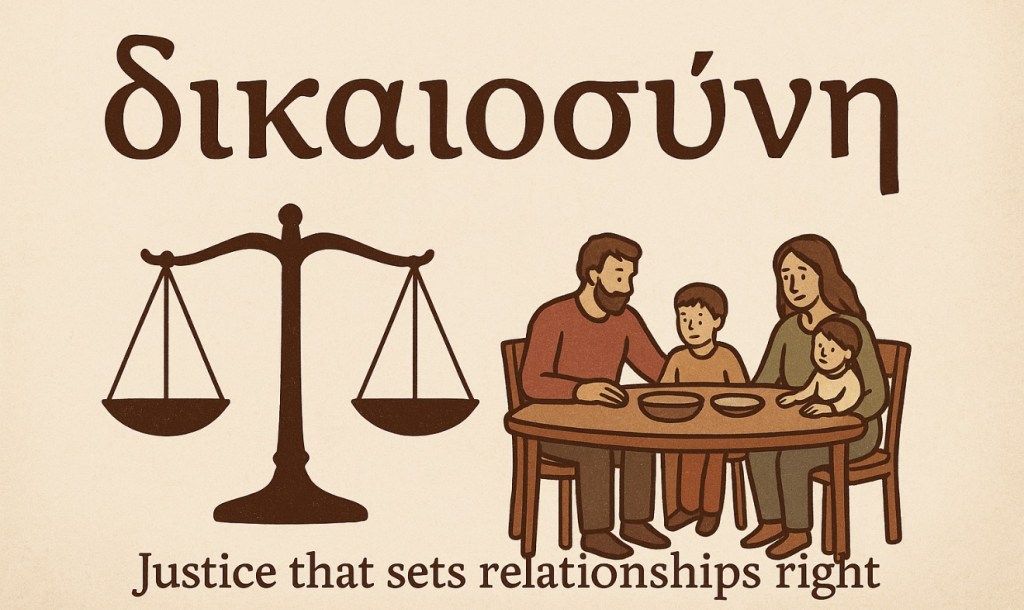
Dikaiosynē: What “Righteousness” and “Justice” Really Mean
⸻
In the West, dikaiosynē became a word of legal guilt or moral performance.
But in Scripture, it’s the powerful word for right relationship—
the justice of putting God’s whole family back together in love.
Of all the words in our theological vocabulary, justice might be the most tragically misunderstood.
⸻
⚠️ Why “Justice” is often mistakenly the Biggest Objection to Love
If you tell most Christians that God’s central attribute is love, the response often comes quickly:
“Yes, but He is also just.”
And by “just,” they mean retributive justice—God enforcing the law, punishing every violation, and making sure no sin goes unpunished.
This is why the idea of God’s love so often rings hollow. Because when justice is defined as retribution, it seems to stand in direct opposition to love. Mercy becomes God bending the rules. Forgiveness becomes God letting someone off the hook. Justice and love are locked in tension.
But that’s not how the Bible speaks of justice.
⸻
Resetting the Scene
When many Western Christians hear that God is “just” or that salvation involves “justification,” they picture a courtroom scene—one where guilt is weighed, laws are enforced, and penalties are assigned. In this legal model, justice means getting what one deserves.
That framework deeply affects how people understand the Gospel:
Jesus is imagined as absorbing the punishment we deserve so God can remain “just” in forgiving us.
But here’s the problem:
That legal understanding of justice—retributive justice—was not what the biblical writers meant by the Greek word dikaiosynē (δικαιοσύνη).
And when we misread that word, we end up misrepresenting the very heart of God.
⸻
🚫 Lost in Translation: From Right-Relationship to Retribution
Here’s the tragedy: the Hebrew word ṣĕdāqāh and the Greek word dikaiosynē both mean the same thing—right relationship. Yet over the centuries, translators rendered these words as “justice” or even worse “vengeance,” importing the language of punishment, repayment, and retaliation.
This shift distorted God’s character. Instead of the Father who longs to set His children right, we imagined a Judge with a personal vendetta. And when that mistranslation got paired with orgē (misunderstood as wrath), the picture was complete: God as the angry punisher, whose justice means pain and whose wrath means destruction.
But in Scripture, dikaiosynē never meant vengeance. It never meant retribution. It meant reconciliation, restoration, and healing.
Justification doesn’t mean God declares you legally innocent—it means God declares you to be in right relationship with Him. And that rightness doesn’t stop there—it spills over into every relationship with others, with creation, and with ourselves.
⸻
What Dikaiosynē Really Means
The Greek word dikaiosynē is traditionally translated in English Bibles as either “righteousness” or “justice.” But it’s not two words—it’s one.
The difference in translation often depends on context, but the meaning remains consistent:
dikaiosynē is about being in right relationship—with God, with others, with creation, and with yourself.
What would it look like if every relationship in your life was made right?
Imagine it:
No more resentment in your family. No more walls between communities. No more systems that crush the weak while serving the powerful. No more separation between you and God.
Only wholeness.
Only love.
Only peace.
That vision isn’t just a dream.
It’s dikaiosynē.
And it’s the very heart of the Gospel.
⸻
Lost in Translation: How “Righteousness” Got Tamed
The Greek word dikaiosynē (δικαιοσύνη) shows up all over Scripture—especially in the writings of Paul. But modern readers often miss the full weight of it.
Why? Because dikaiosynē gets translated as either “righteousness” or “justice,” and both words are… broken.
“Righteousness” sounds personal, private, even pious—about being morally upright or spiritually pure. “Justice” in modern Western thought often sounds retributive—about crime, punishment, or getting what you deserve.
As A.W. Tozer notes:
“In the inspired Scriptures, justice and righteousness are scarcely to be distinguished from each other. The same word in the original becomes in English justice or righteousness, almost, one would suspect, at the whim of the translator.”
This means dikaiosynē is not a legal category.
It’s a relational and moral reality—a way of being in right standing with God, with others, and with creation.
Biblical justice is relational justice.
It’s not about getting what you deserve.
It’s about being set right, restored, and reconciled.
⸻
What Dikaiosynē Really Meant
In its original context, dikaiosynē referred to the state of everything being in right relationship—with God, with others, with self, and with creation.
It’s about more than law or guilt.
It’s about harmony.
It’s about justice that heals, not just punishes.
It’s about restoring what has been broken.
Think of it like this:
In a family, dikaiosynē is when love flows freely and each person is safe, honored and cherished.
In a community, dikaiosynē is when the vulnerable are protected and no one is left behind.
In the heart, dikaiosynē is when you know you are seen, loved, and whole before God.
This kind of justice isn’t cold. It’s warm.
This kind of righteousness isn’t isolated. It’s relational.
And that’s why dikaiosynē is often paired in Scripture with mercy, peace, faithfulness, and grace. It’s not a tension between justice and mercy—it’s justice expressed through mercy.
⸻
Restoring Relationships: God’s Justice Through Confession, Repentance, and Forgiveness
When someone in the family harms another—through sin, injustice, or any action that disrupts relational harmony—God’s dikaiosynē springs into action. His justice is not about punishment for punishment’s sake; it is about restoring relationships, both individually and communally.
Scripture reveals three non-negotiable components that make this restoration possible: confession, repentance, and forgiveness. Without all three, the rift remains; the family cannot be whole. These are not optional virtues—they are essential tools in God’s relational justice system.
In God’s family, justice is never about cold punishment—it’s about restoring what was broken. And restoration only happens when hearts move. That’s why the Bible gives us three non-negotiables for healing:
Confession – We name the truth. We agree with God and with one another about what has been broken. Confession drags sin out of the shadows where it festers and brings it into the light where it can be healed. There is no restoration without honesty.
Repentance – We turn around. Repentance isn’t just regret; it is a re-orientation. It’s saying: “I was walking the wrong way. I choose now to walk toward love, toward God, toward wholeness.” Repentance is proof that confession is real, that the words are not empty.
Forgiveness – The one harmed releases what is owed. They show mercy by not insisting on the other getting “what the deserve” and gracefully let the offender back into full communion with the family. Forgiveness (along with mercy and grace) is not pretending nothing happened. It is choosing healing over revenge, choosing restoration over resentment.
All three are essential. Without confession, wounds are hidden and never named. Without repentance, cycles of hurt continue unchecked. Without forgiveness, reconciliation is impossible. Together, they are how God heals His family.
This is why Jesus made forgiveness so weighty: “If you do not forgive others, your Father will not forgive you” (Matt. 6:15). He was not giving us a loophole where God refuses to love us. He was showing us the reality of the family table: if I refuse to forgive, I cannot sit there in peace with my brother or sister who by forgiveness, mercy and grace has been restored to the family table.
Think of the prodigal son. He confessed his wrong and repented by turning back home. The Father ran to him with open arms. But was the family truly whole yet? Not quite. Because the elder brother stood outside, arms crossed, unwilling to forgive. As long as he refused to join his brother at the table, dikaiosynē was incomplete.
Do you see it? Forgiveness is not an optional add-on to salvation—it is salvation at work. Without it, the family of God cannot be healed. Without it, we are the older brother, keeping the family divided while the Father pleads: “Come inside. Lay down your anger. Be part of the celebration.”
This is how God’s justice works: not through revenge, but through confession, repentance, and forgiveness—restoring us into one family again.
Trusting God’s Justice: Rethinking “Vengeance Is Mine”
This flows directly into Paul’s thought in Romans 12:19. Most translations make God sound vengeful like he is a judge with a personal vendetta and an axe to grind:
“Never take your own revenge, beloved, but leave room for the wrath of God, for it is written: ‘VENGEANCE IS MINE, I WILL REPAY,’ says the Lord.”
But listen to it afresh through the lens of God’s relational justice aimed at healing relationship (dikaiosynē) and His restorative reordering passionate wrath (orgē):
“When we are wronged, we ought never to try to set things right on our own. Instead we should leave room for God’s passionate, ordered correction. For it is written: ‘To set things right is Mine, says the Lord, and I will discipline each appropriately.’” (Romans 12:19; Deut. 32:35 LXX)
This isn’t God claiming the right to punish harder than we can. It’s God saying: “You are my children. Don’t try to punish each other. Trust me. I know how to discipline in love. I know how to bring confession, repentance, and forgiveness in the right way, at the right time.”
If you’ve ever had siblings—or raised kids—you’ve seen this. Two children are fighting, both ready to hit back. And the parent steps in: “Stop. It’s not your job to punish your sibling. That’s mine. I see what happened, and I’ll handle it.” That’s what Paul is showing us.
And notice: Paul doesn’t stop there. The very next verse says:
“If your enemy is hungry, feed him; if he is thirsty, give him something to drink.” (Romans 12:20)
Do you see the picture? Our job is not to force confession. Our job is not to demand repentance. Our job is to forgive, to love, and to do good even to those who harm us. Because when we do, we leave space for the Father to bring the discipline, the correction, the lessons that may one day lead them to confess, repent, and be restored via His grace and mercy.
This is why forgiveness is required of us even when the other person refuses to confess or repent. Because God is the one who knows how to lead them home. And He is also the one who knows how to discipline us when we are the stubborn child in need of correction.
So Paul’s point is not: “God will get them back.” His point is: “God will set things right—so you don’t have to. Your job is to forgive and to love. His job is to restore the family.”
That is the real meaning of “Vengeance is mine.” And that is very good news.
⸻
⚠️ Changing out scenes
As discussed much of Christian theology has reduced dikaiosynē to a courtroom metaphor:
God is a judge.
We are guilty.
Jesus pays our fine.
We are declared legally righteous.
But this model:
Distorts God into a cosmic bookkeeper, Treats sin as a debt rather than a disorder, And turns salvation into a legal status instead of a living relationship.
In contrast, the biblical scene that we should adopt is this:
God is a Father.
We are lost children. Orphans not knowing who our father is.
Jesus shows us the way home to the father.
God forgives, heals, and reestablishes relationship.
As long as we remain on the path—trusting God, walking with Him, and growing in love—we are justified or stated more specifically as long as we walk in faithful relationship with and trusting God, God declares us to be in right relationship with Him regardless if we always act perfectly lovingly and rightly in every situation or not. If it’s done in pistis (faithful trust) we are growing into the mature loving ways of God himself and are in right relationship with the father.
It’s like a 5 year old in right relationship with God looks a lot different than a 20 year old, and the 20 year old looks a lot different than a 50 year old (etc…) but according to God as long as we remain in loyal faithful relationship with the father God declares all of them to be in right relationship with Him regardless of how perfectly or not they live out love at the moment.
So that means it’s not because we’ve earned it.
But because God always, regardless of their maturity or growth in love level, declares those who trust and remain faithful to be in right relationship with him. (See Romans 1:17)
⸻
So What Does It Mean That God Is Just?
It doesn’t mean God gives people what they deserve.
It means God does what is right—and what is right, in His eyes, is healing the broken, forgiving the repentant, and restoring the lost.
As 1 John 1:9 puts it:
“If we confess our sins, He is faithful and just to forgive us…”
Not just merciful. Just.
Because forgiveness is how dikaiosynē works.
⸻
A Different Kind of Judgment Day
If orgē is the day when God reorders the chaos of the world…
…then dikaiosynē is the day when He restores every relationship in agapē love.
This is the vision of Paul in Romans:
“The righteousness (dikaiosynē) of God has been revealed…” (Romans 1:17) “Now the righteousness of God has been manifested apart from the law…” (Romans 3:21) “The goal of the law is Christ, who brings righteousness to all who trust.” (Romans 10:4)
God’s justice isn’t Him sitting on a bench with a gavel.
It’s Him standing at the head of the table and saying to His family:
“Come home. Be healed. Let’s make this right.”
⸻
Why This Matters Now
Because too many Christians still imagine a God who is divided:
A God who is merciful on some days and retributively just on others.
But if God is love—then His justice is love in action.
His righteousness is His commitment to restore every broken bond, every torn heart, every shattered community.
So here’s the truth:
You are not saved from God’s justice.
You are saved because of it.
And when you live in right relationship with Him—trusting, walking, repenting, forgiving—you are participating in His righteousness. You are being made right, and you are helping to make the world right.
⸻
Dikaiosynē and the Kingdom of God
Let’s put this into our broader Mistranslated Gospel series:
Euangelion — The royal announcement: God’s kingdom of love is coming, and Jesus is King.
Metanoia — Change allegiance. Turn toward God’s reign of love.
Pistis — Give your loyal trust to the King.
Sōzō — Be liberated, rescued, healed, and made whole.
Zōē — Receive the abundant life of the age coming in the love of the Kingdom.
Orgē — Let God’s love confront your chaos and reorder it in wisdom.
Dikaiosynē — Step into restored relationship with God, others, and all creation.
This is what the Gospel leads to.
This is what salvation is for.
This is the justice of God—not against us, but for us.
⸻
Conclusion: The Day Love Restores God’s Family
In a world of fractured families, lonely souls, and systemic injustice, dikaiosynē means God has not given up on His loving purposes of creation.
He is not just saving individuals from hell.
He is restoring His entire image-bearing human family into agapē-shaped rightness—every son, every daughter, every sibling reconciled to Him and to each other.
That is God’s justice: one table, one family, one Father.
And one day soon, He will finish what He started.
Let that day find you already made right.
Already trusting.
Already living in love.
⸻
🔜 Coming Next: Teknon
Children of the Father, Restored
If justice is God putting relationships right, what kind of relationship are we restored into?
Rather than defendant the biblical narrative is this:
The move is from estranged orphans to children of the loving father who created us.
That’s where we’re headed next.
 The Logos of Agape
[…] Mistranslated Series: Word 18 – Dikaiosyne: Justice that sets relationships right. […]
LikeLike
Just a question about your blog page. I’m wanting to share it with my congregation but there’s some kind of suspension on it and it can’t be accessed. Any chance that it will be rectified soon?
Thanks, Tammy O’Connor Pike Community Church
LikeLiked by 1 person
Thank you for bringing this to my attention. I believe we have rectified the issue and you should be able to access everything on the blog site now. Feel free to use these as resources for your church however God inspires you to. Please feel free to let me know if you have any further issues accessing the pages on the site in any way. May God’s love keep you and bless you!
LikeLike