Huios and Huiothesia: Growing Into Glory, Placed as Co-Rulers with Christ
- Greek: υἱός (huios) – mature son, a child who has matured
- Greek: υἱοθεσία (huiosthesia) – placement as mature heir, adoption
- Hebrew equivalents (conceptual): בֵּן (ben) – son
Also legal imagery from Ancient Near Eastern “placing” customs
Mistranslated & Misunderstood Series – Entry 20
In our last post, we explored the rich biblical meaning of teknon—a word that shows us what it means to be reborn as true children of God, having the divine image (eikōn) healed and restored in us through the power of the Gospel.
But teknon is only the beginning.
Scripture offers another word for “child” that carries an even deeper layer of meaning: huios (υἱός). And when paired with its theological cousin huiothesia (υἱοθεσία)—often translated “adoption”—a breathtaking picture begins to emerge. While the word huios is dictated by context and can simply mean a mature son (rather than teknon which typically means a child who is not yet of mature age and development). When Huios is accompanied by placement language like (en dynamei in Romans 1 or huiosthesia in Romans 8) it means even more. The picture that emerges when placement language is present with the word huios is one of growth, maturity, glorification, and co-rulership. This is an image that redefines what the Gospel and salvation is ultimately for.
Translation Trouble: “Adoption” Doesn’t Say Enough
Modern Bible translations often use the word adoption for huiothesia, but that can be misleading. In our world, adoption usually means a legal shift in family status—from being outside the family to being brought in.
But in the Roman and Jewish world of Paul’s day, huiothesia didn’t mean legally becoming a child. It meant the formal placement or recognition of a mature son or daughter as the inheritors and co-rulers of the family estate.
This was not about entering the family. This was about being declared ready to reign with the father and on the father’s behalf.
The Family Business of God
One of the challenges we face when reading Paul’s words is that we naturally import our modern, Western view of family into the text. Today, when children reach 18 or 21, they “leave the nest” to start their own life, career, and household. Family ties remain, but the assumption is independence. This is not how family worked in the ancient world.
For most of human history, the goal of parents was to raise children to maturity so that they could join in and eventually help lead the family trade. If the parents were shepherds, the children were trained as shepherds. If the family crafted tents, the children learned the art of tentmaking. If they were carpenters they would learn carpentry and so on. Once children had matured in ability (which we could correlate to logos) and character (which we could correlate to Agape), they were entrusted with running the family business alongside their parents. Maturity meant partnership in the family’s vocation.
This is the imagery Paul draws on when he speaks of us becoming mature sons and daughters through the Spirit. As God’s children, our family trade is not shepherding or tentmaking or anything less than reigning in Shabbat, establishing and maintaining God’s shalom in creation. This was humanity’s original vocation in Genesis 1:26-28 to bear God’s image by ruling alongside Him in love. To be placed as mature sons and daughters in Christ is to be entrusted with the family business — to co-rule with Jesus, the Anointed King, in bringing about God’s unending Shabbat.
This is why the gospel is not simply about forgiveness or escape from judgment, but about being restored to our true vocation as God’s family. We are raised, trained, and matured by the Spirit so that one day, at the time of huiostheia, we may take our place in the family business — not departing from God’s house, but reigning with Him forever as a part of it.
This is why it’s so important to notice the difference when Scripture uses teknon and huios. The shift is huge, and intentional and that is why the word teknon should never simply be swapped for huios—because they don’t mean the same thing. You can be a teknon and still immature. You can be a teknon and still unprepared. But a huios is different.
A huios is a teknon who has grown into likeness—into the character of the parent, especially their agapē-shaped wisdom, judgment, and love.
Jesus Was Declared Huios in Resurrection Power
Paul is crystal clear about this in Romans 1:
“…concerning his Son, who was descended from David according to the flesh
and was declared to be the Son of God in power (huios theou en dynamei)
by his resurrection from the dead…”
—Romans 1:3–4
Jesus was always the Son (teknon) of God—but it was at His resurrection that He was publicly declared huios in power. That moment marked His exaltation, His enthronement, and His placement as ruler and heir—the first fully mature human King, reigning as God’s image and likeness on behalf of creation.
And this is the very pattern Paul says we too are destined for—if we follow in Christ’s footsteps.
Romans 8: The Road from Teknon to Huios
Romans 8 is the clearest place where Paul lays out this journey.
In verse 16, Paul affirms that we are teknon—children of God in the restored image sense—because the Spirit testifies to this truth. In verse 14, Paul says that those who are led by the Spirit of God are huios of God—mature sons and daughters who are walking in the character of the Father. And in verse 17, he raises the stakes: “…if we are children (teknon), then we are heirs—heirs of God and co-heirs with Christ, if indeed we share in his sufferings in order that we may also share in his glory.”
Here Paul adds a crucial tension: receiving the Spirit as a down payment makes us teknon now, but it does not guarantee that we will automatically become huios. Having the Spirit is not the same as following the Spirit.
Becoming huios requires repeatedly choosing the Spirit’s way of agapē love—self-giving, self-sacrificing, even suffering love on behalf of God and others. Over time, these repeated choices shape our character until it reflects the likeness of our Father. The journey from image to likeness is dynamic, not inevitable.
This is why Paul writes a few verses later that we still wait for our huiothesia—our future placement as mature heirs:
“We groan inwardly as we wait eagerly for our huiothesia, the redemption of our bodies.”
—Romans 8:23
At the resurrection, we will be publicly declared ready to co-reign with Christ—the full inheritance of God’s Kingdom entrusted to mature Sons and Daughters.
The Whole Creation Is Waiting
Paul doesn’t limit this to personal salvation. He places it inside the cosmic story of redemption:
“The creation waits in eager expectation for the revealing of the huios of God.”
—Romans 8:19
Why?
Because when God’s children (teknon) grow into maturity (huios), and are publicly placed as rulers through resurrection (huiothesia), then the exile ends—not just for us, but for the whole created order.
The world groans under the weight of corruption and chaos.
It groans for restoration.
It groans for rulers who will reign not by domination, but by agapē love.
When those mature Sons and Daughters are revealed, shalom will be restored.
Shalom and the Return to Shabbat
This isn’t the end of the story. It’s the true beginning.
God’s plan was never merely to forgive sins or transport souls to heaven. It was to form a family of mature image-bearers who reflect His wisdom and love and place them as co-rulers who bring healing, peace, and wholeness to the world.
This is what creation was made for. This is what we were made for.
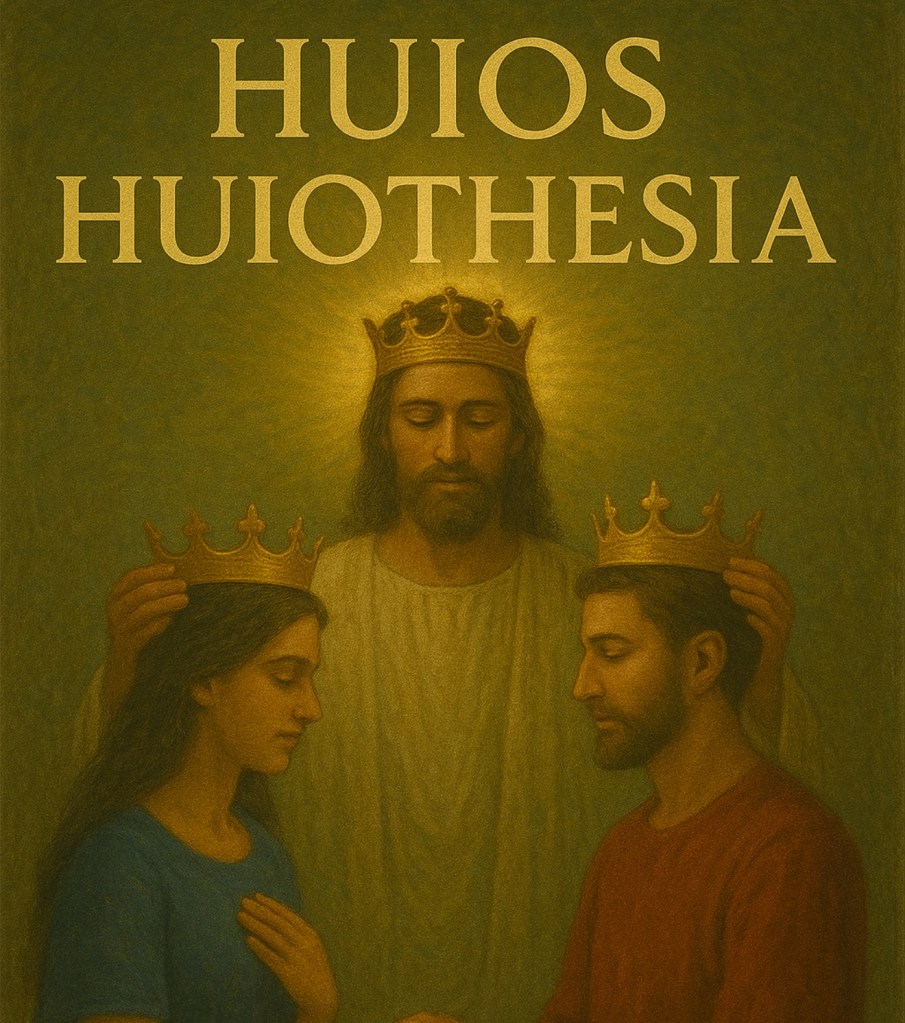
And this is what Scripture means by glorification:
The restoration of our likeness to God. Our final placement as co-inheritors with Christ. Our stepping into the royal priesthood of New Creation.
Here the story of Genesis 1 finds its fulfillment. Humanity—male and female—called to rule together in God’s image is finally restored. And the story of Revelation 21–22 confirms it: creation renewed, harmony restored, Shabbat unending.
This is Shabbat—not just a day, but a reign.
Not merely rest from work, but the harmony of a world ruled by agapē love.
What Was Mistranslated?
We translated huiothesia as “adoption” and huios as just another word for “child.”
But we missed the weight.
This wasn’t just about entering the family.
This was about growing into maturity—into likeness—so we can be trusted to reign with the Father in His Kingdom.
And while our culture sees salvation as a one-time status, Scripture sees it as a journey:
Teknon (restored image) → Huios (refined likeness) → Huiothesia (public placement) → Shabbat (restored reign in peace and harmony).
This is salvation: not merely forgiveness, but the journey of love that restores our image, matures us into likeness, and places us as inheritors, rulers with Christ in the eternal Shabbat of God’s Kingdom. This is not optional—it is the very telos, the purpose and goal of salvation itself. Scripture is clear: those who refuse to walk this journey of transformation into love cannot inherit the Kingdom. Paul, while writing to believers and teknon, warns in 1 Corinthians 6:9–10, Galatians 5:19–21, and Ephesians 5:5 that those who persist in lives of selfishness, greed, or exploitation cut themselves off from the family business of God’s reign. Yet these warnings are not meant to drive us to despair but to call us into life: the abundant zoe life Jesus promised, a life where true living is found in loving. By grace, the Spirit empowers us to leave behind the old way and step into our inheritance as beloved children and co-rulers with Christ.
While Paul is the one who clearly speaks of huiothesia this vision of placement where we receive our inheritance is not limited to him but is a part of the larger overall apostolic witness. For example, Peter, too, reminds us that in Christ we have been “born anew into a living hope … into an inheritance that can never perish, spoil, or fade, kept in heaven for you” (1 Pet 1:3–4). This is the family inheritance of God’s reign—the eternal Shabbat where we share in Christ’s rule. And Peter makes clear that this inheritance is received through a journey of faith refined by love, so that “the outcome of your faith [is] the salvation of your souls” (1 Pet 1:9). Here again, salvation is not static but the maturing of God’s children into the fullness of likeness, prepared to inherit God’s Kingdom and co-reign with Christ.
In the end, the Gospel and the salvation it offers humanity is the restored freedom to live in God’s likeness of love and it settles for nothing less than the maturing into demut—the likeness of God we were created for—so that in Christ we may truly live the abundant zoe life of love, co-reigning with God, and ushering in the flourishing of creation, just as we were always intended to mature into from the beginning (see our post on demut – the likeness of God for further understanding of this).
Coming Next: Kainē Ktisis – The New Creation: Shabbat Revisited
We’ve seen how teknon, huios, and huiothesia trace the journey from reborn children to mature sons and daughters placed as co-rulers. But what is the ultimate horizon of this story?
Our final post in the series will turn to Paul’s breathtaking phrase kainē ktisis—the New Creation. Here we will revisit Shabbat one last time, seeing how the Kingdom of the Logos of Agapē brings heaven and earth together in wholeness.
 The Logos of Agape
[…] Mistranslated Series: Word 20 – Huios & Huiosthesia- What we have tragically gotten wrong … […]
LikeLike