Kainē Ktisis – Creation Renewed
- Greek: καινὴ κτίσις (kainē ktisis) – new creation, renewed creation
- Hebrew conceptual equivalent: בְּרִיאָה חֲדָשָׁה (beriah chadashah) – renewed creation
- Also Isaiah 65:17 and 66:22 use “Renewed heavens and renewed earth” — שָׁמַיִם חֲדָשִׁים וְאֶרֶץ חֲדָשָׁה

If you’ve grown up in Christian circles, you’ve likely heard that one day, God will destroy this world and take us to heaven. The popular assumption is that the end goal of the gospel is escape—leaving this broken world behind and going “somewhere better.”
But that’s not the story the Bible is telling.
At the very end of Scripture—in Revelation 21—John writes:
“Then I saw a new heaven and a new earth… for the first heaven and the first earth had passed away.”
The Greek term here is kainē ktisis (καινὴ κτίσις)—“new creation.” Too often, we’ve imagined this means God will wipe everything out and start over. But that’s not what the text says.
Revelation 21:5 could not be clearer:
“Behold, I am making all things new,”
This does not mean how we have so often taken it as if God were saying: “I am making all new things.”
That difference changes everything.
This is not demolition.
This is restoration.
The world is not discarded—it is healed, reordered, transfigured. This is not Plan B. This is the completion of Plan A. Eden—Shabbat—is being revisited and re-established.
Misunderstanding the End of the Story
Western theology has too often been shaped by dualism: the idea that matter is bad and spirit is good, that earth is temporary and heaven eternal, that salvation means leaving the physical behind.
But that’s not the Hebrew story. That’s not the early Christian hope.
From the beginning, creation is called “good.” Not perfect in a static sense, but good in potential—good because it is oredered and functional, made for growth, for love, for communion. God’s plan was always to dwell with His image-bearers in harmony. The climax of creation was not humanity, but Shabbat—the rest of God and his human family filling creation with wholeness.
The problem was never creation.
The problem was rebellion.
And the solution is not escape.
It is restoration of relationship by turning from that rebellion.
What Kainē Ktisis Really Means
The word ktisis means creation. Kainē doesn’t mean “brand new, never-before-seen.” It means renewed, restored, made new in quality—not from scratch, but redeemed. Think of a home gutted and rebuilt into the beauty its architect always intended.
That’s why Paul declares in 2 Corinthians 5:17:
“If anyone is in Christ, they are a kainē ktisis—a (re)new(ed) creation.”
And in Romans 8, Paul pictures creation itself “groaning in the pains of childbirth”—waiting for the revealing of the huios (mature sons and daughters of God), so that it too will be “set free from its bondage to decay.”
This is not the language of destruction.
It is the language of rebirth.
Isaiah foresaw this too:
“For behold, I create new heavens and a new earth, and the former things shall not be remembered” (Isaiah 65:17).
And Paul anchors it in Christ’s cosmic reconciliation:
“Through him God was pleased to reconcile all things to himself, whether on earth or in heaven, making peace by the blood of his cross” (Colossians 1:20).
John, Paul, Isaiah—they are all singing the same song. The end is not annihilation. It is renewal.
The Restored Cosmos: The Return of Shabbat
Genesis begins with creation, not as a finished product, but as the stage for God’s love to unfold. And the crown of that story was not humanity’s dominion but Shabbat—God’s rest, God’s dwelling with His human image bearers in creation designed for both God and his children.
That was disrupted in the fall.
But it is being restored in Christ.
The kainē ktisis is not just “a better world someday.” It is Eden restored and transfigured. It is the cosmos reborn. It is Shabbat fulfilled—not just rest, but restful engagement, love at work, creation whole again.
This is the return of Shalom.
This is the resurrection of the world.
This is the apocalyptic hope of the gospel.
Not a spiritual evacuation plan.
But the full healing of creation.
The Kingdom of Love filling all in all.
The Full Story in 21 Words
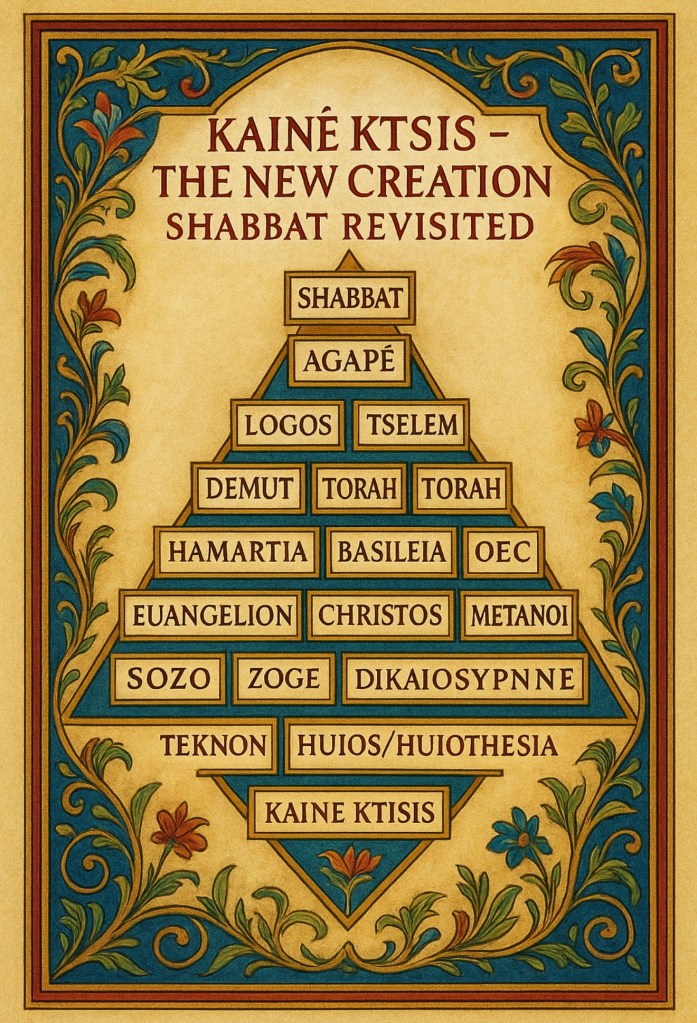
This final word doesn’t just stand alone—it completes the whole arc of the gospel. Over 21 words, we’ve traced the story of creation, disruption, and restoration. Not as random definitions, but as a poetic, chiastic proclamation.
I. Shabbat Established – God’s Good Design (Words 1–7)
1. Shabbat – Restful communion at the heart and purpose of creation
2. Agapē – God’s love as the heart of God and the “why” of creation and Shabbat
3. Logos – God’s Logic/wisdom as the how of God’s creation and the order established for flourishing
4. Tselem – Humanity as God’s royal reflection of Logos and Wisdom to be able to create and order things anew.
5. Demut – Humanity designed to mature into the likeness and character of divine agape love
6. Torah – God’s wise instruction for how to order the world via love for flourishing
7. Shalom – Harmony and wholeness in all things when they are in correct relationship with God and creation as a whole.
➡️ The chiasm here centers on Logos and Tselem: humanity was always meant to reflect the divine Wisdom of image and become the likeness of Agape Love.
II. Shabbat Disrupted – The Fall and the Way of Return (Words 8–14)
8. Hamartia – Sin as the failure to love and rule rightly be remaining in correct relationship and learning from God the father.
9. Basileia – The Reign of whose will is being done and the tragedy that we handed over the rule of the world to darkness, sin, death and rebellious powers.
10. Euangelion – The royal announcement of God’s reign of wisdom and love we and all of created for is returning
11. Christos – The King of God’s who embodies rescue from the counter kingdoms to love that had been set up by human rebellion.
12. Metanoia – Turning of our minds free from the other false kingdoms and seeing ourself as on the side of God’s kingdom of love we were always meant for.
13. Pistis – Loyal trust, allegiance and devotion to the King Jesus and to live for God’s Kingdom he is restoring on earth.
14. Charis – Grace as God’s empowering presence to restore us to living as member of God’s family and Kingdom.
➡️ This chiasm centers on Christos: the heart of the gospel is not just a message, but a King of God’s Reign of Shabbat coming on earth revealing what humans were created for.
III. Shabbat Restored – God’s Healing Fulfillment (Words 15–21)
15. Sōzō – Salvation as liberation from false kingdoms and the healing of the freedom of God’s image within us.
16. Zōē – The abundant life of the Kingdom manifested when we live out and mature into the kingdom law of love and the life that becomes God’s likeness brings.
17. Orgē – God’s passionate reordering of the world in Logos/Wisdom
18. Dikaiosynē – All relationships set right again by the work of Jesus and following his example.
19. Teknon – Image-bearers restored to freedom and orphans re-established as children of God’s family.
20. Huios / Huiothesia – Those children maturing into the likeness of the fathers love and placed as co-rulers
21. Kainē Ktisis – The renewed creation and reestblishment of the Shabbat as it was always intended.
➡️ This chiasm centers on Orgē and Dikaiosynē: divine agape setting relationships right by retribution but reordering and re-creation—God reordering the world in love so that God and his whole human family can dwell together and all of creaton can flourish as it was inteneded to.
The Shape of the Story
When we step back, we can see how the whole gospel fits into this chiastic design of Kainē Ktisis. At the center stands the cross and resurrection, but all the pieces work together to proclaim one reality: God has acted in Jesus as the anointed King to bring forth a new creation, one that restores, renews, and heals what was broken.
And if this is the shape of the story, then here is its invitation—for us, and for the world.
The Gospel for Us
For those of us who already follow Jesus, the gospel is not just the door we once walked through—it is the air we breathe. It is the royal announcement that God’s kingdom of love has broken into the world, and we are invited to live in its power of love even now. The story of Kainē Ktisis is not just about someday—it is about the Spirit making us new today, reshaping our desires, healing our wounds, and teaching us to love as Christ loves.
To believe this gospel is to receive our identity as part of God’s family and new creation, already here and yet still coming. It calls us to live as people of resurrection in the midst of a world that still bears the scars of death.
The Gospel We Share
And if this is the good news for us, it is also the good news for others. The same kingdom we have entered is the kingdom that every human heart longs for. When we share the gospel, we are not offering mere rules or escape plans, but announcing the true story of reality: that God, out of love, has acted in Jesus to rescue the world from sin and death, and to renew all things to their original design and purpose.
For the unbeliever, the invitation is simple yet profound: this kingdom of love is open to you. You were created for this life, this wholeness, this belonging. Jesus’ death and resurrection are for you, too, and by trusting Him you step into the story you were always meant to live.
✨ The Gospel of the Scriptures in its simplest form to share with the world:
We Humans were made to Rule alongside God in Wisdom and Love. However, this world is Ruled by Kingdoms of rebellion, hatred, anger, fear, darkness, oppression and sin. Into this state we announce to you that God’s Kingdom of love that we were all created for and long for has come in Jesus the King. He frees us from sin, fear, and shame, and He invites us into a life shaped and ruled by the agape love we were created for.
The Final Charge
Kainē Ktisis—new creation—stands as the heartbeat of the gospel. It is the royal announcement of God’s kingdom of love, breaking into the world through Jesus the Savior King. It is for us, to reshape our lives. It is for the world, to offer hope to all who long for renewal.
So let us live it, breathe it, and share it. For in Jesus the King, the old ways of living for self, pride, and sin has gone, the renewed way of living out the love we were created for has come.
Deep inside we all know its true so may we live in freedom and in love and along with God establish:
Shabbat Shalom!
 The Logos of Agape
[…] Mistranslated Series: Word 21 -Kainē Ktisis – New Creation or Shabbat Restored? […]
LikeLike