
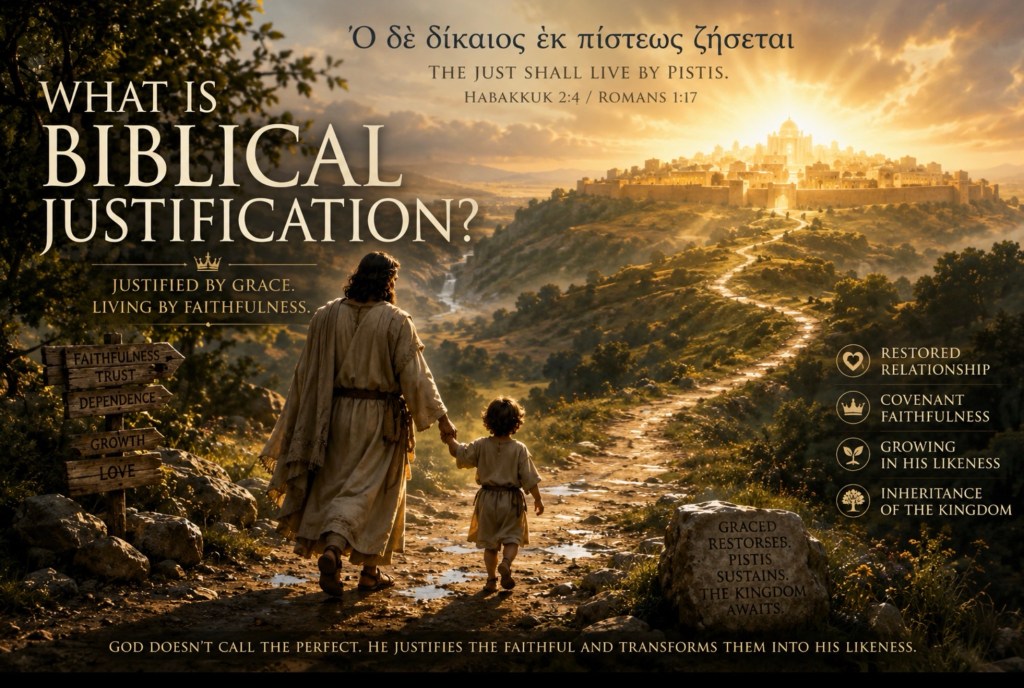
“For I am not ashamed of the Gospel of Christ, for it is the power of God unto salvation for everyone who believes, for the Jew first and also for the Greek. For in it the justice of God is revealed from faith to faith; as it is written, ‘The just shall live by faith.’”
— Romans 1:16–17
This is a key set of verses because it sets up in principle what Paul is going to spend the majority of his great Letter of Romans explaining. You see most scholars recongnize these two verses to be Pauls “propostio”. That is, his thesis statement of what is contested and what he is setting out to prove as true in the writing of this letter…
And, if I am being honest, for a very long time these two verses (specifically how these two veres ended) have been a source of great confusion for me.
This confusion largely centered around one question:
What does it actually mean to be “just” and/or “justified” according to God?
I had inherited an understanding of of justness and justification that essentially gave me only two possible ways a person could be considered just according to God:
Either:
- a person lived perfectly without any type of sin whatsoever,
or - a person believed in Jesus’ death on the cross so that Christ’s perfection could be legally imputed to them instead.
For a long time those seemed like the only available options.
And because of that framework, I believed justification primarily meant something like:
“God no longer truly sees me as I am, but instead sees Jesus in my place.”
At first, this sounded coherent.
But over time, I encountered a major problem.
All those people discussed in the Old Testament did not yet know about Jesus’ death and resurrection the way Christians speak about them today. They did not possess developed atonement theories. They did not understand the cross through later systematic theology.
And yet scripture repeatedly calls many of them:
- just,
- blameless,
- upright,
- innocent.
However, when I actually read their stories, these people were obviously imperfect.
Just to name a few examples of obvious well known sin of people who were called just/righteous, blameless or innocent are:
Noah became drunk.
Abraham lied out of fear repeatedly.
David committed terrible sins of adultry and murder.
Lot made deeply questionable decisions that none of us would consider blameless of just.
Job wrestled with confusion and frustration.
And that created a serious tension for me.
Because if justification meant either:
- perfect moral performance,
or - belief in a future atonement framework they did not yet know,
then how could any of these people possibly be called just?
The confusion only deepened because scripture itself also says that no one lives perfectly and that Jesus alone fully lived without sin.
Paul himself says in Romans 3:
“All have sinned and fall short of the glory of God.”
So what was happening….
Then one day I realized something I had somehow overlooked for years.
Paul was quoting the Old Testament.
A Note About “Just,” “Justice,” and “Justification”
Before continuing, it is important to explain something about language.
In English translations, we often see words like:
- just,
- justified,
- justification,
- righteous,
- righteousness,
- justice.
But in Greek, these are not separate conceptual word families.
They all come from the same root (I have written about this elsewhere on this blogsite) that root system is:
- δίκαιος (dikaios),
- δικαιοσύνη (dikaiosynē),
- δικαιόω (dikaioō).
In many English translations, some forms are translated “righteous” while others are translated “justified” or “justice.”
This can unintentionally make readers think scripture is discussing completely separate concepts when it is not.
For the sake of consistency throughout this article, I will primarily use the language of:
- just,
- justified,
- justification,
- justice.
Not because “righteousness” is wrong (in fact some of your translations you may read from verses I quote in this post may say righteous or righteousness instead), but because even if some translators translate these words to a person being righteous, I want us to clearly see the continuity between these ideas.
This matters enormously because the entire argument Paul makes in Romans depends upon this continuity.
“The Just Shall Live by Faith”
Romans 1:17 closes by saying:
“The just shall live by faith.”
But Paul is not inventing a brand new theological system here. He even says this is according to scripture.
He is quoting Habakkuk 2:4.
In the Septuagint — the Greek translation of the Old Testament that Paul frequently quotes — Habakkuk 2:4 says:
“Ὁ δὲ δίκαιος ἐκ πίστεώς μου ζήσεται”
“The just shall live by faith/faithfulness/faithful loyalty.”
Paul echoes this directly in Romans:
“Ὁ δὲ δίκαιος ἐκ πίστεως ζήσεται”
“The just shall live by pistis.”
This realization changed everything for me.
Because once I went back and read Habakkuk in context, I realized the passage did not fit the understanding of justification I had inherited.
Salvation, Justification, and Pistis in Romans 1:16–17
There is another important detail in Romans 1:16–17 that I overlooked for many years that add to the clarity.
Paul writes:
“For I am not ashamed of the Gospel of Christ, for it is the power of God unto salvation for everyone who believes… For in it the justice of God is revealed from faith to faith; as it is written, ‘The just shall live by faith.’”
At first glance, these verses may appear to shift between different ideas:
- salvation, v16
- belief, v16
- justice, v17
- justification, v17
- and faith. v17
But in Greek, these ideas are deeply connected.
In verse 16, Paul says the Gospel brings salvation to:
“everyone who believes.”
The Greek phrase is:
“παντὶ τῷ πιστεύοντι”
literally:
“to everyone covenantly trusting.”
This uses the Greek verb πιστεύω (pisteuō).
Then in verse 17, Paul says:
“The just shall live by faith.”
Here Paul uses the noun πίστις (pistis).
This is extremely important because:
- πιστεύω (pisteuō) and
- πίστις (pistis)
come from the same Greek word family.
In English, we often separate:
- belief,
- faith,
- faithfulness,
- trust,
- loyalty,
- allegiance,
as though they are mostly unrelated concepts.
But in Greek, these ideas are deeply interconnected.
Paul is not merely describing intellectual agreement with facts.
He is describing a life of trusting covenant faithfulness and allegiance flowing from the Gospel (the announcement of God’s Kingdom) itself.
And this helps explain the connection between salvation and justification.
For many years, I unconsciously treated salvation and justification as mostly separate categories.
Justification was viewed as a legal declaration.
Salvation was viewed as the result afterward.
But Paul’s argument in Romans 1:16–17 is far more unified than that.
The Gospel saves because within it the justice of God is revealed.
And who are the saved?
The just.
Who are the just?
Those who live by pistis.
In other words, the justified are the saved precisely because justification means being restored into right covenant relationship with God.
This becomes even clearer when we remember the original context of Habakkuk.
Habakkuk speaks of judgment, corruption, chaos, and destruction approaching Israel.
And in that context God declares:
“The just shall live by pistis.”
The point is not merely:
“They will go to heaven someday.”
The point is that the faithful covenant people will endure, remain within covenant life, and participate in God’s preservation and restoration through faithful allegiance to Him.
Paul takes this covenant framework and expands it through the Gospel of King Jesus.
Thus salvation is not merely escaping punishment.
Salvation is participation in the restoring life of God’s Kingdom.
And justification is the declaration that one stands within that covenant relationship through pistis.
This is why Romans 1:16–17 flows together so naturally:
- the Gospel saves,
- because it reveals God’s covenant justice,
- and the just participate in that salvation by living through pistis.
The just live because they remain within faithful covenant relationship with the God who is restoring creation into shalom.
The Context of Habakkuk Changes Everything
Habakkuk is not discussing:
- penal substitution theory,
- transferred legal perfection,
- or mentally believing future doctrinal propositions about the cross.
The context is covenant faithfulness during corruption, injustice, suffering, judgment, and chaos.
Habakkuk cries out to God because the world around him is filled with violence, corruption, oppression, and wickedness. Babylon is rising. Judgment is coming. Everything appears unstable and frightening.
And in that context, God contrasts two kinds of people:
- the proud who turn away from Him,
- and the just who remain faithful.
The “just” in Habakkuk are not presented as flawless people.
They are people who continue trusting and faithfully remaining aligned with God amid chaos and uncertainty.
That realization shook me.
Because Paul uses this passage to explain justification.
Which means Paul’s understanding of justification was deeply rooted in this older covenantal framework.
And suddenly the Old Testament saints made far more sense.
Paul Expands This Idea in Romans 3
Paul spends the next several chapters of Romans unpacking what he means by:
“The just shall live by pistis.”
And by the time we arrive at Romans 3, Paul’s argument begins to come into focus.
Paul writes:
“By works of the law no flesh will be justified in His sight, for through the law comes the knowledge of sin.”
— Romans 3:20
For years I assumed Paul meant:
“Good works are meaningless.”
But that is not actually Paul’s argument.
Paul is not condemning faithful obedience itself.
Rather, Paul is arguing that covenant standing before God cannot be established through:
- Torah observance,
- ethnic distinction,
- ritual covenant markers,
- or flawless legal performance.
Why?
Because:
“All have sinned and fall short of the glory of God.”
— Romans 3:23
For years, I assumed this meant justification must involve God pretending believers are already perfect.
But notice Paul’s language carefully.
He says humanity “falls short.”
This language fits remarkably well with the concept of ἁμαρτία (hamartia) — missing the mark.
Humanity falls short of the fullness of what God created humanity to become.
Humanity is incomplete.
Immature.
Broken.
Still growing toward the likeness of God.
But falling short is not identical to covenant rebellion.
A child learning to walk falls repeatedly.
That does not mean the child has rejected the parent.
And suddenly Romans 3 began fitting together with Habakkuk.
The just live by pistis while humanity still falls short.
The Problem Was My Understanding of Justice
The more I studied scripture, the more I realized my misunderstanding of justice and justness to be the source of my problem.
The problem was my inherited understanding of justice.
I had inherited an almost entirely legal and retributive understanding of justice.
Justice meant:
- punishment,
- penalty,
- payment,
- balancing guilt,
- satisfying legal debt.
Under this framework, justification became little more than a legal accounting system where guilt is transferred and charges are cleared.
But the more I studied scripture, the more I realized that biblical justice is fundamentally relational and restorative.
I have written elsewhere in much greater detail on how biblical justice (dikiasune) is restorative justice in scripture, so I will not fully reargue that case here. But this foundational point matters immensely:
Biblical justice is not primarily about balancing abstract legal accounts.
It is about restoring right relationship, covenant faithfulness, right order, and ultimately shalom.
And this matters because justification belongs to this same relational word family.
Δικαιόω (Dikaioō): Justification and Right Relationship
The Greek word δικαιόω (dikaioō) transformed how I understood justification.
In scripture, justification is not merely:
“God pretending someone is morally flawless because another person’s perfection has been transferred onto them.”
Rather, justification fundamentally carries the idea of being regarded and declared by God as being in right covenant relationship.
This suddenly made sense of the Old Testament saints.
God was not declaring Noah, Abraham, Job, David, or others to be flawless.
He was declaring them faithful within covenant relationship.
This understanding also suddenly made sense of Romans 3:21–22:
“But now the justice of God apart from the law is revealed… even the justice of God through pistis…”
Paul is describing God’s covenant faithfulness revealed through Christ.
Not merely abstract legal bookkeeping.
God acts through Christ to restore relationship, redeem humanity, and bring humanity back into covenant life.
This Does Not Deny Grace
At this point, some may worry that this understanding somehow denies grace or turns justification into human achievement.
But that is not what I am saying at all.
In fact, grace becomes even more central within this framework.
Humanity cannot heal itself.
Humanity cannot perfect itself.
Humanity cannot restore covenant relationship through legal performance.
God graciously acts through Christ to redeem humanity, deal with sin, restore relationship, and patiently form humanity toward maturity.
Paul explicitly says humanity is:
“justified freely by His grace.”
— Romans 3:24
The question is not whether grace is necessary.
The question is:
What does justification actually mean?
And throughout scripture, justification appears far more relational and covenantal than many modern legal models allow.
Πίστις (Pistis): More Than Mere Belief
This is why πίστις (pistis) matters so much.
In many modern contexts, faith is reduced to intellectual agreement:
- believing facts,
- affirming doctrines,
- mentally accepting propositions.
But pistis carries a much richer meaning:
- trust,
- faithfulness,
- loyalty,
- fidelity,
- covenant allegiance.
(I have written full blog posts on this meaning of pistis if you would like more on this but for now let us return to Habakkuk for the context Paul is borrowing from)
The just in Habakkuk were not merely people mentally agreeing with propositions.
They were people faithfully remaining loyal to God amid chaos.
And Paul says:
“The just shall live by pistis.”
This has always been how God’s people lived.
Not by flawless perfection.
Not by legal fiction.
But through faithful covenant relationship.
Why the Just Were Still Imperfect
This realization finally resolved the tension that had confused me for years.
The just throughout scripture were not flawless people.
They were faithful people.
Noah was still growing.
Abraham was still learning trust.
David repeatedly failed.
Job wrestled with understanding.
Yet all of them were still living within covenant relationship toward God.
This is no different from how healthy family relationships work.
As a father, I do not expect my young children to display the same maturity, wisdom, discipline, and understanding that I hope they will possess as adults.
My four-year-old may attempt to clean his room by picking up only a few toys while sincerely believing he has done an excellent job.
And honestly, within the limits of his present maturity, he has.
He is still my son.
He is still in right relationship with me.
He is still faithfully responding to my guidance according to his current level of development.
He is immature.
But he is not rebellious.
That distinction changed everything for me.
Ἁμαρτία (Hamartia) and Rebellion
One reason so much confusion exists is because English translations often flatten several distinct Greek concepts into the single word “sin.”
But scripture uses different terms with different meanings.
Ἁμαρτία (Hamartia)
Hamartia literally means “to miss the mark.”
It describes falling short of what humanity was created to become.
This is crucial.
Hamartia does not always describe outright rebellion against God.
Often it describes:
- immaturity,
- incompleteness,
- weakness,
- limitation,
- failure during growth,
- or falling short during the process of maturation.
This fits perfectly with Romans 3:23:
“All have sinned and fall short…”
Humanity falls short of God’s intended likeness.
But falling short is not necessarily identical to rejecting covenant relationship.
The difference between hamartia and anomia (another word we translate sin) is the difference between a child stumbling while learning to walk and a child abandoning the family altogether.
A child learning to walk falls repeatedly.
But falling is not the same thing as rejecting the parent.
Hamartia describes falling short within the journey toward maturity.
And this explains how someone may still experience hamartia while genuinely remaining in right covenant relationship with God.
So what will really need is to distinguish this falling short concept of sin from two other words often translated sin:
Παράπτωμα (Paraptōma)
Paraptōma carries the idea of trespass, deviation, or transgression.
Ἀνομία (Anomia)
Anomia means lawlessness — rebellion against rightful authority and covenant order itself.
These distinction matters immensely.
A person may still be justified while struggling with hamartia because growth toward maturity is gradual.
But one cannot remain in faithful covenant relationship while embracing anomia — the rejection of God’s authority, covenant, and way of love itself.
Hamartia describes falling short while still walking with God.
Paratoma describes moments of breaking known rules.
but Anomia describes rejecting the relationship altogether and saying there are no rules given from God.
That distinction unlocks an enormous amount of scripture.
Can Someone Lose Justification?
This understanding also helps make sense of a major debate among Christians.
Some Christians argue that justification (and therefore salvantion) can never be lost under any circumstances.
But in order to maintain this position, many warning passages throughout scripture must either be heavily reinterpreted or largely ignored.
Romans 11 warns believers not to become arrogant but to continue in God’s kindness lest they too be cut off.
Hebrews 6 warns against falling away after having participated in the things of God.
Numerous passages warn believers about ceasing in pistis/covenant loyalty.
At the same time, many other Christians live in constant fear that every mistake, weakness, failure, or sin may mean they have lost justification and correspondingly salvation altogether.
And both sides, I believe, often miss this important nuance.
If justification is fundamentally relational and covenantal, then the picture becomes much clearer.
A child does not cease being a faithful child every time they stumble while learning and growing.
Likewise, believers do not cease being justified merely because they still struggle with hamartia while maturing toward the likeness of God.
Ordinary weakness, immaturity, failure, and falling short are not the same thing as abandoning covenant relationship.
What destroys justification is not ordinary failure during growth.
It is the abandonment of pistis itself.
If pistis means faithful allegiance and covenant loyalty, then losing justification would involve intentionally abandoning covenant relationship — rejecting God and walking away from faithful allegiance altogether.
That is very different from a sincere believer who still struggles, fails, repents, learns, and continues growing.
This relational understanding of justification preserves the warnings of scripture without turning salvation into a state of constant fear and anxiety.
Why Jesus Centered Children
This also sheds tremendous light on why Jesus repeatedly centered children when speaking about the Kingdom of God.
Children:
- trust,
- depend,
- imitate,
- grow,
- mature slowly,
- and remain relationally faithful even while imperfect.
This is why Jesus could say:
“Whoever does not receive the kingdom of God like a child shall not enter it.”
Children still experience hamartia constantly.
They fall short every single day.
And yet children who trust and faithfully remain within loving relationship are not regarded as rebellious enemies.
They are growing sons and daughters.
The Kingdom belongs to those who live by pistis like that.
The Gospel Reveals the Justice of God
As we noted in Paul’s thesis argument in Romans 1:17 he writes:
“For in “it” the justice of God is revealed…”
What is the “it”?
The Gospel.
And what is the Gospel?
The Gospel is the announcement that God’s Kingdom has come through King Jesus.
It is the proclamation that God is restoring creation, defeating the powers of sin and death, and reconciling humanity back into covenant relationship with Himself.
And Paul says:
“In it the justice of God is revealed.”
The Gospel reveals that God’s justice is not merely retributive bookkeeping.
It is restorative covenant faithfulness rooted in agape love.
The just live by pistis because the Kingdom of God has always been about faithful covenant relationship with the God who is in agape love restoring creation into the shalom it was intended for.
The gospel is not that God refuses to see us.
The gospel is that through King Jesus and the coming of God’s Kingdom, God lovingly restores humanity into covenant relationship with Himself and patiently transforms His children into His likeness through faithful communion with Him.
The “just”and “justified” throughout scripture were never flawless people.
They were people faithfully living within covenant relationship with God while gradually growing toward the fullness of what humanity was created to become.
To be justified does not mean:
- God pretends we are perfect,
- God no longer sees us,
- or maturity is instantly completed.
It means we are regarded by God as being in right covenant relationship with Him through pistis.
And through that faithful relationship, God patiently transforms humanity into His likeness.
God is not seeking legally flawless servants.
He is raising faithful children into His likeness.
And only those who remain faithful within that covenant relationship will inherit His Kingdom of agape love and shalom.

