
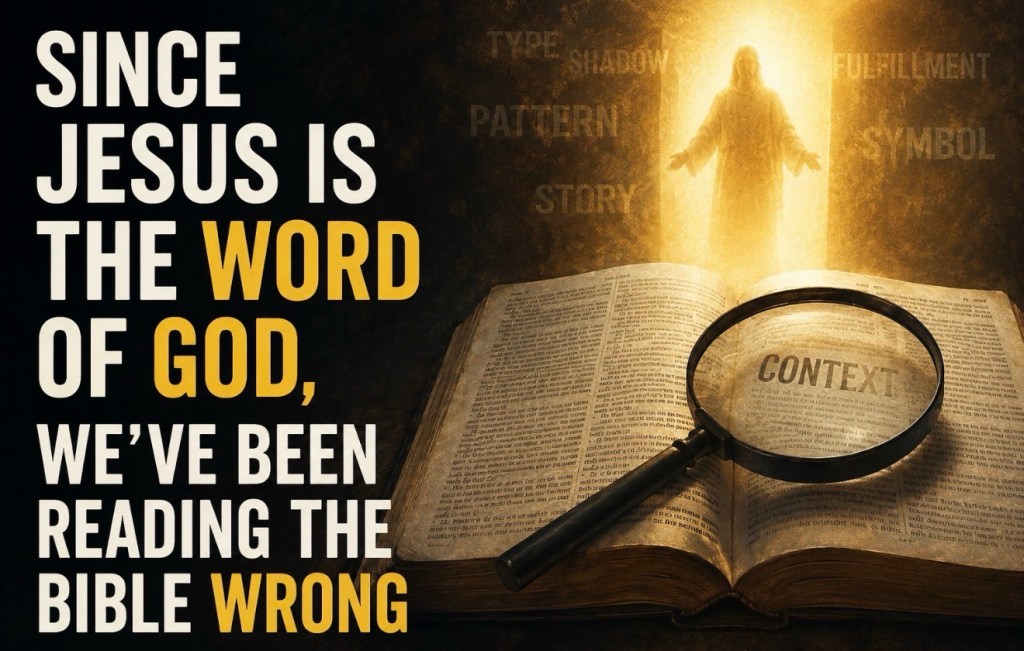
In a popular previous article, I argued something many Christians have never seriously considered:
Despite what many of us had been told the Bible never calls itself the Word of God.
Instead it calls Jesus the Word of God
Scripture itself says that Jesus is:
- the Logos made flesh (John 1:1–14),
- the exact representation of God’s being (Hebrews 1:3),
- the fullness of God revealed (Colossians 1:19),
- and the one with all authority in heaven and on earth (Matthew 28:18).
(If you have not read it and would like to read the full explanation you can read it here:)
Those were not small claims.
They change everything about how we understand the Bible itself.
Because if Jesus is the ultimate revelation of God, then Scripture cannot be understood apart from Him.
And yet much of modern Christianity has inherited a way of reading the Bible that often does exactly that.
We have been taught to flatten Scripture.
To treat the Bible as though every verse carries the same level of revelation equally.
To read it primarily as:
- a rulebook,
- a doctrinal system,
- a collection of propositions,
- or a perfectly uniform historical document.
But the Bible does not read itself that way.
Jesus does not read Scripture that way.
The apostles do not read Scripture that way.
And the early church did not read Scripture that way.
Instead, the Bible presents itself as a progressive movement toward fuller revelation in Jesus.
Hebrews says it plainly:
“In the past God spoke to our ancestors through the prophets at many times and in various ways, but in these last days he has spoken to us by his Son…”
— Hebrews 1:1–2
Notice the movement.
“In many ways…”
“But now…”
The text itself describes revelation unfolding progressively toward something fuller.
The prophets matter.
The Scriptures matter.
But they are partial.
Jesus is presented as the fullness.
And once we truly accept that, we begin realizing something enormous:
The Bible was never meant to be read as a flat collection of equally direct statements about God.
It was written as layered theological literature moving toward Jesus.
And according to Jesus Himself, if we are not reading Scripture in a way that leads us to Him, then we are reading it wrongly.
Jesus Says the Scriptures Are About Him
One of the most important passages in the entire New Testament is found in John 5.
Jesus is speaking to religious leaders who know the Scriptures better than anyone else.
These are experts in Torah.
Experts in the Prophets.
Experts in the sacred writings.
And yet Jesus says this to them:
“You search the Scriptures because you think that in them you have eternal life; and it is they that testify about me, yet you refuse to come to me that you may have life.”
— John 5:39–40
Think carefully about what Jesus is saying.
He is not accusing them of failing to read Scripture.
He is accusing them of reading Scripture wrongly.
They knew the text.
They studied the text.
They defended the text.
But they did not see Jesus.
And according to Jesus, that means they missed the point of Scripture itself.
Most Christians instinctively soften this passage.
We reduce Jesus’ claim to something manageable:
“Well yes, there are some messianic prophecies in the Old Testament.”
But Jesus’ claim is much larger than that.
He says:
“The Scriptures testify about me.”
Not isolated verses.
Not merely a handful of predictions.
The Scriptures.
The entire story.
And if we are honest, this creates a problem for many modern readers.
Because when we read large portions of the Old Testament literally and flatly, many sections do not appear to point to Jesus at all.
Entire passages feel disconnected from Him.
Sometimes entire books do.
Large sections appear to be:
- tribal warfare,
- genealogies,
- census records,
- ritual regulations,
- purity laws,
- political history,
- or ancient legal material.
And if we are simply reading at the surface level, we are often left wondering:
How exactly is this pointing to Jesus?
But perhaps that question itself reveals the problem.
Because Jesus does not say:
“A few passages point to me.”
He says:
“The Scriptures testify about me.”
Which means if we are not seeing how the Scriptures point toward Jesus, then the issue is not with Scripture.
The issue is with how we are reading it.
Jesus Shows Us How Scripture Was Meant to Be Read
This becomes even clearer after the resurrection on the road to Emmaus.
Two disciples are walking in confusion after Jesus’ death, struggling to understand what has happened.
And Jesus says to them:
“How foolish you are, and how slow to believe all that the prophets have spoken! Did not the Messiah have to suffer these things and then enter his glory?”
— Luke 24:25–26
Then Luke tells us something astonishing:
“And beginning with Moses and all the Prophets, he interpreted to them in all the Scriptures the things concerning himself.”
— Luke 24:27
This passage is revolutionary.
Jesus is not merely saying:
“Here are a few proof texts about the Messiah.”
He is saying the entire narrative movement of Scripture was already pointing toward:
- suffering,
- death,
- deliverance,
- restoration,
- and the kingdom of God through Him.
And importantly, many of those connections are not obvious through a merely literal reading.
Jesus is reading patterns.
Themes.
Narrative echoes.
Typology.
Symbolic movements.
The story beneath the story.
This is exactly the kind of reading many modern Christians were never taught.
The Bible Was Written as Layered Theological Literature
This was one of the great turning points in my own understanding of Scripture.
Over the last decade, scholars and teachers like:
- N. T. Wright
- John H. Walton
- Michael Heiser
- and Tim Mackie and BibleProject
helped me begin seeing something I had completely missed growing up.
The Bible is not primarily written like modern informational literature.
It is written as layered theological literature.
Meditation literature.
The biblical authors constantly build meaning through:
- repeated patterns,
- narrative hyperlinks,
- symbolic structure,
- thematic repetition,
- literary echoes,
- typology,
- and parallel imagery.
And once you begin learning to read the Bible this way, something remarkable happens:
Large portions of Scripture that once felt disconnected suddenly begin pointing toward Jesus everywhere.
Not through arbitrary imagination.
Not through making the text mean whatever we want.
But through patterns intentionally woven into the narrative itself.
The Bible Repeats Messianic Patterns Constantly
Take Jonah for example-
Jonah goes:
- down to Joppa,
- down into the ship,
- down into the depths of the sea/chaos waters, (and poetically Jonah equates this as a trip down into Sheol symbolically through the belly of the fish)
Then after 3 days he emerges to the land of the living again.
This is not random storytelling.
The biblical authors repeatedly use downward-and-upward movements as symbolic patterns of death and deliverance.
And this is precisely why Jesus uses Jonah the way He does.
Jesus says:
“For as Jonah was three days and three nights in the belly of the great fish, so will the Son of Man be three days and three nights in the heart of the earth.”
— Matthew 12:40
Now think carefully about this.
If we force Jesus’ statement into strict literal precision, the chronology immediately becomes difficult because the Gospel narratives themselves do not describe Jesus literally spending three full days and nights in the grave.
Which means the point Jesus is making is not primarily mathematical chronology or literal history.
The point is theological pattern.
Jonah represents a 3-fold descent into death-like chaos followed by deliverance.
Jesus says that pattern reaches fulfillment in Him.
This is how ancient Jewish theological storytelling often worked.
And once you begin seeing these patterns, you realize the Hebrew Scriptures are saturated with them.
The Bible starts behaving less like disconnected religious reporting and more like an intentionally unified theological story moving toward Jesus from the very beginning.
The Bible Was Designed for Meditation
This is why Scripture repeatedly rewards slow reflection rather than surface reading.
The biblical authors designed these texts to be revisited repeatedly.
Meditated upon.
Explored layer by layer.
Psalm 1 describes the righteous person as one who meditates on Torah day and night.
Why?
Because the meaning is often deeper than the surface.
The stories echo one another.
Themes spiral and develop.
Images repeat and mature across books and generations.
The Bible behaves less like a modern encyclopedia and more like a unified literary world.
This is why ancient readers noticed patterns modern readers often miss.
The biblical authors expected readers to meditate deeply enough to discover connections across the story.
And once those patterns become visible, the Scriptures begin pointing toward Jesus everywhere.
Why This Changes Everything
This changes everything because it reshapes what biblical authority actually means.
The authority of Scripture is not found in flattening every passage into equally direct revelation about God.
Its authority is found in faithfully leading us toward Jesus.
Toward the Logos.
Toward the fullest revelation of God’s character.
And what does Jesus reveal about God?
Love.
Not violence as ultimate.
Not domination as ultimate.
Not tribal hatred as ultimate.
Love.
Jesus says all the Law and the Prophets hang on love.
Paul says love fulfills the law.
John says God is love.
Which means Scripture must ultimately be read through both:
- Jesus as the fullest revelation of God,
- and love as the hermeneutical key Jesus Himself gives us.
And according to Jesus Himself, if our reading of Scripture does not ultimately lead us there, then we are reading it wrongly.
That does not diminish Scripture.
It restores Scripture to the purpose Jesus says it was always meant to serve.
Not as an end in itself.
But as a witness pointing beyond itself to Him.
Now, as someone who heard all this before but thought well yeah O can get all that while still forcing it all to be coherent and discovered while read literally I understand that this does not fully deny a literal interpretation.
However, while I did come to notice some of these things it was not until I emerged myself in this type of scripture meditation that I realized reading scripture this way made the idea that it all points to Jesus so much more real and true then I ever had imagined.
So how did we get there. What is the proof that caused me to go from somewhat understanding this to fully embracing it as the way in which the authors intended the scripture?
That is where we go from here in our next blog post.
To continue on and read that next blog post in the series here is the link:


[…] https://logosofagape.com/2026/05/15/since-jesus-is-the-word-of-god-weve-been-reading-the-bible-wrong… […]
LikeLike