Why Love Shares Life, Glory, and Rule
A opening note: Why Revisit This Topic?
Over the last several years, discussions surrounding the Divine Council have become increasingly associated with the work of Michael Heiser.
For many Christians, Heiser introduced an idea that initially sounded strange:
God presiding over a heavenly council of spiritual beings to deliberate on decisions that needed to be made on how to rule his creation.
Passages like Psalm 82, Job 1–2, Daniel 7, and many others suddenly began to look different.
Many readers found themselves asking:
“How did I miss this?”
Others became skeptical.
Some assumed this language implied polytheism.
Some thought it sounded too unusual or too dependent on ancient Near Eastern concepts.
Others simply associated the entire idea so closely with one modern scholar that they assumed if problems arose with the scholar’s theology in places, then the concept itself must also collapse.
I think that would be unfortunate. Not necessarily because I think we should agree with everything Heiser wrote but because the Divine Council concept did not begin with Michael Heiser.
I believe it began in Scripture.
Heiser’s contribution was helping many Christians notice something that had been sitting in plain sight.
In light of this when he had first brought attention to it a while back I had actually written portions of this series at that time but never got around to completing and publishing them. However, with the renewed discussions around Heiser and the Divine Council resurfacing recently, I decided it was finally worth returning to these ideas.
However my series will be somewhat unique as I want to explore an area that I think deserves greater attention:
God’s desire for Humanity to have a role in His Divine Council.
Because if the Divine Council is merely a discussion about angels and spiritual beings, then we have only told part of the story.
The biblical story ultimately centers on human beings and God’s desire to bring humanity into communion, maturity, and participation in His work.
So before we ask whether God has a Divine Council, we should ask a prior question:
Why Would God Want a Divine Council?
The Problem with having the wrong starting point (and the wrong Omni’s)
Traditional theology often begins discussions of God with a familiar list of attributes:
- Omnipotence (all-powerful)
- Omniscience (all-knowing)
- Omnipresence (present everywhere)
- Immutability
- Impassibility
Many of these ideas have deep roots within Christian tradition and contain important concepts to consider concerning God and His character.
But sometimes these concepts become detached from what Scripture itself presents as God’s primary characteristic.
Scripture never says:
God is power.
God is knowledge.
God is control.
God is transcendence.
But Scripture does explicitly say:
“God is love.”
—1 John 4:8 & 16
That matters.
Because if love is not merely one attribute among many, but God’s very nature, then everything else we say about God should flow from that center.
God’s wisdom should look like love.
God’s power should look like love.
God’s sovereignty should look like love.
God’s knowledge should look like love.
When power becomes detached from love, we can begin imagining God as a cosmic dictator.
When knowledge becomes detached from love, we can begin imagining God as a detached observer.
When sovereignty becomes detached from love, we can begin imagining God as merely controlling.
But Scripture repeatedly presents a different picture.
God reasons.
God invites.
God listens.
God grieves.
God responds.
God delights in relationship.
If love truly sits at the center, then perhaps our attributes should reflect that.
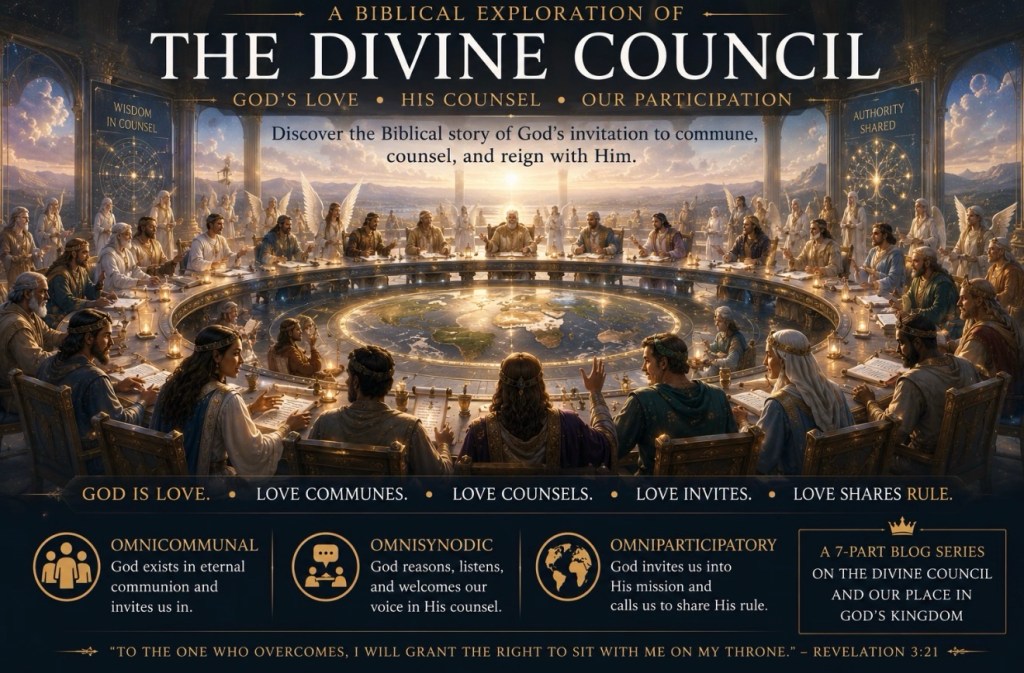
And so to start this series off let us begin by introducing 3 new Omni concept as outflows of his central characteristic of Agape Love.
1. Omnicommunal: God as Eternal Communion
Before creation existed, God already existed in relationship.
Father.
Son.
Spirit.
God was never solitary.
He never needed creation to become loving because love already existed eternally within God’s own life.
Love requires relationship.
Thus God may be understood as Omnicommunal:
The God who exists in perfect communion and continually extends that communion outward.
Creation itself becomes an invitation into that shared life.
2. Omnisynodic: God as Deliberative Love
Love does not merely issue commands.
Love listens.
Love reasons.
Love invites dialogue.
Scripture repeatedly depicts God gathering councils and inviting participation.
He asks:
“Whom shall I send?”
He listens to Abraham regarding Sodom.
He hears Moses intercede for Israel.
He gathers heavenly assemblies.
God appears throughout Scripture as One who delights in counsel.
Not because He lacks wisdom—
but because love delights in sharing wisdom.
Thus God may also be understood as Omnisynodic:
The God who governs through communal wisdom and loving counsel.
3. Omniparticipatory: God as Shared Mission
Perhaps most surprisingly, God continually invites others into His work.
He shares responsibility with:
- spiritual beings
- prophets
- apostles
- the church
- ordinary people
Prayer itself demonstrates this reality.
Prayer is not merely informing God of facts.
Prayer is participation.
Prayer is joining ourselves to God’s purposes.
Prayer is entering God’s work.
Thus God may also be understood as Omniparticipatory:
The God who continually invites others into communion, counsel, and mission.
Why the Divine Council Exists
Once we begin with love, the Divine Council stops seeming strange.
It becomes almost expected.
If God is love—
love shares.
Love gathers.
Love invites.
Love includes.
Love delights in participation.
The Divine Council therefore is not evidence that God needs help.
It is evidence that God delights in partnership.
And as we will discover in this series, that partnership was never intended only for angels.
It was always intended for humanity as well.

