In the previous two articles in this series I argued two things that many modern Christians have never seriously considered.
First, I argued that the Bible never calls itself the Word of God in the way many Christians commonly speak about it today. Those titles belong ultimately to Jesus Himself. Jesus is the Logos made flesh. Jesus is the exact representation of God. Jesus is the fullness of God revealed, and Jesus possesses all authority.
Second, I argued that if Jesus truly is the fullest revelation of God, then we have learned to read Scripture wrongly whenever our interpretation ultimately fails to point us toward Him.
But that immediately creates a problem.
If Jesus is the interpretive center of Scripture, then how are we actually supposed to read the Bible?
Because if we are honest, many of us inherited a particular way of reading Scripture. We were taught to approach it primarily as a rulebook, a systematic theology manual, a historical record, or a collection of doctrines and propositions. We learned to ask questions like: What happened? What doctrine does this establish? What rule does this prove?
None of those questions are necessarily bad questions.
But what if they are incomplete?
What if Scripture itself is signaling that it wants us to read differently? What if the biblical authors are constantly drawing our attention to repeated themes, symbolic patterns, literary structures, and theological connections that modern readers often completely miss?
And what if Jesus, the apostles, and the earliest Christians all understood this naturally, but somewhere along the way much of the modern church forgot it?
That is what this article is about.
Not skepticism.
Not dismissing Scripture.
Quite the opposite.
This is about rediscovering how the Bible itself taught its readers to read it.
Years ago I began reading the early church fathers, and honestly, at first I found them deeply frustrating.
The Early Church Fathers Felt Completely Foreign
They seemed to read Scripture completely differently than I did.
Passages that I thought were obviously about one thing suddenly became symbolic. Historical events became theological patterns. Stories became spiritual realities pointing beyond themselves.
Sometimes I would read their interpretations and think:
“How on earth did they get that from this passage?”
At times it honestly felt like they were simply making things up.
I think many Christians raised in conservative Protestant environments understand exactly what I mean.
Because if you grow up within a modern literal-historical framework, the fathers can feel almost foreign. It felt like trying to force a square peg into a round hole.
I thought one of two things had to be true.
Either these men had completely lost the plot almost immediately after the apostles…
or they understood something about reading Scripture that I didn’t.
At the time I did not know what to do with that tension.
Part of me trusted earlier voices more. After all, some of these men had direct connections to the apostles themselves. Irenaeus, for example, was taught by Polycarp, who according to church history had been taught by the apostle John.
That matters.
But another part of me still carried assumptions I inherited growing up:
“The early church got corrupted quickly.”
So for a while I pushed the tension aside.
Then I Noticed the Apostles Doing the Same Thing
Then one day I noticed something I could no longer ignore.
The apostles themselves were reading the Old Testament exactly like the church fathers.
Once I saw it, I could not unsee it.
Paul Was Not Reading Flat History
One of the clearest examples comes from Galatians 4:21–31.
Paul begins discussing Sarah and Hagar.
Now if someone had asked me growing up what Genesis was about, I would have answered very simply:
“It is history.”
Abraham had two sons.
One by Hagar.
One by Sarah.
End of story.
Then Paul does something that completely disrupted my assumptions.
In Galatians 4:24 Paul writes:
“These things are being taken allegorically…”
Pause there for a moment.
Read that again.
“These things are being taken allegorically.”
Paul tells us directly what he is doing.
He takes two historical women and suddenly transforms them into two covenants. Hagar becomes Mount Sinai and slavery. Sarah becomes freedom. Earthly Jerusalem becomes contrasted with heavenly Jerusalem.
Now imagine for a moment that a church father had done that.
Imagine Origen doing it.
Imagine Gregory of Nyssa doing it.
Imagine Augustine doing it.
How many modern Christians would immediately say:
“He’s reading things into the text.”
“That isn’t what Genesis meant.”
“That’s allegorizing.”
But Paul did it.
Paul himself.
Suddenly I found myself asking a question I had never asked before:
If Paul reads Scripture this way, why was I assuming Scripture was intended to function only as flat historical information?
Suddenly I Started Seeing Patterns Everywhere
And then I started seeing it everywhere.
Then I started noticing that Paul was doing this kind of thing all over the place.
One example in particular completely caught me off guard because I had quoted it for years without ever stopping to ask where it originally came from.
In 1 Corinthians 15 Paul is discussing resurrection. He builds toward one of the most triumphant moments in the entire chapter and suddenly declares:
“O death, where is your victory? O death, where is your sting?” (1 Corinthians 15:55)
I had heard those words my entire life.
Most Christians have.
They are often quoted at funerals. They are quoted in Easter sermons. They are quoted whenever we talk about Christ defeating death.
Growing up, I simply assumed Paul was quoting a straightforward messianic prophecy about resurrection.
I assumed Hosea had predicted resurrection in the Old Testament, and Paul was merely pointing out that Jesus fulfilled it.
But one day I actually went back and read Hosea.
And honestly, I remember sitting there thinking:
“Wait… what?”
Because Hosea 13 is not functioning like a straightforward resurrection prophecy at all.
The chapter is largely about covenant judgment against Israel.
Israel has rebelled.
Israel has pursued idols.
Israel is facing destruction and exile.
Death and Sheol are being personified almost like agents of judgment.
The language is harsh and heavy.
Then in Hosea 13:14 we read:
“Shall I ransom them from the power of Sheol? Shall I redeem them from death? O Death, where are your plagues? O Sheol, where is your destruction?”
Depending on the translation, the wording shifts somewhat, but the larger point remains the same.
When read in Hosea’s immediate context, the passage is tied directly to Israel’s judgment and eventual restoration. It is not sitting there as a neat little isolated prediction saying:
“One day Jesus will rise from the dead.”
Yet Paul suddenly takes that language and places it into a completely new setting.
He places it into Christ’s resurrection and the final defeat of death itself.
Suddenly the movement becomes something like this:
In Hosea:
Israel → judgment → death imagery → eventual restoration
But in Paul:
Jesus → resurrection → defeat of death → new creation
Paul is not ignoring Hosea.
That was one of the biggest realizations for me.
He is not twisting Hosea.
He is not ripping it out of context.
He is seeing a larger pattern.
Israel’s story itself becomes a pattern that points beyond itself.
Death followed by restoration.
Judgment followed by redemption.
Descent followed by exaltation.
Paul sees Jesus as the fullest expression of that pattern.
And suddenly what once looked like Paul randomly grabbing Old Testament verses started looking very different.
He was rereading Israel’s story through Jesus.
Peter Does the Same Thing
And then I noticed Peter doing the exact same thing.
In 1 Peter 2:10 Peter writes:
“Once you were not a people, but now you are God’s people; once you had not received mercy, but now you have received mercy.”
Again, this sounds beautiful and straightforward if you simply read Peter.
But Peter is quoting Hosea.
Specifically Hosea chapters 1 and 2.
So I went back and read Hosea again.
In Hosea, God tells Hosea to give symbolic names to his children:
Lo-Ammi:
“Not my people.”
Lo-Ruhamah:
“No mercy.”
The meaning in Hosea’s immediate context is fairly clear.
Israel has broken covenant relationship.
Judgment is coming.
But then later God promises restoration.
Not-my-people becomes my people.
No-mercy becomes mercy.
The original movement looks like this:
Israel → covenant judgment → restoration
But Peter suddenly does something surprising.
Peter takes language originally spoken to Israel and applies it to the Church, including Gentile believers.
Now the pattern becomes:
Humanity outside covenant relationship → brought near in Christ → restored people of God
Again I remember stopping and thinking:
“Wait a minute…”
Because Peter was doing exactly what Paul had done.
He was not merely reading Hosea as isolated historical information.
He was seeing a theological pattern embedded within the story itself.
The story was pointing beyond itself.
And once I noticed Paul doing it and Peter doing it, I suddenly started seeing these kinds of things absolutely everywhere.
Then I Noticed John reading scripture this way too.
John’s Gospels and letters started feeling different after that.
Not because I had never read them before.
I had.
Probably dozens of times.
But suddenly I noticed things I had somehow completely missed.
John constantly organizes his Gospel around symbolic architecture.
He repeatedly develops themes and patterns that build on one another:
- light and darkness
- water imagery
- bread from heaven
- temple imagery
- seven signs
- creation themes
- new creation themes
John is obviously reporting events.
But he is doing more than simply recording events.
He is arranging them in ways that communicate theological meaning.
The more I read John, the harder it became to believe he was merely stacking historical facts one after another.
He was intentionally constructing something.
He wanted readers to see patterns.
He wanted readers connecting ideas.
He wanted readers meditating.
Jesus Himself Reads Scripture This Way
And then I noticed something even more important:
Jesus Himself reads Scripture exactly this way.
Not occasionally.
Constantly.
And that was the point where things really started changing for me.
Because it is one thing to say Paul reads Scripture this way.
It is another thing to say Peter does too.
But when Jesus Himself repeatedly handles Scripture this way, suddenly the question becomes much harder to avoid:
What if this was never a strange way of reading Scripture at all?
What if this was the normal way Scripture was always meant to be read?
The Scriptures Testify Through Patterns
And then I realized something even more important.
In the previous article I already argued that Jesus says the Scriptures ultimately point to Him.
Jesus says in John 5:39–40:
“You search the Scriptures because you think that in them you have eternal life; and it is they that testify about Me, yet you refuse to come to Me that you may have life.”
I had read that verse many times before.
But I think I had always unconsciously assumed Jesus meant something like:
“The Old Testament contains a bunch of predictions about Me.”
So I pictured isolated prophecies scattered throughout the text like hidden clues waiting to be discovered.
But the more I studied, the more I realized that this explanation felt too small.
Because if we are honest, large portions of the Old Testament do not obviously appear to be direct predictions of Jesus at all.
Large portions are laws.
Large portions are genealogies.
Large portions are historical narratives.
Large portions are poetry.
Large portions are stories about kings, prophets, exile, warfare, and Israel’s repeated failures.
If someone handed me the Old Testament alone and asked:
“Where exactly is Jesus in all of this?”
I honestly do not know that I would naturally arrive at the answer many Christians give.
At least not by reading everything flatly.
And that was where everything started changing for me.
Because I began realizing that Jesus and the apostles did not merely see isolated predictions.
They saw patterns.
They saw recurring movements.
They saw themes repeating themselves over and over.
They saw stories echoing earlier stories.
They saw Israel’s history functioning almost like a living theological drama that repeatedly pointed beyond itself.
And once I started noticing these patterns, suddenly the Bible began feeling less like disconnected material and more like one unified story.
The Flood Changed the Questions I Was Asking
One of the clearest examples for me early on was the flood narrative.
For years I approached the flood almost entirely through modern questions.
Was it global?
Was it local?
How much water was there?
How did the animals fit?
How did the ark function?
Those were the kinds of questions I had inherited.
Again, those are not necessarily bad questions.
But then I noticed something that surprised me.
When Peter talks about the flood, his focus lands somewhere very different.
In 1 Peter 3:20–21 he writes:
“In the days of Noah… eight people were saved through water, and this water symbolizes baptism that now saves you also…”
That honestly stopped me in my tracks.
Because Peter was not primarily discussing flood mechanics.
He immediately moved toward theological meaning.
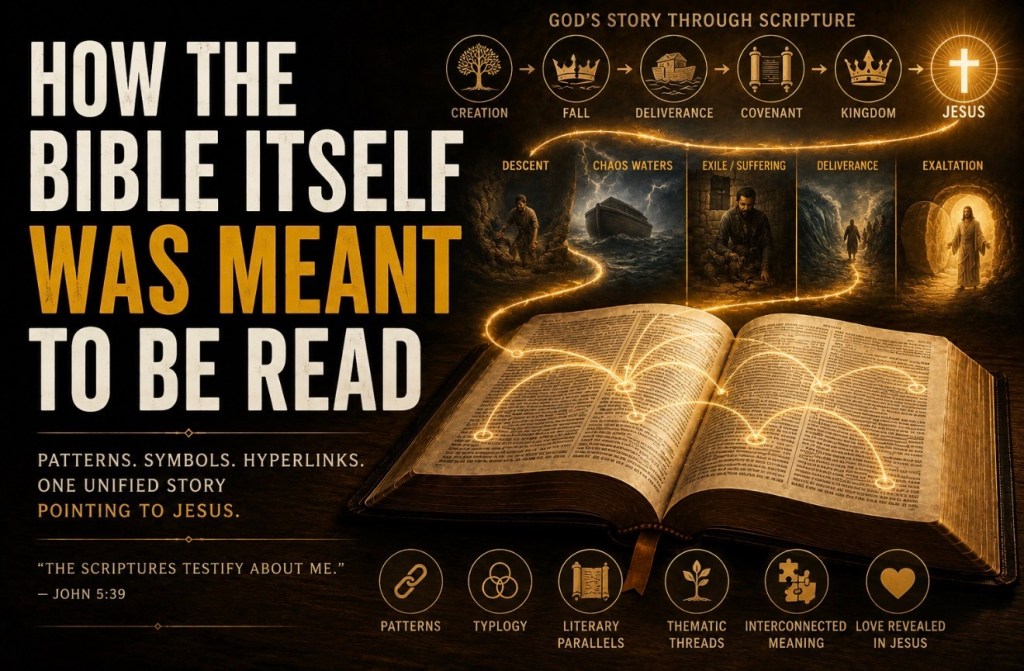
He saw the flood as a pattern.
He saw:
chaos,
judgment,
deliverance,
passing through waters,
death and emergence into new life.
Suddenly I realized something I had never asked before:
Peter apparently was not primarily focused on the kinds of historical questions I had been trained were important to ask or prove.
Peter read the flood narrative as a theological pattern that found its fulfillment in Jesus and baptism.
And honestly, I found myself wondering something I had never seriously considered before:
Peter’s theological conclusion did not seem to depend on the historicity I had spent so much time worrying about.
His point continued to stand either way.
Peter read the flood narrative as a theological pattern that found its fulfillment in Christ and baptism.
That does not answer historical questions someone might ask about the flood.
But it does force another question:
Why was Peter instinctively interested in something so different than what I had been taught to focus on?
And suddenly I began asking myself a question:
Why was Peter instinctively reading this story differently than I had been trained to read it?
Peter saw something bigger happening.
The story itself was functioning as a pattern that pointed beyond itself.
The Bible Shows Itself to Be Repeating the Same Story
And once I noticed that in the flood narrative, I began seeing similar movements repeated all over Scripture.
I began noticing stories repeatedly moving downward before moving upward.
Again and again I began noticing stories moving through repeated descents before eventual exaltation.
Joseph:
- descends into the pit
- descends into slavery in Egypt
- descends into prison
before being lifted up to save many.
Israel:
- descends into slavery
- descends through chaos waters
- descends into wilderness testing
before entering promised restoration.
Jonah:
- descends into the ship
- descends into the sea
- descends into the belly of the fish (symbolically into Sheol)
before deliverance.
I remember staring at these stories thinking:
“How did I never notice this before?”
Because now Jesus’ words about Jonah no longer felt random.
They felt inevitable.
At first I thought I might simply be seeing patterns because I had started looking for them.
But then I noticed that Scripture itself keeps drawing attention to these repeated movements.
The text itself seems to invite readers to connect the stories.
The stories are not merely sitting beside one another.
They are speaking to one another.
And suddenly Jesus’ use of Jonah started making much more sense to me. He saw the pattern of 3 descents too. In fact that is how he referenced them.
In Matthew 12:40 Jesus says:
“For just as Jonah was three days and three nights in the belly of the great fish, so the Son of Man will be three days and three nights in the heart of the earth.”
Growing up I had almost always heard discussions surrounding this passage become debates over chronology.
People debated whether Jesus had to be crucified on Wednesday or Friday.
People counted hours.
People built charts.
People tried reconciling exact time measurements.
They were trying to rectify Jesus statement that seems of because he doesn’t stay 3 days and nights dead.
But now I found myself noticing something different.
Jesus was not merely counting days or even saying how long he was going to be dead.
But now I realized Jesus was doing something bigger than simply counting hours or days.
He was drawing attention to the same triple descent and then deliverance pattern I had begun noticing throughout Scripture.
Suddenly Jonah no longer felt random.
Jonah’s descent into chaos and emergence into deliverance had become a pattern pointing toward Jesus Himself.
And then something else hit me.
Paul describes Jesus in Philippians 2:5–11 in a remarkably similar movement though not just surrounding his death but about his whole life.
In the passage Jesus
Jesus descends by emptying Himself & becoming human.
Descends and take the form of a servant/slave.
Descends and submits Himself to death.
And only then is He is exalted.
Lifted up.
Given the name above every name.
Jesus Was the Climax of the Pattern
Suddenly I realized something that felt almost shocking.
Jesus was not simply fulfilling isolated predictions scattered throughout Scripture.
Jesus was becoming the climax of patterns that had been unfolding all along.
The descent and exaltation narratives.
The death and resurrection movements.
The chaos-to-new-creation themes.
The exile-and-restoration stories.
The Bible had been quietly building toward Him the entire time.
And once I began seeing that, I honestly felt like I was reading an entirely different Bible.
Not because I had stopped believing Scripture.
Ironically, it felt like I was finally starting to see what Scripture had been doing all along.
I Felt Like I Was Reading a Different Bible
And that was the moment when something finally clicked into place for me.
The breakthrough did not come because I suddenly stopped believing Scripture.
Ironically, it happened because I began taking Scripture more seriously than I ever had before.
For most of my life I had assumed that taking the Bible seriously meant reading it primarily at the surface level. If Genesis says something happened, then the most important question was whether I could defend it historically. If a prophet said something, the most important question was whether it predicted a future event. If Paul quoted something from the Old Testament, I assumed he was simply pulling out proof texts that had obvious meanings sitting on the surface.
But now I found myself seeing something I had somehow missed for years.
The biblical authors seemed to expect readers to slow down.
They expected readers to remember earlier stories.
They expected readers to notice repeated language.
They expected readers to connect themes.
They expected readers to meditate.
The Bible itself seemed to assume that readers would sit with the text rather than simply extract information from it.
Learning to Read Like Ancient Readers
Around this same period I encountered scholars and teachers like N. T. Wright, Michael Heiser, John Walton, Tim Mackie (of the BibleProject) and more who read the scriptures in this way. Regardless of where someone lands on every theological conclusion these people hold, they helped put language around something I had already begun noticing inside the text itself.
They pointed out that ancient Jewish readers often approached Scripture differently than modern Western readers do.
Modern readers often approach texts looking primarily for information.
We want quick answers.
We want bullet points.
We want systems.
We want conclusions.
Ancient Jewish meditation literature often functioned differently.
Instead of immediately resolving tension, it often intentionally created tension.
Instead of answering every question immediately, it often invited readers to sit with questions.
Instead of flattening stories into isolated historical moments, it often connected stories into larger narrative worlds.
The Fathers Suddenly Made Sense
And once I began seeing this, I suddenly understood why the early church fathers no longer felt completely strange to me.
Because years earlier I had assumed they were inventing meaning.
Now I began wondering if they had simply preserved ways of reading that modern readers had largely forgotten.
That does not mean every church father was right about everything.
Far from it.
Nor does it mean every allegorical reading ever proposed is automatically correct.
Some interpretations from the fathers can feel stretched. Some conclusions seem speculative. Some ideas clearly went too far.
But that was not my great realization.
My realization was much simpler.
The apostles themselves were already reading this way.
Paul did it.
Peter did it.
John did it.
Jesus did it.
And suddenly the fathers looked less like innovators and more like continuers.
That was the breakthrough.
Because for years I had unconsciously imagined two separate worlds.
I had imagined the Bible functioning one way and the fathers functioning another way.
I had imagined the apostles reading Scripture literally while later Christians started introducing symbolic interpretations.
But I increasingly realized that this picture had things almost completely backwards.
The apostles themselves repeatedly looked beneath surface readings toward deeper theological patterns.
The fathers inherited that instinct.
They did not wake up one morning and decide:
“Let’s turn everything into allegory.”
They believed the text itself was inviting readers to look deeper.
And once I started noticing this inside Scripture itself, I began arriving at some of the same conclusions naturally.
Not because I was trying to imitate church fathers.
Not because I was forcing symbolism onto the text.
But because the text itself kept leading me there.
And honestly, that was shocking for me.
Because for years I had looked at many early Christian interpretations and thought:
“There is no way they got that from the text.”
Now I found myself reaching similar conclusions and then discovering that the fathers had often already seen similar patterns centuries earlier.
I remember having moments where I would trace some repeated theme through Scripture and think:
“Wait… Gregory noticed this?”
“Wait… Irenaeus saw this?”
“Wait… they were saying something like this long before modern scholarship?”
That was unsettling.
Not because it weakened my faith.
Because it actually strengthened it.
Scripture Was Teaching Me How the Scriptures wanted to be Read
The Bible stopped feeling like disconnected religious material.
It began feeling like a unified world.
Stories were no longer isolated.
Narratives began echoing one another.
Themes started building on earlier themes.
Images reappeared and expanded.
Things that once felt random suddenly felt intentional.
And honestly, it became difficult not to see it everywhere.
Water repeatedly moves from chaos toward life.
Wilderness repeatedly becomes a place of testing and transformation.
Mountains repeatedly become places of divine encounter.
Exile repeatedly becomes a movement toward restoration.
Death repeatedly becomes a doorway into new life.
Again and again Scripture seemed to be teaching readers how to read Scripture.
Not merely by giving instructions.
But by forming habits of attention.
By training readers to notice.
By training readers to meditate.
By training readers to recognize patterns.
But Doesn’t That Make Interpretation Dangerous?
And once I started seeing that, another question immediately emerged.
If Scripture contains symbolic depth, literary patterns, typology, and layered meaning…
then what keeps interpretation grounded?
Because at this point a very fair objection appears.
Someone could say:
“Okay, but couldn’t someone make the Bible mean anything they want?”
And honestly, that concern is legitimate.
Because symbolic interpretation without boundaries can become untethered very quickly.
So what keeps interpretation faithful?
What keeps readers from simply inventing meanings?
What keeps Scripture from becoming whatever we want it to become?
That was the next realization.
And strangely enough, Jesus had already answered it.
 The Logos of Agape
[…] How the Bible Wants to Be Read […]
LikeLike