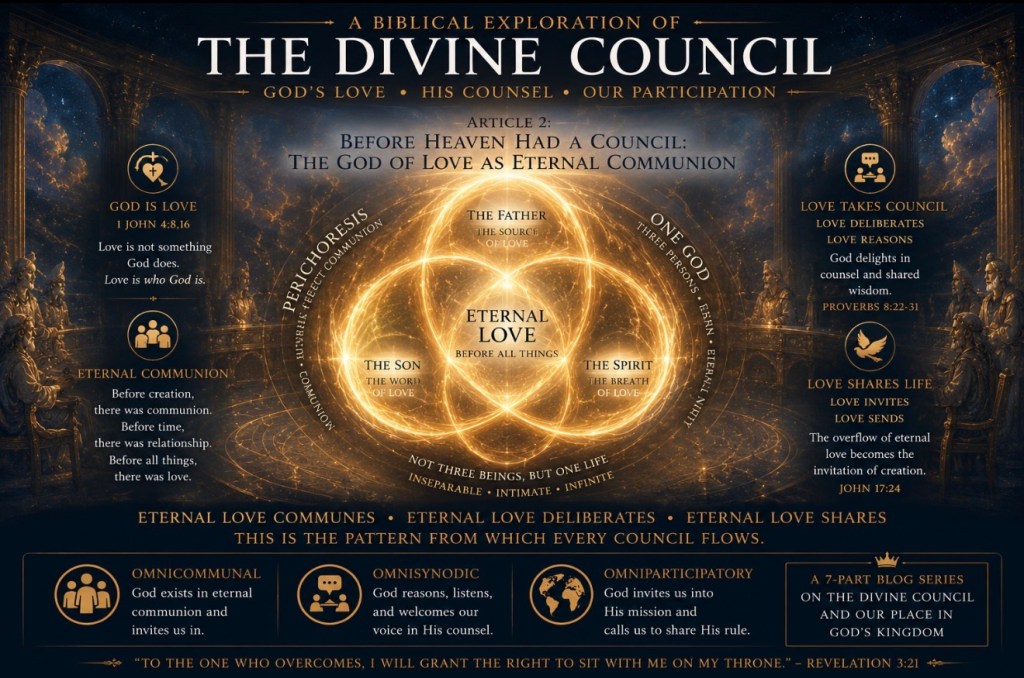
Article 2: Before Heaven Had a Council: The God of Love as Eternal Communion
In the previous article we asked an important question:
Why would God want a Divine Council at all?
We suggested that if Scripture is correct when it says:
“God is love.”
—1 John 4:8,16
then perhaps sharing life, wisdom, and participation should not surprise us.
Love communes.
Love counsels.
Love invites.
Love shares.
If this is true, however, then another question immediately emerges:
Where did this pattern begin?
Did God create angels because He needed help?
Did He create humanity because He lacked companionship?
Did God invent participation only after creation?
Scripture points us toward a surprising answer:
No.
The pattern existed before creation itself.
Before there was a heavenly council of spiritual beings…
Before there were stars…
Before there was humanity…
There was God.
And within God’s own life we already find the eternal reality that later overflows into everything else.
Not loneliness.
Not isolation.
Communion.
God Never Became Loving
One of the implications of saying “God is love” is that love cannot merely be something God does occasionally.
Love must be something God eternally is.
Early Christian theologians used the word perichoresis to describe this mystery: the mutual indwelling and interpenetration of Father, Son, and Spirit. The idea was not that three gods cooperate together, but that the one God exists in an eternal communion of shared life and love. The Father is in the Son, the Son in the Father, and the Spirit fully shares in this divine life. Love, in other words, is not added to God; love is woven into God’s very being.
This matters because love requires relationship.
If God existed as a solitary individual before creation, then before creation there would have been no one to love.
Love would have required creation in order to exist.
But Christian theology has traditionally recognized something profound:
God did not become loving after creation.
God was already love.
Father.
Son.
Spirit.
From eternity, God exists as communion.
Jesus says:
“Father, You loved Me before the foundation of the world.”
—John 17:24
Notice the implications.
Before worlds existed:
The Father eternally loves the Son.
The Son eternally receives and returns that love.
But what of the Spirit?
Scripture also presents the Spirit not as an impersonal force but as One who actively participates in God’s own life and work.
From the opening verses of Scripture we read:
“In the beginning God created the heavens and the earth… and the Spirit of God was hovering over the face of the waters.”
—Genesis 1:1–2
And elsewhere Paul writes:
“For who among men knows the thoughts of a man except the spirit of the man which is in him? So also no one knows the thoughts of God except the Spirit of God.”
—1 Corinthians 2:11
Jesus further says regarding the Spirit:
“He will glorify Me, because He will take from what is Mine and disclose it to you.”
—John 16:14
Notice what these passages reveal.
The Spirit creates.
The Spirit knows.
The Spirit glorifies.
The Spirit searches the depths of God Himself.
Rather than existing at the margins, the Holy Spirit fully participates in the eternal life, activity, and love of God.
Thus before creation there already exists an eternal movement of love:
The Father giving.
The Son receiving and returning.
The Spirit revealing, glorifying, and sharing life.
Creation itself becomes the overflow of that communion.
Love did not begin in Genesis.
Love existed before Genesis.
Creation did not create love.
Love created creation.
Communion Before Command
Many of us unconsciously imagine God first as ruler.
King.
Judge.
Sovereign.
Commander.
Those things certainly appear in Scripture.
Before God ever issues a command in Genesis, we find something already present beneath creation itself:
communion.
Creation emerges from shared life rather than isolated power.
This may be why in Genesis 1 we find this intriguing language:
“Let Us make humanity in Our image according to Our likeness.”
—Genesis 1:26
Entire libraries have been written about that plural language.
Some understand it as anticipation of Trinitarian revelation. Which would work with the trinity in mind.
Some (like Michael Heiser) understand this to be the first divine council imagery.
Some see both themes present.
Whatever one’s position, one thing seems clear:
God does not reveal Himself as isolated.
He reveals Himself in relational language.
The God who creates humanity already exists in fellowship.
And if Article 1 was correct—
if God is Omnicommunal—
then this should not surprise us.
Communion is not something God occasionally participates in.
Communion is what God is.
Love Shares Glory
We often imagine glory as something rulers guard and protect.
Human kingdoms usually work this way.
Power rises by concentrating authority.
Glory becomes centralized.
Status becomes protected.
But God repeatedly does something surprising:
He shares.
Jesus says in John 17:
“The glory which You gave Me I have given them.”
Pause there.
That statement is astonishing.
Jesus does not merely say:
“I have given them mercy.”
Or:
“I have given them forgiveness.”
He says:
“I have given them glory.”
That begins revealing something important:
Love does not hoard.
Love gives.
Love shares.
Love delights in multiplying joy.
The pattern later seen throughout Scripture—
God sharing authority with spiritual beings…
God sharing responsibility with prophets…
God inviting human participation…
did not suddenly appear later.
It already existed within God’s own life.
The sharing of glory begins with God Himself.
The Eternal Pattern Behind Every Later Council
Now we arrive at an important clarification.
When we speak about the Divine Council in this series, we are not claiming that God needs advice.
Nor are we suggesting that God requires assistance.
The Divine Council exists because God’s own life reveals something about how love operates.
Love does not diminish itself by sharing.
Love multiplies itself through sharing.
The heavenly assemblies we later encounter in Scripture—
Psalm 82.
Job 1–2.
Daniel 7.
Isaiah 6.
Revelation.
are not strange interruptions in an otherwise solitary universe.
They are reflections of something much older.
They mirror the communal life already present within God Himself.
The councils of heaven are not inventions. They are echoes, created reflections of the eternal communion already present within God Himself.
They are echoes.
Shared Rule Begins With Shared Love
This becomes important because many people struggle with the idea that God shares authority.
Some assume:
“If God is truly sovereign, then He must control everything directly.”
But Scripture often presents a different picture.
God delegates.
God invites.
God commissions.
God sends.
God listens.
God welcomes participation.
And perhaps that should not surprise us.
Because God’s own life is not characterized by isolated control.
It is characterized by shared love.
Authority in Scripture is frequently exercised through relationship.
Jesus says:
“All authority in heaven and on earth has been given to Me.”
—Matthew 28:18
And then what does He immediately do?
He shares that mission with others.
“Go therefore…”
The pattern continues.
Received love becomes shared love.
Received authority becomes shared mission.
Shared life produces shared rule.
Looking Ahead
So we have now seen that the roots of the Divine Council do not begin with angels.
They begin with God Himself.
The God who is love already exists as eternal communion.
And from that communion comes the desire to invite others into shared life and shared purpose.
But this raises another question:
If God delights in sharing life and rule—
who were the first created participants?
Before humanity ever appears in Genesis, Scripture introduces another group:
The heavenly beings.
The elohim.
And as we will see next, their story becomes both beautiful and tragic.
Because shared glory can be received…
and shared glory can also be abused.
Next Article:Shared Glory: The God of Love and the Divine Council
Article 3: The Heavenly Family — Spiritual Beings, Shared Authority, and the First Rebellion
 The Logos of Agape