
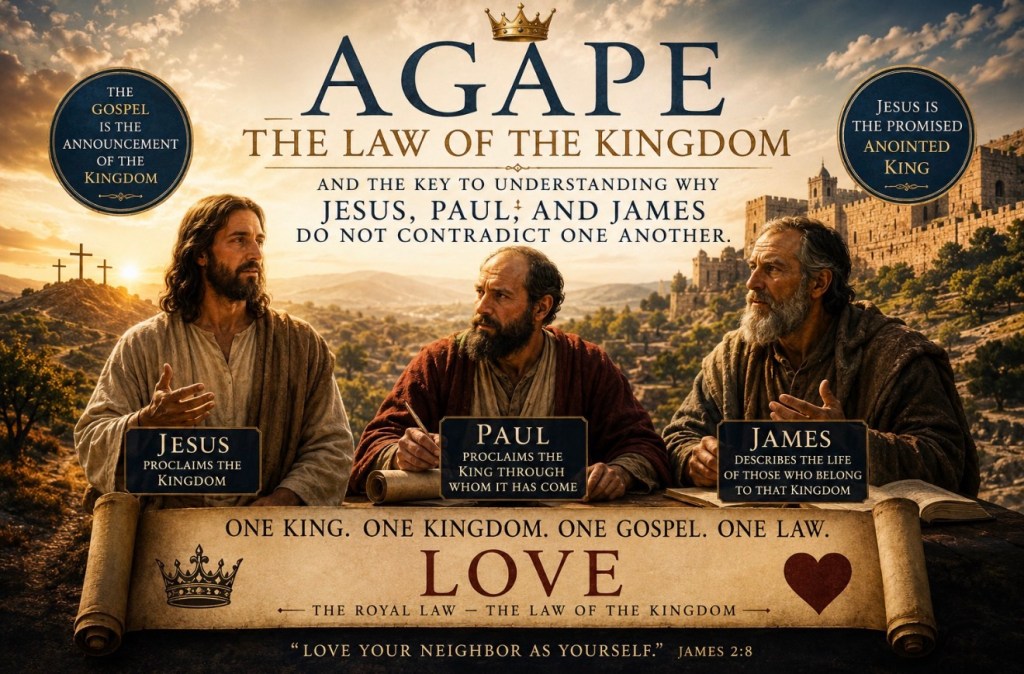
The Key to Understanding Why Jesus, Paul, and James Do Not Contradict One Another
Few passages in Scripture have generated more theological debate than James 2. For centuries, Christians have wrestled with what appears to be a contradiction between James and Paul.
Paul writes:
“For we conclude that a person is justified by faith apart from the works of the law.” (Romans 3:28)
James writes:
“You see that a person is justified by works and not by faith alone.” (James 2:24)
Some have concluded that James is correcting Paul.
Others have gone even further, arguing that Paul himself shifted the focus of the Gospel away from the Kingdom proclaimed by Jesus. According to this view, Jesus preached the Gospel of the Kingdom to Israel while Paul later proclaimed a different gospel centered on justification by faith for the Gentiles.
Both conclusions rest upon the same assumption: that Jesus, Paul, and James are proclaiming different messages.
The New Testament presents a very different picture.
Jesus announces the Kingdom.
Paul proclaims the King through whom that Kingdom has come.
James describes the life of those who belong to that Kingdom.
Rather than presenting competing gospels, they proclaim one Gospel from three complementary perspectives.
James 2 provides one of the clearest demonstrations of this unity, but only if the chapter is allowed to unfold in the order James himself presents it.
Before turning to James, two previous studies provide important background for this discussion.
The first concerns the Greek word euangelion. As explored in an earlier article, the word “gospel” originally referred to the announcement that a king had ascended his throne and that his reign would bring peace, justice, and blessing to his people. The Gospel is fundamentally the announcement of a Kingdom.
The second concerns the word Christos. “Christ” is not Jesus’ surname but His royal title. It means God’s promised Anointed King, the One through whom the prophets declared God’s Kingdom would finally come. If euangelion announces the Kingdom, Christos identifies the King whose reign that Gospel proclaims.
A third word will also prove important: pistis. While often translated simply as “faith,” the word carries the richer sense of trusting faithfulness, covenant loyalty, and faithful allegiance. That fuller meaning becomes essential for understanding both Paul and James.
With those foundations established, the argument of James can now be read on its own terms.
The Verse That Unlocks James 2
Most discussions of James 2 begin in verse 14.
“What good is it, my brothers and sisters, if someone claims to have faith but does not have works? Can such faith save him?”
That is understandable, since this begins James’ famous discussion of faith and works.
It is not where James begins.
James begins by confronting partiality.
A wealthy man enters the assembly and is welcomed with honor.
A poor man enters and is treated with contempt.
James condemns this behavior because it contradicts the character of God’s Kingdom.
Then he explains why.
“Indeed, if you fulfill the royal law according to the Scripture, ‘Love your neighbor as yourself,’ you are doing well.” (James 2:8)
This verse is the interpretive key to everything that follows.
James does not begin with justification.
He does not begin with faith.
He begins with the law that governs God’s Kingdom.
Everything that follows grows out of that reality.
The Royal Law Is the King’s Law
James calls love the royal law.
The Greek phrase is nomon basilikon (νόμον βασιλικόν).
The adjective basilikos means “royal,” “kingly,” or “belonging to the king.”
James is identifying whose law this is.
It is the King’s law.
Because it is the King’s law, it is also the law that governs His Kingdom.
For that reason, referring to it as the Law of the Kingdom simply makes explicit the Kingdom implications already present in James’ language.
James returns to this same idea throughout his letter.
In James 1:25 he speaks of the “perfect law of liberty.”
In James 2:8 he calls it the “royal law.”
In James 2:12 he instructs believers to “speak and act as those who are to be judged by the law of liberty.”
These are not different laws.
They are different descriptions of the same Kingdom reality.
The King’s law is perfect because it restores humanity to its intended purpose.
It is liberating because it frees people from the destructive power of sin.
It is royal because it belongs to the King.
Jesus Revealed the Law of the Kingdom
None of this would have surprised the first disciples.
Jesus began His ministry proclaiming:
“The time is fulfilled, and the Kingdom of God has come near. Repent and believe the Gospel.” (Mark 1:15)
The Gospel Jesus proclaimed was the announcement that God’s Kingdom had arrived.
Every kingdom has a king.
Every king governs according to a law.
The obvious question therefore becomes:
What law governs the Kingdom of God?
Jesus answered that question directly.
When asked which commandment was greatest, He replied:
Love the Lord your God with all your heart, soul, mind, and strength.
Love your neighbor as yourself.
Then He concluded:
“On these two commandments hang all the Law and the Prophets.” (Matthew 22:40)
Jesus was not reducing the Law.
He was revealing its foundation.
Love is the law from which every other command finds its meaning.
The Sermon on the Mount demonstrates what this law looks like in practice.
Love your enemies.
Pray for those who persecute you.
Forgive others.
Show mercy.
Care for the least.
The parable of the Good Samaritan shows what loving one’s neighbor actually looks like.
Jesus’ final command to His disciples summarizes His entire ministry:
“Love one another as I have loved you.”
Agape is not simply one Christian virtue among many.
It is the governing principle of God’s Kingdom.
James Applies the Teaching of Jesus
Once this Kingdom context is recognized, James’ argument becomes remarkably straightforward.
James is not introducing a debate about earning salvation.
He is confronting Kingdom citizens whose lives contradict the King’s law.
Their confession is orthodox.
Their conduct is not.
They confess Jesus as Lord while humiliating the poor.
They profess faith while withholding mercy.
They claim allegiance to the King while violating the law of His Kingdom.
That is why James reminds them of the royal law before he ever begins discussing faith and works.
Only then does he ask:
“What good is it, my brothers and sisters, if someone claims to have faith but does not have works?”
The context never changed.
James is still talking about the Law of the Kingdom.
Notice the examples he gives.
A brother lacks food.
A sister lacks clothing.
Someone offers kind words but refuses practical help.
Mercy is withheld.
Favoritism is shown.
Every example James provides is an expression—or failure—of agape.
These are not random good works.
They are works of love.
They are the visible expression of the law that governs God’s Kingdom.
This observation also explains why James is the only biblical author to use the phrase “faith alone.”
The phrase appears only once in the entire New Testament:
“A person is justified by works and not by faith alone.”
What kind of “faith alone” is James rejecting?
The chapter itself provides the answer.
It is a faith that sees a hungry brother and does nothing.
It is a faith that confesses the right things while refusing to embody the King’s law.
It is not living faith because it does not participate in the life of the Kingdom.
Abraham and Rahab
James then turns to Abraham and Rahab.
These examples are often read as though James has shifted from discussing love to discussing meritorious obedience.
He has not.
Abraham’s willingness to offer Isaac was not an attempt to earn covenant relationship with God.
It was the mature expression of a lifetime of faithful allegiance.
James explicitly says that Abraham’s faith was working together with his works and that his faith was brought to maturity through them.
His works revealed the reality of his pistis.
Rahab’s story makes the same point.
She protected the spies because she had come to trust the God of Israel.
Her actions flowed from faithful allegiance expressed through courageous love.
In both cases, works did not replace faith.
Works revealed living faith.
Does James Contradict Paul?
The apparent contradiction between James and Paul disappears once each writer is allowed to answer his own question.
Paul asks:
How does someone enter covenant relationship with God?
James asks:
What does the life of someone in covenant relationship with God actually look like?
Paul’s concern is covenant entrance.
James’ concern is covenant life.
Romans 3:28 therefore deserves careful attention.
Paul writes:
“For we conclude that a person is justified by faith apart from the works of the law.”
The phrase “works of the law” is essential.
Paul is not contrasting faith with love.
He is contrasting faithful allegiance to King Jesus with reliance upon the works of the Mosaic Law as the basis of covenant standing.
Throughout Romans, Paul argues against the idea that circumcision, Torah observance, dietary regulations, or the covenant markers of the Mosaic covenant establish one’s standing before God.
They do not.
All have sinned and fall short of God’s glory.
Justification comes through God’s gracious action in Christ and is received through pistis—faithful allegiance to God’s Anointed King.
Paul’s point is not that love is unnecessary.
His point is that covenant relationship is not established through the Mosaic Law.
James’ point is that covenant relationship cannot remain lifeless.
These are complementary truths, not contradictory ones.
Paul Describes the Same Kingdom Life
The harmony becomes unmistakable when Paul’s letters are read beyond Romans 3.
In Romans 13 he writes:
“The one who loves another has fulfilled the law… Love therefore is the fulfillment of the law.”
In Galatians he writes:
“The whole law is fulfilled in one statement: Love your neighbor as yourself.”
James quoted exactly the same command.
Then Paul makes one of the clearest statements in all of Scripture:
“For in Christ Jesus neither circumcision nor uncircumcision accomplishes anything; what matters instead is faith working through love.” (Galatians 5:6)
Notice what Paul does not say.
He does not say faith alone is all that matters.
He says the only thing that counts is faith expressing itself through love.
That is precisely James’ argument.
Paul presses the point even further in 1 Corinthians 13.
“If I have all faith so that I can move mountains, but do not have love, I am nothing.”
Mountain-moving faith without love amounts to nothing.
James says faith without works is dead.
Paul says faith without love is nothing.
Both are describing the same reality.
Living faith always becomes visible through agape.
Does Paul Contradict Jesus?
The debate between James and Paul is ultimately part of a much larger misunderstanding.
Some have argued that Jesus proclaimed the Gospel of the Kingdom while Paul later proclaimed a different gospel centered on justification by faith.
The New Testament knows nothing of two gospels.
Paul begins Romans by describing his message as “the Gospel of God… concerning His Son.”
The Gospel Paul proclaims is the announcement that Jesus is God’s promised King.
Likewise, the book of Acts repeatedly describes Paul’s ministry as proclaiming the Kingdom of God.
The final verses of Acts summarize Paul’s ministry this way:
“Proclaiming the Kingdom of God and teaching about the Lord Jesus Christ…” (Acts 28:31)
That summary is profoundly significant.
Paul proclaims the Kingdom.
He teaches the King.
This is exactly what should be expected.
Euangelion is the announcement of the Kingdom.
Christos identifies the King.
Jesus emphasizes the arrival of God’s Kingdom.
Paul emphasizes the identity and saving work of God’s King.
James emphasizes the life of those who belong to that Kingdom.
The emphasis changes.
The Gospel does not.
One King. One Kingdom. One Gospel. One Law.
The unity of the New Testament becomes remarkably clear once the Kingdom remains at the center of the story.
Jesus announces the Kingdom.
Paul explains how humanity enters that Kingdom through faithful allegiance to King Jesus rather than through the works of the Mosaic Law.
James describes what life within that Kingdom looks like.
The governing law of that Kingdom is agape.
This is why faith and love are never presented as rivals.
Faithful allegiance brings people into covenant relationship with the King.
Love is the law that governs life under His reign.
The works James describes are simply the visible expression of Kingdom citizens learning to live according to the character of their King.
The apparent contradictions disappear because they were never contradictions at all.
Jesus, Paul, and James are not proclaiming different messages.
They are proclaiming one Gospel.
The Gospel of God’s Kingdom.
The Gospel of God’s Anointed King.
The Gospel that calls humanity into faithful allegiance and then patiently forms its citizens into a people whose lives increasingly reflect the law of that Kingdom.
The law of agape.
For where the King truly reigns, His law is lived.
And where His law is lived, love becomes visible.


God bless you, Chris! I really appreciate your perspective and approach to understanding the Bible. Do you have ways for people to reach out to you to discuss? I would love to know more about your beliefs.
LikeLike