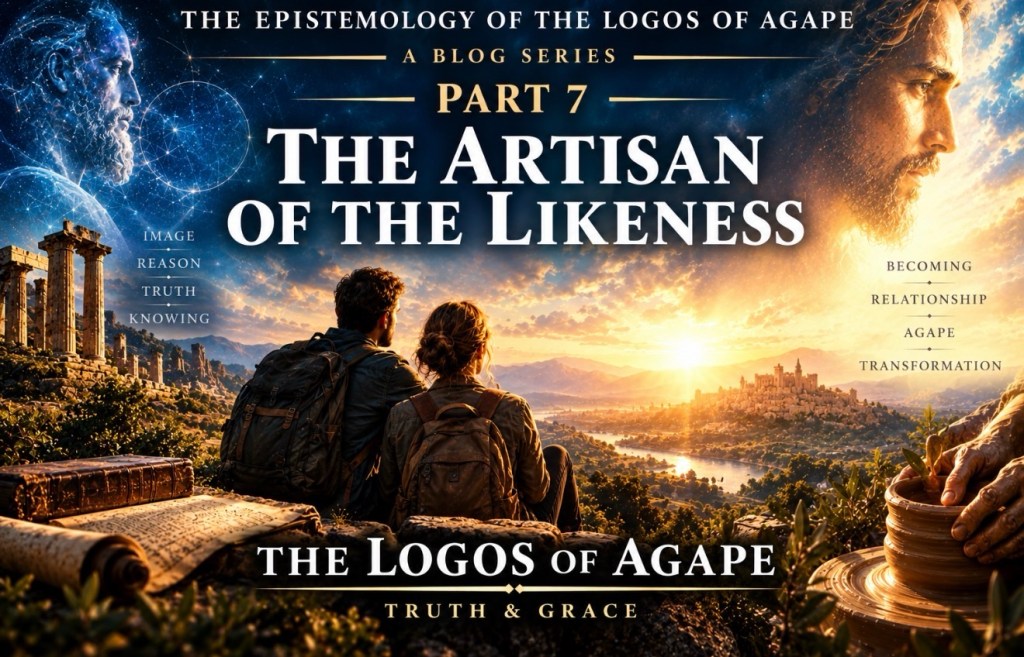
The Artisan of the Likeness
At the close of our last chapter, we arrived at a staggering cosmic realization: the underlying structural logic of the universe is not cold mathematical geometry, but self-giving, cruciform love. Jesus is the Logos of Agape made flesh.
But this realization immediately forces a transition from cosmic architecture to human anthropology. If the universe is structured by Agape, and if Jesus is what that looks like in a human life, then what does that mean for us? Why are we the specific creatures who can look at the cross and recognize it as the ultimate definition of reality?
To understand the connection between the Logos out there and the human experience in here, we have to look to one of the earliest Christian theologians, St. Irenaeus of Lyons. In the second century, Irenaeus wrote a brilliant passage that explains exactly why the historic arrival of a visible Savior changes how we understand our own design:
St. Irenaeus of Lyons (Against Heresies, V.16.2):
“For in times past it was said that man was made after the image of God, but it was not [actually] shown; for the Logos was as yet invisible, after whose image man had been made. Wherefore also he did easily lose the likeness. When, however, the Logos of God became flesh, He confirmed both these: for He both showed forth the image truly, since He became Himself what His image was; and He re-established the likeness after a sure manner, by assimilating man to the invisible Father through means of the visible Logos.”
What Irenaeus is saying cuts right to the heart of the blueprint we established in Part 4. For centuries, humanity had a vague, haunting intuition that we were made for something higher. We felt the pull of a moral conscience, the desire to track truth, and a secret longing to become a creature shaped by Agape.
We knew we bore an Image—our baseline human equipment of reason and free will. But because the Logos was invisible, we had no concrete model to copy. We had a map, but we didn’t know what the destination looked like—and as a result, we easily lost the Likeness.
But when the Logos became flesh, the invisibility ended. In Jesus, God put the model on physical display. Jesus shows us exactly what our hardwired Image was designed for from the very beginning: to use our human freedom to choose to live in the active likeness of God’s self-giving love.
Whether we consciously realize it or not, this is the exact way of being that every human being secretly desires to achieve. We are called to be the artisans of this transformation, turning the mirror of our soul away from self-preservation and toward the radiant beauty of the true Logos.
The Two Rails Finally Meet
This is the exact coordinate where the two rails of our entire series finally crash together.
One path began with our objective, intellectual experience of reality. We discovered that the world has an intelligible structure and that human minds can track truth. That path moved along a specific trajectory:
Logos → Intelligibility → Knowing → Truth.
The other path began with our subjective, internal experience of the heart. We discovered our insatiable hunger for meaning, relational communion, and the persistent desire to become whole. That path moved along a different trajectory:
Image → Becoming → Relationship → Agape → Transformation.
And now they meet. Because the Logos is revealed in Jesus, we now know that the Logos is the Logos of Agape.
The One who makes the physical laws of the universe intelligible is the exact same One who defines self-giving love on a Roman cross. The One who reveals Agape is the very Destination whose Image we bear.
This explains the deepest aches of the human condition we have been tracing. Why do we desperately want to know? Why do we possess a restless longing to become? Why do we recognize objective goodness instead of reducing it to personal utility?
Because we were made for communion with the One who is Agape—the One in whom absolute truth and radical grace are perfectly united.
The goal of the Creator was never to build biological computers that could think abstractly. The goal was to create free offspring who could actively choose to embody Agape.
God grants us the ability to track truth because truth is the framework of love that rescues us from illusion. He infuses that truth with grace because His voice is designed to heal our wounds rather than destroy our souls. And He gives us Jesus, the Logos made flesh, so that we can finally pick up our tools as artisans and see exactly what the model looks like.
Becoming Fully Human
The Logos of Agape tells us that knowledge was never meant to remain detached, cold information trapped inside our skulls.
- Knowledge serves relationship.
- Reason serves communion.
- Truth serves restoration.
The purpose of knowing the One who is Agape is not to win a theological argument or possess a list of flawlessly correct, inerrant propositions about God. The purpose of knowing Him is to let our phroneō—our gut-level, instinctual orientation—empty itself so we can become just like Him.
This is the miracle at the center of the whole thing: God gives us the Logos so that Agape can become fully intelligible to creatures made in the image of Agape.
And if that is true, one haunting question remains.
If we have been given this deep, hardwired capacity to recognize the Logos of Agape, where exactly does that recognition happen within us? Where do we encounter the demanding law of Agape before we have ever learned how to read a Bible, articulate a creed, or build a theological system?
Where does that internal, quiet awareness come from that tells us—sometimes even against our own survival instincts and self-interests—that a vulnerable stranger matters?
Where does the voice come from that breaks through our justifications and whispers:
This is right.
This is wrong.
You should not have done that.
You need to go back and make it right.
Perhaps the Logos of Agape has not only been revealed historically outside us in the person of Jesus.
Perhaps there is also an ancient, unshakeable witness written directly into the very fabric of our being.
And that is exactly where we go next.
 The Logos of Agape