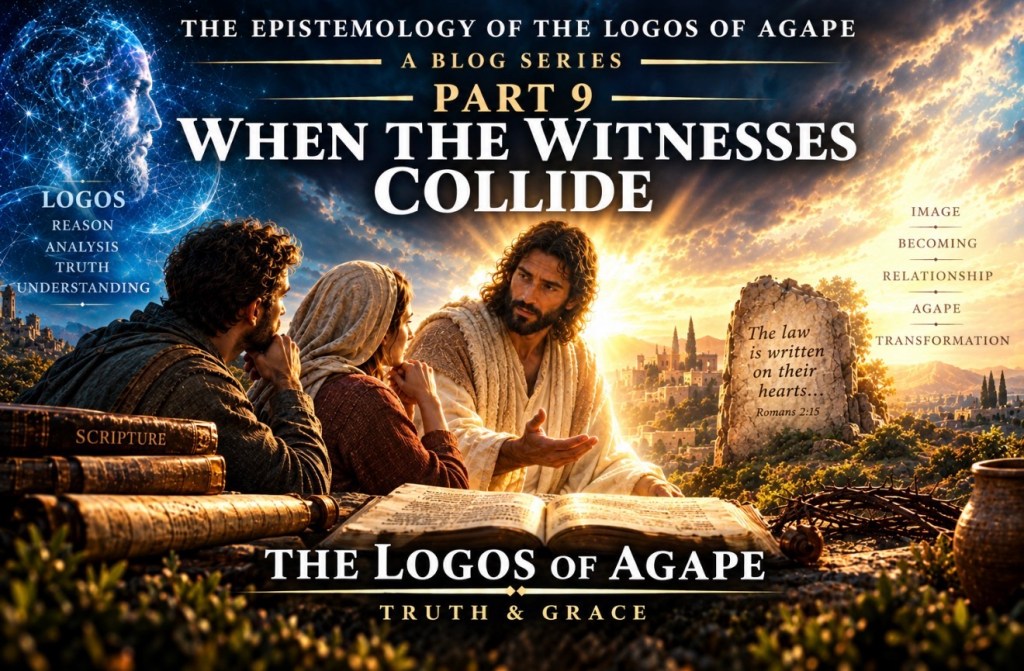
When the Witnesses Collide
At the close of our last chapter, we arrived at an agonizing epistemological crisis: we possess genuine, God-given witnesses to reality, but none of the witnesses we encounter within our human skin is mechanically perfect.
- Scripture is an inspired witness, but it’s a shadow and it comes to us mediated through human authors, ancient languages, and historical contexts.
- Conscience is an internal witness, but it can be numbed, self-deceived, and darkened by sin.
- Logos is our vital faculty of reason, but our logic can easily be weaponized to justify our own selfish desires.
So, what are we supposed to do when these faculties inevitably collide?
What happens when you read a passage of Scripture and interpret it to mean one thing, but your moral conscience screams that your interpretation is fundamentally incompatible with love, while your human reason seems frustratingly capable of defending either side? Which witness do you trust?
The answer begins with a premise we have already established: We do not need another finite shadow. We need Light. And this is precisely where the historical person of Jesus becomes the unshakeable center of our entire epistemology.
The Light
John begins his Gospel by introducing us to the cosmic Logos. The Logos was with God, the Logos was God, and the Logos became flesh. But John drops another critical description of this incarnate reality:
“The true light, which gives light to everyone, was coming into the world.” (John 1:9)
That specific language is vital. Light actually does something to an environment. Light alters our capacity to perceive reality. If a room is shrouded in pitch-black darkness, bringing more darkness into the room will never help you understand the shapes hidden inside it. The only functional answer is to turn on a light.
John is making a profound, category-shattering claim about Jesus: Jesus does not merely report data about God; Jesus perfectly reveals God.
In Him, the invisible Creator becomes visible. The transcendent becomes personally knowable. The Word becomes flesh, the Light floods the darkness, and suddenly we discover what to do with our imperfect, human witnesses.
We bring them out of the shadows and we stand them up directly in the Light.
Re-interpreting the Shadows
This is why the New Testament’s deliberate description of earlier revelation as a “shadow” is so liberating. A shadow is not an optical illusion. A shadow is not a lie. A shadow is real. But it is fundamentally incomplete. It proves that an object exists, mapping its basic silhouette, without ever giving you the object’s actual substance.
The Old Testament relentlessly points beyond its own borders:
- The law points beyond itself.
- The priesthood points beyond itself.
- The sacrifices point beyond themselves.
- The temple points beyond itself.
Jesus validated this exact trajectory when He told the religious elite that the written Scriptures find their ultimate meaning by testifying about Him. This means that when we approach a difficult text, our primary question can never simply be, “What do these words say?” The deeper, more mature question must be:
“Where is this passage pointing? What is its telos? What substance cast this specific shadow?”
When we bring those ancient shadows into the clear light of Christ, the scattered pieces of the puzzle begin to converge beautifully. We discover that the Law and the Prophets have always been moving toward a singular destination: Love.
Jesus states plainly that the entire structural weight of the Law and the Prophets hangs on two commands: loving God and loving your neighbor (Matthew 22:40). The Greek word he uses for “hang” is kremannymi: meaning to suspend a heavy weight from a fixed, permanent peg. Love is the architectural anchor of reality. If you remove that peg, the entire building collapses.
Paul echoes this by declaring that love is the absolute fulfillment of the law. James calls it the “royal law.” John crowns it by stating that God is love.
The telos of divine revelation was never mindless compliance to an encrypted catalog of external commands. The telos is the relational formation of people who love God and love one another. The law of God is ultimately the law of Agape and Jesus does not merely lecture us on that law; He physically embodies it.
The Cross Defines the Term
This is why the execution of Jesus is the absolute center of human history. If we want to know what Agape actually looks like, we do not have to guess, philosophize, or construct abstract theories. We can simply look at the cross.
“By this we know love, that he laid down his life for us.” (1 John 3:16)
Notice how John defines the term: Agape is made visible exclusively through radical self-giving. It is not a fleeting sentiment. It is not cheap affection. It is the voluntary emptying of oneself for the life of the other.
The cross is the definitive, unmediated revelation of what the Creator of the cosmos is actually like. And the moment that cosmic Light turns on, the earlier shadows of Israel’s history instantly begin to make sense.
The blood, the priesthood, the temple, the lamb, the suffering servant, the covenants, and the language of atonement; these things were not an accidental collection of random religious rituals. Together, they were constructing a highly sophisticated theological vocabulary. And the cross brings that entire vocabulary into the sharpest possible focus. Jesus does not merely tell us what Agape means; He shows us.
Cleansing the Internal Witness
But this returns us to the agonizing problem of our conscience. If our syneidēsis is a genuine witness to the law written on our hearts, but our consciences have been darkened, hardened, and cauterized by a history of selfishness, what does God do to repair the damage?
The answer recorded in the letter to the Hebrews is striking:
“How much more will the blood of Christ… cleanse our conscience from dead works to serve the living God?” (Hebrews 9:14)
That is an extraordinary diagnostic statement. The human conscience is actively cleansed for a specific operational purpose: so that we can successfully serve the living God.
But what does it actually mean to serve Him? Based on everything we have built across this series, serving God cannot mean the blind performance of rigid, legalistic duties. If the law of God is the law of Agape, then serving God means actively participating in the life of self-giving love for which we were designed.
The cleansing of your conscience is not a legal fiction designed to merely make you feel less guilty. It is an act of spiritual surgery preparing you for communion. God is actively restoring your biological capacity to live the life you were created to live.
From Temple to Human Being
To understand the depth of this restoration, we have to look at the ancient mechanics of the temple. In the biblical imagination, the temple was the literal intersection of heaven and earth—the physical dwelling place of God’s localized presence.
Because it housed the Divine, the sanctuary was treated with immense care. It had to be systematically cleansed and purified with sacrificial blood so that it could remain a fitting environment for God’s presence. The point was never that God was dirty and needed cleanup; the point was that the space had to be intentionally prepared to host His glory.
Now, the author of Hebrews takes that massive cosmic temple imagery and applies it to something shockingly intimate: the human conscience.
This is the beautiful trajectory the biblical narrative has been making from the very first page of Genesis: God fiercely desires to dwell within humanity. The tabernacle and the temple were merely localized, temporary architectural shadows of that deeper desire.
When John records the arrival of the Logos in his Gospel, he writes that the Word became flesh and “dwelt” among us (John 1:14). The Greek word is skēnoō: literally, He pitched His tabernacle.
In Christ, that movement reaches its breathtaking conclusion: You have become the temple. Paul looks at the early believers and asks, “Do you not know that you are God’s temple and that God’s Spirit dwells in you?”
The dwelling place of the Creator is no longer a stone building in a specific geographic coordinate. God has taken up residence inside the human person. But if the human heart (lēb) is to host the Living God, the internal darkness must be driven out.
The blood of Christ cleanses the human conscience because God intends to comfortably live there.
The Image Begins to Heal
When the internal sanctuary is prepared, and God comes to dwell within us, the foundational identity we established in Part 4 finally begins to heal: the damaged Image of God within us is restored.
An image can be cracked. An image can be obscured by dust, distortion, and a history of bad moral choices. But when the Holy Spirit takes up residence within a human being, He does not hand us a new rulebook or drop more data into our brains. God gives us Himself.
And that completely revolutionizes the entire purpose of the Christian life. We are no longer students trying to memorize correct data about a distant Deity. We are patients being transformed into people who actively reflect the character of our Creator.
The Image is being systematically healed.
And what does God look like? Agape.
What does the healed image look like? Agape.
What does it mean to become like God? It means becoming increasingly capable of participating in the self-giving, cruciform love revealed in Christ.
This is why the law written on the heart matters. This is why conscience, Scripture, and Logos matter. They are all distinct, inspired channels pointing toward the exact same target. But the witnesses themselves are not the destination. Christ is.
The Text Without a Context is a Con
This Christological priority completely alters how we handle the apparent conflicts between Scripture and conscience.
Suppose you encounter an ancient biblical passage that seems to portray the character of God in a way that is fundamentally incompatible with the enemy-loving, self-emptying character of Jesus. How do you respond?
You cannot simply say, “My modern conscience disagrees, therefore this passage is wrong.” That would flatten your subjective conscience into the final, absolute authority of your life. But neither can you say, “The text says it, therefore I must violently crush my conscience.” That would treat a partial shadow as though it were the ultimate Light.
Instead, you bring both witnesses directly to Christ. You look at the text through His eyes and ask:
- What does this passage reveal within the grand arc of human history?
- What unique literary genre is this author utilizing?
- Where is this specific shadow pointing, and how does it participate in the unfolding narrative of God?
- Above all: What does the Logos made flesh reveal about the God this passage is witnessing to?
Jesus becomes the absolute interpretive center of the library. Not because we have decided Jesus is more convenient than the Old Testament, but because Scripture itself relentlessly commands us to look at Him. The shadows do not get destroyed by the Light; they are finally explained by it.
There is an old, classic hermeneutical saying that hits with devastating accuracy here: “A text without a context is a con.”
A isolated verse can say something that appears perfectly clear when you violently rip it away from the narrative surrounding it. But a text does not exist in isolation. It exists within a vital context. And if the epistemological argument of this series is correct, the ultimate context for every scriptural witness is not merely the paragraph before it or the chapter after it.
The ultimate context is Reality Himself.
Paul quotes the Greek poets in Athens: “For in him we live and move and have our being.” John records that the Logos is the true Light who gives light to everyone. Jesus states that the Scriptures find their meaning in Him.
When you lock those witnesses together, a beautiful reality emerges: If Jesus is the Logos through whom all things were made, and if He is the true Light of the world, then Jesus is not one more piece of evidence sitting on the table for you to analyze. Jesus is the very environment in which all evidence exists.
And if the Logos who orders that environment is Agape, then the law of love is not a secondary religious rule. It is the literal moral shape of reality itself.
That means Scripture cannot faithfully be interpreted apart from the Christ to whom it points. Conscience cannot be interpreted apart from the Love to which it bears witness. Reason cannot be interpreted apart from the Logos that makes it intelligible.
The witnesses desperately need context and the ultimate context is Jesus.
When you sever a verse from its Christological context, you commit an epistemological con. You take a genuine shadow and mistake it for the solid object. You take a partial, historical revelation and treat it as the absolute whole. You take an inspired witness and accidentally turn it into an idol.
The text itself may be authentic. The witness may be real. But if you disconnect it from the self-giving character of Jesus, you can force that witness to testify to something it was never intended to establish.
Jesus is not the conclusion of our intellectual argument; He is the living context in which the entire human experience finally makes sense. He is the Light by which we see the shadows, the Logos by which we comprehend physics, the Image by which we recognize God, and the revelation of Agape toward which our conscience has been tracking all along.
Therefore, when a particular interpretation of Scripture appears to flatly contradict the character of Jesus, the answer is never to silence your conscience. The contradiction itself becomes a divine invitation to look again.
- Perhaps you have misunderstood the ancient cultural context.
- Perhaps you have misread the literary genre.
- Perhaps you have mistaken a historical imperfect shadow for an eternal reality.
- Perhaps you have allowed an imperfect, human witness to speak beyond what it can actually tell you.
The goal of reading the Bible is never to force the text to say whatever you want it to say. The goal is to let Scripture do what it was designed to do: witness to Jesus. And that requires a relentless commitment to a Christological context.
The context is not an escape hatch away from the Bible; the context is the only space where you can finally hear the Bible faithfully.
Cleansing the Vision
If our internal conscience has been darkened by our own history of selfishness, simply telling ourselves to “try harder” will never solve our epistemological crisis. A blind eye cannot force itself to see.
The conscience needs Light. It needs blood. It needs systemic transformation. The exact same Christ who reveals the Father outside us simultaneously begins healing the intuitive faculty inside us that recognizes what love requires.
The result of this sophisticated epistemology is beautiful: We do not become people who blindly obey whatever we think a literalistic text says, nor do we become people who blindly follow our unformed, emotional instincts.
Instead, we become fully human offspring whose reason is illuminated by the Logos and whose conscience is progressively formed by Agape. We are no longer trying to eliminate our imperfect, human faculties; we are finally learning how to bring our imperfect witnesses directly into the healing presence of the Perfect Revelation.
When the Witnesses Collide
So now, I think we can finally answer the question we ended with in our last chapter: What do we do when the witnesses collide?
We do not pretend the collision is not real. We do not simply declare one imperfect witness to be magically infallible and violently silence the others.
Instead, we bring the witnesses directly to Christ.
- We allow the Light to illuminate the historical shadows.
- We allow the Logos to clarify and correct our fractured reasoning.
- We allow Agape to reveal the absolute moral direction of reality.
- And we allow Christ to cleanse and transform the very conscience through which we recognize that reality.
This does not mean that every difficult theological question suddenly becomes easy. It means we finally possess an unshakeable center.
Creation witnesses. Reason witnesses. Conscience witnesses. Scripture witnesses. Tradition and human experience are witnesses. But all of them ultimately stand before Christ. And Christ is not merely another equal witness sitting among them at the table.
He is the Light by which the witnesses are seen. He is the Logos through whom reality becomes intelligible. He is the image of the invisible God. He is the fullest revelation of the Father. And the God He reveals is Agape.
That gives us a beautiful way forward. But it also hands us a terrifying warning.
Because it is entirely possible to possess an inspired witness and ruthlessly refuse to listen to it. It is possible to memorize the text of Scripture and still completely fail to see the living Person it is pointing toward. It is possible to have God-given reason and use it strictly to defend what we already selfishly want to believe. It is possible to have a conscience and repeatedly silence its whispers until it becomes impossible to hear.
And it is entirely possible to construct an entire theological system that successfully explains away every single witness that dares to challenge us.
Perhaps the deepest epistemological failure is not that we possess imperfect human witnesses. Perhaps it is that we sometimes flatly refuse to let the Light correct them.
And that is exactly where we have to go next.
Because what happens when we encounter a theological system that actively demands we silence our conscience, distort the definition of love, or completely explain away the self-emptying character of Jesus just to preserve the boundaries of the system? What happens when we choose the abstract system over the living witnesses? What happens when we ignore the witness entirely?
That is where the next part begins.
 The Logos of Agape