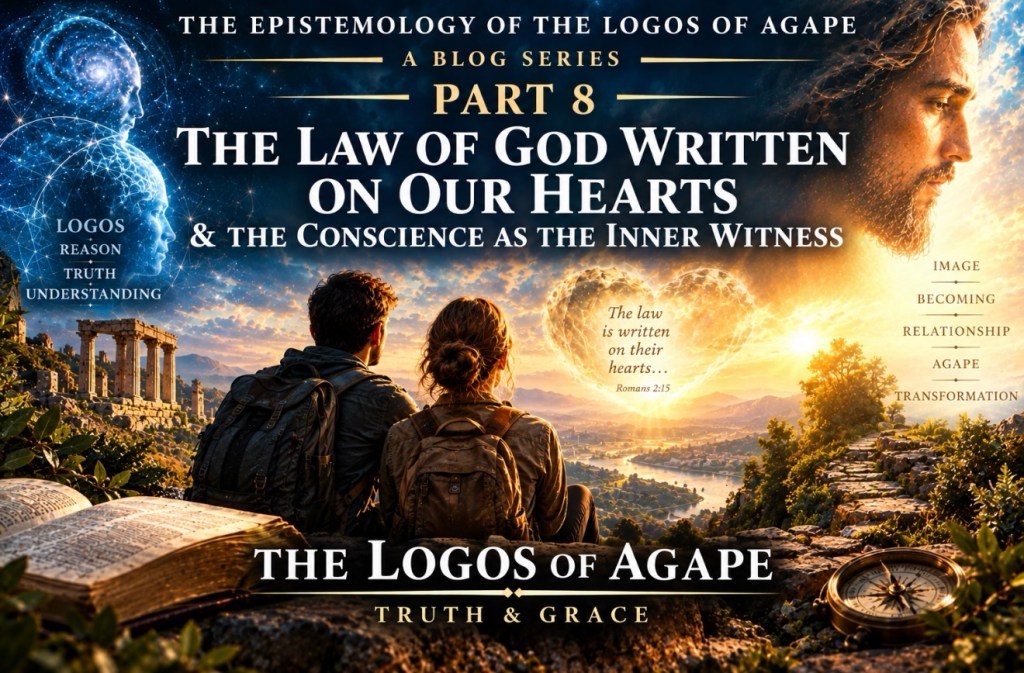
The Law of God Written on Our Hearts & The Conscience as the Inner Witness
So far in this series, we have talked extensively about the Logos.
We have explored the human capacity to reason, to recognize complex patterns, to ask deep existential questions, to distinguish possibilities, and to relentlessly pursue what is objectively true.
But abstract knowledge was never meant to be the final destination. At some point, knowledge has to cross the threshold into active life.
We do not merely want to know what is factually true; we want to know what is good. And we do not merely want to know what is good; we desperately want to become the kind of people who actually live according to what is good.
But that raises a fundamental question: How do we actually know what is good?
Something deep within our biology seems to instinctively recognize that some ways of living are inherently better than others. We universally recognize courage as better than cowardice, honesty as better than deception, compassion as better than cruelty, generosity as better than selfishness, and love as better than hatred.
Crucially, we recognize these stark differences even when doing so costs us something personal.
We can know with absolute certainty that we ought to tell the truth, even when a lie would immediately benefit our bank accounts. We can know that we ought to extend forgiveness, even when nursing a bitter resentment feels far more satisfying. We can recognize that another person’s suffering matters, even when we have absolutely nothing tangible to gain from helping them.
There is an internal compass within us that does not merely ask, “What do I want?” It relentlessly demands to know:
“What ought I to do?”
And this is precisely where the biblical framework of the law of God written on the heart becomes so critical to our epistemology.
The Law Written on the Heart
The apostle Paul gives us one of the clearest statements of this internal reality in his letter to the Romans. Discussing the nations outside Israel who do not possess the written text of the Torah, yet who naturally do what the moral law requires, Paul writes:
“They show that the work of the law is written on their hearts, while their conscience also bears witness, and their conflicting thoughts accuse or even excuse them…” (Romans 2:15)
That is an extraordinary claim. Paul is explicitly stating that God’s moral structure is not encountered solely through an external, written document. There is an ancient, unshakeable inner witness to it.
And Paul calls that inner witness the conscience.
When Paul uses the phrase “written on their hearts,” his Jewish mind is structurally echoing the great covenantal promise of Jeremiah 31:33: “I will put my law within them, and I will write it on their hearts.” But Paul expands this scope globally. He argues that this internal inscription is a universal human reality.
The conscience is not the law itself; it is our active awareness of the law. It is the inward co-witness that stands up within us and whispers, “This is right,” or “This is wrong,” or perhaps most painfully, “I know I should have done something different.”
This perfectly explains the framework of human purpose we have been building throughout this series. Human beings do not merely possess the intellectual capacity to know facts. We have a deep, hardwired sense that we are supposed to become something whole. We know, at least dimly, that we were designed for a particular kind of life.
And the biblical claim is that the structural shape of that life has been written directly into the fabric of our being.
Conscience as Witness
Paul’s specific Greek word for conscience is syneidēsis.
The word itself was already a well-established piece of the secular Greek moral vocabulary in the ancient Greco-Roman world. It literally carries the idea of “joint-knowledge” or “knowing with oneself”, particularly in direct relation to one’s own moral responsibility and past actions.
And once again, we see a brilliant methodology that we have repeatedly encountered across this series: The apostles were never afraid of ideas that existed outside Israel’s Scriptures.
They did not fear secular philosophy; they recognized truth wherever they encountered it.
We saw Paul model this on the streets of Athens, where he listened to pagan poets, recognized their genuine insights, and then showed how those fragments converged on the God revealed in Christ. We saw John do the exact same thing with the word Logos—taking a popular Greek philosophical concept and filling it with incarnate reality.
Paul’s use of syneidēsis belongs to that same beautiful, subversive pattern. He is not simply borrowing a foreign philosophical idea and blindly importing it into Christian dogma. He recognizes a genuine, undeniable feature of the universal human experience and places it accurately within the larger, unfolding revelation of God.
This also has an important Hebrew dimension. The Hebrew Bible has no single technical word that maps perfectly onto the Greek concept of syneidēsis. Instead, much of what we would modernly describe as the conscience is expressed through the deeply holistic language of the heart—lēb or lēbāb.
In the biblical imagination, the heart is far more than the seat of fleeting emotions. It is the absolute center of thinking, desiring, intending, choosing, and responding. It is the primary engine from which a human being lives.
So when Paul pairs these two worlds, speaking about the law being written on the Hebrew lēb and the Greek syneidēsis bearing witness, he describes something profoundly consistent.
We are not morally empty, blank slates waiting for an external textbook to tell us what goodness means. We are purposeful offspring who have been intentionally designed for a specific way of being.
And somewhere deep within us, we already know it.
Logos and Conscience
This realization gives us the next critical piece of our epistemology. While both are essential, Logos and conscience perform two entirely different functions within the human psyche:
- Logos allows us to reason, analyze patterns, and ask whether a proposition is factually true.
- Conscience bears witness to moral obligation, confronting us directly with what we ought to do and who we ought to become.
Yet, when we approach the task of interpretation, both faculties are completely inseparable. This matters enormously when we talk about how we read Scripture.
Nobody simply reads a text without active interpretation. The absolute moment I open the pages of a Bible, I am dynamically using language, memory, reason, cultural comparison, textual context, logic, and human experience. I am using Logos.
But I am also, fundamentally, a moral creature. As I read, I am constantly asking what this text reveals about the character of God, what it asks of my life, and whether my specific understanding of it makes coherent moral sense. I am actively engaging the conscience.
We cannot interpret Scripture without Logos, and we cannot interpret Scripture without conscience. These are not optional, secondary filters that we add to the text; they are the fundamental, God-given human faculties through which we encounter, evaluate, and digest everything we know.
And that creates a massive, important problem.
Because neither faculty is perfect.
The Problem of a Darkened Witness
We have already established that sin fractures human freedom. But there is a deeper, more insidious dimension to sin that becomes critically important to our epistemology: Sin radically distorts human perception.
It does not merely cause us to make bad moral choices. It actively contracts our vision, making it harder for us to even see what the healthy alternatives are.
- A person who repeatedly chooses selfishness becomes increasingly blind to anything outside of self-interest.
- A person who routinely responds to another’s pain with indifference eventually loses the cognitive capacity to imagine that person’s suffering.
- A person who constantly justifies dishonesty will eventually stop experiencing dishonesty as a moral problem at all.
Our choices gradually freeze into habits. Our habits structurally shape our character. Our character dictates our daily perception. And our perception ultimately limits what choices we are even capable of imagining.
This is precisely what the biblical writers mean when they warn against a hardened heart. The problem is not necessarily that the person has never been exposed to the truth; the problem is that they have rendered themselves completely unable or unwilling to recognize it when it stands right in front of them.
The inner witness of the conscience can become profoundly warped. Paul goes so far as to describe consciences that have been defiled or even seared (1 Timothy 4:2). The Greek word he uses is kautēriazō—literally cauterized with a red-hot iron. A seared conscience has had its spiritual nerve endings burned away. It can no longer feel the visceral, gut-level phroneō of love.
Therefore, while the conscience is a very real witness, it is not an infallible witness.
And that distinction changes everything. I cannot simply say, “My conscience tells me this is right, therefore God says this is right.” To do so would be to turn my subjective conscience into an absolute god. But neither can I say, “My conscience is imperfect, therefore I should ignore it entirely.” That would mean discarding the primary intuitive faculty through which human beings encounter moral reality.
The correct path forward is far more demanding. The conscience must be consistently listened to, ruthlessly examined, and intentionally formed.
The Law of Love
What is the baseline moral reality toward which a healthy conscience is ultimately pointing?
This is the exact coordinate where everything we have been tracing across this series locks together. When asked to identify the core architecture of reality, Jesus states plainly that the entire library of human revelation hangs on two simple pegs: Agape God with everything you have, and Agape your neighbor as yourself (Matthew 22:40).
In Romans 13:10, Paul echoes this, writing that Agape is the absolute fulfillment of the law and that every commandment is summed up in the singular call to love your neighbor. James calls Agape the “royal law” in James 2:8, and John, as we have seen, synthesizes it into three words: God is love. (1 John 4:8&16)
So when we speak about the law written on the human heart, we are not talking about an arbitrary, hidden list of religious taboos or denominational rules. We are talking about the relational, moral shape of the life for which we were explicitly created.
The law of God is ultimately the law of Agape. And the conscience is the hardwired internal witness to that law.
This explains why your conscience can forcefully confront you even when there is no written rulebook telling you what to do. You encounter a stranger who is suffering. You instantly recognize that you possess the resources to help. And something silent within your chest whispers: You should.
You don’t reach that conclusion because you calculated a personal benefit. You don’t do it because an authority figure threatened you with punishment. You do it because your deep internal programming recognizes that Agape is exactly what ought to happen in this moment.
The Epistemological Crisis
But this brings us face-to-face with a problem that is far bigger than the fallibility of our conscience.
We have already established that Scripture itself is a unique, inspired witness. It is a genuine witness of God’s revelation across history. But as we uncovered in Part 5, if Scripture is the witness, it is not the final destination. The text itself uses the vocabulary of a “shadow” to describe its earlier iterations. A shadow is real. It proves a substance exists. It can reveal a basic silhouette and tell you something about the object casting it. But a shadow is never the substance itself.
Scripture is a genuine witness to the Logos, but it is not identical to the Logos.
This leaves us with two distinct witnesses sitting on the table in front of us: Scripture and Conscience. Both are authentic, God-given channels of awareness. But neither one is mechanically perfect.
- Scripture comes to us progressively and partially, mediated through human authors, ancient languages, distinct cultural perspectives, and a complex history of translation.
- Conscience comes to us mediated through human beings whose hearts can be darkened, hardened, and cauterized by a history of selfishness.
So, what are we supposed to do when they collide?
If Scripture were a flat, unmediated, dictated textbook dropped from heaven, the solution would be simple: read the page and mindlessly execute the data. But that is a modern illusion. The moment we open the text, we are forced to interpret it. And the very moment we interpret it, we are instantly utilizing our fallible Logos (reason) and our fallible conscience.
We cannot escape our humanity by appealing to our interpretation of the Bible. We have simply kicked the problem one level deeper. We have Scripture (a witness). We have conscience (a witness). And we have our reason, through which we try to synthesize them both. Yet our reason can be distorted, and our conscience can be darkened.
What happens when the witnesses appear to explicitly disagree?
What happens when you read a passage of Scripture and believe it commands a certain action, but your moral conscience screams that your interpretation is fundamentally incompatible with the self-emptying law of Agape? What happens when your logic tells you an interpretation is textually coherent, but your gut-level instinct recognizes that the final result looks completely contrary to the character of Jesus?
Which witness wins?
We have to be intensely honest about the massive epistemological problem we have created.
We cannot simply say, “Just trust Scripture,” because we still have to use human reason to decide what the Scripture actually means. We cannot simply say, “Just trust your conscience,” because our consciences can be numbed by cultural blind spots. We cannot simply say, “Just trust logic,” because human reason is notoriously excellent at justifying our own selfish desires.
We possess genuine witnesses. But we do not yet possess a perfect, unmediated lens.
And that means the ultimate question we have been building toward from the very first paragraph of Part 1 is now completely unavoidable:
How do we know what is ultimately real when the very witnesses through which we know are themselves imperfect?
Perhaps our mistake has been assuming that one of these finite witnesses could eventually solve the problem for us. What if the answer is not a better intellectual argument? What if the answer is not arbitrarily choosing written text over internal conscience, or conscience over text?
What if we need something that does not merely hand us another piece of information, but enters the room and reveals the witnesses for what they truly are?
Something that brings light into what has become dangerously dark. Something that allows us to see the shadows clearly. Something that can actively correct our distorted perception, telling us exactly what the law of love was pointing toward all along.
We have spent seven chapters learning to recognize the voices of the witnesses. In this chapter, we discovered that even the witnesses inside our own skin are fractured.
We are finally ready for the ultimate question:
What happens when the Light enters the room?
 The Logos of Agape