For more than a decade, conversations surrounding soteriology have often been framed around one central question: How does God’s sovereignty relate to human freedom? Much of the debate has centered around Calvinism, with many non-Calvinists arguing that the Calvinistic understanding of divine sovereignty creates a picture of God that is inconsistent with His revealed character as loving.
One of the most influential voices in the provisionist movement has been Leighton Flowers through his work with Soteriology 101. Provisionism has consistently argued against Calvinism on the grounds that God loves all people, genuinely desires all people to be saved, and that human beings possess meaningful freedom to respond to God’s invitation.
Again and again, provisionists have rightly pointed to passages such as John 3:16, 1 Timothy 2:4, and 2 Peter 3:9 to argue that God loves all people and genuinely desires all people to be saved. This conviction has become one of the movement’s defining critiques of Calvinism. If God eternally determines that some people will never receive salvation, then in what meaningful sense can it be said that He desires their salvation or loves them equally?
However, an important question has recently emerged within these discussions. If the reason Calvinism is rejected is that it presents a view of God that appears incompatible with divine love of all people, does that same concern apply to other theological systems that affirm exhaustive divine foreknowledge?
This question becomes especially important when discussing whether God can genuinely learn something. If Scripture describes God as discovering, experiencing, or coming to know something in real time, what does that imply about God’s relationship to the future?
If God Learns, the Conversation Has Already Changed
Recently, some provisionists have suggested that certain biblical passages genuinely portray God as learning or discovering something. However, they do this while maintaining a common overall stance that is critical of a theological system that is often called Open Theism. If they are going to maintain this, then they have missed an internal inconsistency in their claims.
Among the major Christian theological systems, open theism is the only one that consistently allows for the claim that God genuinely learns.
Why Other Systems Cannot Affirm God Learning
This is where the broader theological landscape becomes important.
Classical theism, Calvinism, Molinism, and traditional Arminianism all reject the possibility that God learns new information.
The reason is not merely theological preference. It is a logical consequence of their understanding of God and reality.
Classical theism affirms that God possesses timeless and exhaustive knowledge of all reality. Because God is not located within temporal succession, God does not move from ignorance to knowledge. All things are eternally present to God.
Calvinism likewise requires exhaustive divine knowledge because God’s eternal decree encompasses all events. The future is not unknown because God has eternally ordained whatsoever comes to pass.
Molinism argues that God possesses middle knowledge, meaning God eternally knows what every possible free creature would do in every possible circumstance. Before creation itself, God knows the complete history of the world He chooses to actualize.
Traditional Arminianism affirms genuine human freedom while still maintaining that God eternally knows the future decisions of creatures.
Each of these systems has significant differences from one another. They disagree about sovereignty, freedom, and the nature of divine action. However, they share one important conclusion: God does not discover new information about the future.
Therefore, if someone argues that God genuinely learns future realities, that argument does not fit within classical theism, Calvinism, Molinism, or traditional Arminianism. It moves toward open theism.
But this only addresses the first question. The deeper issue is not simply whether God knows the future. The deeper issue is whether exhaustive foreknowledge itself creates a problem for the claim that God is love.
The Love Problem Created by Exhaustive Foreknowledge
As noted earlier, many provisionists reject Calvinism because they argue that a God who unconditionally determines who will and will not be saved does not represent the biblical picture of a God who loves everyone.
This argument is based on an important moral intuition: love does not force a relationship.
If God is love, then God must genuinely desire the good of His creatures and genuinely offer them meaningful relationship with Himself.
However, the same concern must logically extend beyond Calvinism.
Consider the implications of any system that affirms exhaustive divine foreknowledge while also rejecting universal salvation.
Nearly all provisionists reject universalism. They affirm that there will be people who are ultimately not reconciled to God. The disagreement is often about why this happens and what freedom looks like in that process. But the conclusion remains that some will not be restored.
Now consider the implications.
If God eternally knew that a particular person would never freely respond to His love, would never enter into reconciliation with Him, and would ultimately experience eternal separation from God, then God knowingly created that person anyway.
The important point is not that God caused the person’s rejection. That would be the modal fallacy, and that argument should be rejected.
The Modal Fallacy Does Not Resolve This Argument
At this point, many readers immediately object, saying, but wait a minute, “doesn’t open theism depend upon rejecting the modal fallacy.”
That objection misses the point.
The modal fallacy concerns causation.
It asks whether God’s knowledge causes human choices.
This is not the argument being made here.
Assume, for the sake of discussion, that knowledge never causes the thing known.
Assume libertarian freedom.
Assume every person who rejects God does so entirely by their own free choice.
Nothing in this article changes.
Because the question being raised is not:
“Did God cause their rejection?”
The question is:
“Why did God create someone whose rejection He already knew with certainty?”
Those are entirely different questions.
The modal fallacy addresses whether knowledge determines an event.
It says nothing about why someone knowingly brings that event about by choosing to create a world in which they know it will occur.
Even if every criticism of the modal fallacy is granted, the argument presented here remains untouched.
Knowing an event does not necessarily cause an event.
However, the question is not causation. The question is love.
If a human parent knew with absolute certainty that having a child would result in that child experiencing a life of rebellion, rejection of every opportunity for restoration, and ultimately either hell and annihilation or hell and eternal conscious suffering, would creating that child be considered an act of love?
The question becomes even more serious when applied to God, because God is not limited by circumstances. God has no obligation to create. God is not forced to bring any particular person into existence.
If God knows before creation that a particular person will never receive salvation, then the decision to create that person requires a purpose beyond that person’s eventual relationship with God.
The question then becomes unavoidable:
How is creating a person whom God knows will never experience reconciliation an expression of perfect love?
The Question Provisionism Should Be Asking
As noted earlier, Provisionists frequently say two things together.
God loves all people.
God desires all people to be saved.
Those two statements are deeply connected, but they are not identical.
The second explains the first.
Why does God desire all people to be saved?
Because He loves them.
But this immediately raises another question.
Why does God want to save them?
The answer cannot simply be “so they avoid hell.”
Humanity was not created for salvation.
Adam and Eve were not placed in the garden because they needed to be saved.
Salvation is not the purpose of creation.
Salvation exists because creation was broken.
Human beings were created for something far greater.
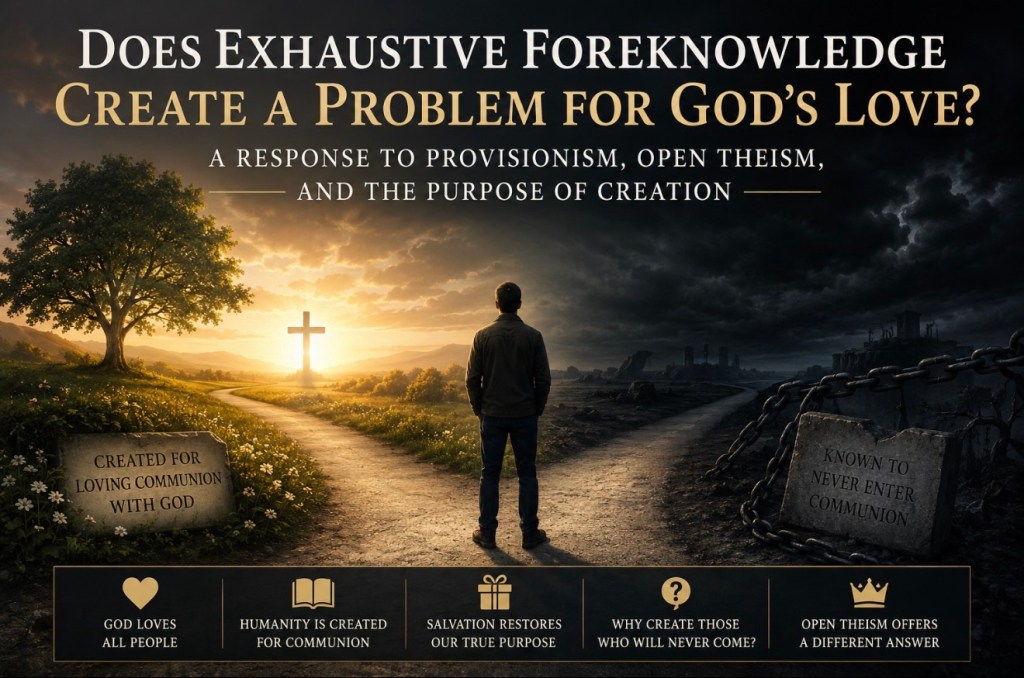
They were created for loving communion with God.
They were created to bear His image.
They were created to participate in His Kingdom.
They were created for fellowship, relationship, and life with Him.
Salvation is God’s gracious work of restoring humanity to the very purpose for which humanity was originally created.
Communion is the destination.
Salvation is the road home.
That distinction changes everything.
What Are Human Beings Created For?
If humanity is created for loving communion with God, then a profound question emerges.
Suppose God creates a person while already knowing with absolute certainty that this person will never enter into that communion.
Suppose God already knows this person will freely reject every invitation of grace.
Suppose God already knows this person will never participate in the Kingdom for which humanity was created.
Then why create that person?
Notice what is not being argued.
The argument is not that God caused the rejection.
The argument is not that human freedom is an illusion.
Assume the strongest possible version of libertarian freedom.
Assume every lost person freely rejects God.
The question remains exactly the same.
Why create someone whom God already knows will never experience the very purpose for which they were created?
This is no longer simply a question about salvation.
It is a question about creation itself.
A Parent’s Love
Perhaps the weight of this question is easier to feel than to explain.
Imagine a husband and wife standing together before deciding whether to have a child.
Now imagine they possess absolute certainty about that child’s future.
They know every joy.
Every sorrow.
Every triumph.
Every failure.
Most importantly, they know with certainty that despite every expression of love they will ever give, despite every opportunity for reconciliation, despite every sacrifice they will ever make, their child will freely reject them and ultimately end in irreversible ruin.
Whether one believes that final ruin is annihilation or eternal conscious torment makes little difference here.
The ending is the same.
The child will never experience the flourishing, joy, and loving relationship for which they were brought into existence.
Would loving parents choose to conceive that child?
This is not a question about blame.
The parents did not force their child’s decisions.
The child remains responsible.
The question is whether knowingly bringing that child into existence is itself an act of love toward that child.
Most parents would instinctively say no.
Not because they do not value freedom.
Not because they wish to control their child.
But because love seeks the good of the beloved.
Love desires flourishing.
Love willingly sacrifices itself so another might live.
If the final destiny of the child is already known with certainty before the child exists, many loving parents would conclude that the most loving act is not to procreate at all.
Now consider how much greater this question becomes when applied to God.
God is under no obligation to create.
God lacks nothing.
God is never surprised.
God freely chooses to create.
If He already knows with certainty that a particular person will never enter into the loving communion for which humanity exists, then why create that person?
The Problem of a Gift That Never Reaches Its Purpose
Now, a provisionist may respond that existence itself is a gift.
Even if someone ultimately rejects God, that person still experiences genuine blessings. They experience relationships, beauty, moments of joy, and the goodness of creation. Perhaps, then, God’s love is demonstrated not only by the final outcome but by the very gift of existence itself and the genuine offer of salvation given throughout life.
This response deserves to be taken seriously.
However, the deeper question remains.
The question is not whether a person’s life contains temporary goods. The question is whether knowingly bringing someone into existence, while knowing that person will never experience the ultimate good for which they were created, can truly be understood as an act of love toward that person.
Human beings intuitively understand this distinction.
Again, imagine a parent who knows before conception that their child will reject every expression of love offered to them. Imagine knowing that from an early age this child will become increasingly alienated from those who seek their good. Imagine knowing they will wound others and themselves through their choices. Some will become deceivers, abusers, or even murderers. Some will sink so deeply into despair that they will take their own lives. Others will spend a lifetime enslaved to addiction, bitterness, or violence. Above all, imagine knowing with certainty that despite every expression of love, every opportunity for repentance, and every offer of grace, this child will never enter into the loving communion for which they were created.
Would a loving parent simply say, “Well, at least they will have some good moments”?
Most parents would recognize that this is not the deepest question.
The question would not be whether the child experienced occasional happiness. The question would be whether bringing that child into existence was truly for the child’s good.
This is not the same as saying, “It is better never to have loved than to have loved and lost.” That statement assumes that the good of love has been experienced and that loss occurs afterward.
The question here is fundamentally different.
The question is whether it is loving to create someone when you already know that person will never experience the very purpose for which they were created, and because you know they won’t, that they will live a life of pain and misery.
If communion with God is humanity’s ultimate purpose, then temporary pleasures and earthly blessings cannot fully answer the question. Those things may be real goods, but they do not resolve the deeper issue of whether the person ultimately receives the good toward which their existence was ordered, nor the fact that in rejecting them they don’t live a neutral life but a miserable one.
The question is not whether God gives good gifts along the way.
The question is whether God knowingly creates someone whose existence will be miserable and will never reach the ultimate purpose for which He created them.
And this returns us to the central issue:
If every person is created for loving communion with God, then why would God create someone He already knows will never enter into that communion?
If Not Love and Communion, Then What?
At this point, the tension can be stated plainly: if God knows (not causes, but simply knows) that someone will, of their own free will, reject Him and never enter into the communion for which they were created, then it becomes impossible to explain how creating that person is an act of love directed toward their ultimate good.
Since this is true, every exhaustive foreknowledge system must answer a surprisingly difficult question.
If a person is not ultimately created for loving communion with God, then for what purpose were they created?
Perhaps someone answers:
To reveal God’s justice.
Or His holiness.
Or His wrath against sin.
Or to magnify His glory through judgment as well as mercy.
But now notice where the argument has arrived.
Provisionists have objected to Calvinism for years because Calvinism says precisely this.
Those who are saved glorify God’s love and mercy.
Those who are condemned glorify God’s justice and holiness.
Provisionists have rightly asked whether this reduces human beings to instruments through which God displays His attributes just to get more glory, whether God has love for them or intends their ultimate good or not.
Yet if exhaustive foreknowledge is maintained while universalism is rejected, does the same question not return?
If God knowingly creates people who will never experience the communion for which they were created, then their existence must ultimately be explained by something other than loving communion.
Whatever that “something” is—justice, holiness, wrath, or glory—it begins to function remarkably like the Calvinistic explanation provisionists have long rejected.
The names may change.
The logical structure does not.
The Universalism Tension
This is why exhaustive foreknowledge creates such a significant tension.
If God knows every person’s final destiny before creation…
If God freely chooses to create every person…
If God loves every person…
If God desires every person to enter into loving communion with Him…
And if some people never do…
Then why were those people created?
Universalism answers that question by saying that eventually everyone reaches the purpose for which they were created.
One may reject universalism for biblical reasons, and many provisionists do.
But rejecting universalism does not make the question disappear.
It intensifies it and shows the self-contradictory position found within whichever system ascribes these doctrines.
Every theological system affirming exhaustive foreknowledge while denying universalism must explain why God creates those whom He already knows will never enter into the loving communion for which He created humanity.
Why Open Theism Offers a Different Answer
This is where open theism deserves more careful consideration than it often receives.
Open theism is frequently criticized because some assume it denies God’s omniscience.
Some expressions of open theism have indeed redefined omniscience in ways many Christians find unconvincing.
But that is not a defining or even necessary claim of open theism.
The defining claim is much simpler.
Future free choices are not yet settled realities.
If future free decisions do not yet exist as completed facts, then God perfectly knows everything that can be known.
He knows every possibility.
Every consequence.
Every circumstance.
Every motive.
Every path by which He may accomplish His purposes.
Nothing surprises Him.
Nothing catches Him unprepared.
The difference is that God does not create people while already knowing that they will never fulfill the purpose for which He created them.
Every person who comes into existence is genuinely created for loving communion with God.
Every invitation is sincere.
Every offer of grace is real.
Every person can truly become what God created them to be.
Some tragically refuse.
But their refusal is not a settled reality before they exist.
The Real Question
Perhaps the debate over open theism has been framed incorrectly.
Perhaps the first question is not:
“What can God know?”
Perhaps the first question is:
“Why does a loving God create?”
If Scripture is correct that God loves all people…
If Scripture is correct that God desires all people to be saved…
If salvation exists because God desires to restore all humans to loving communion with Himself…
Then every theological system must explain why God creates people whom He already knows will never experience the very communion for which they were made.
Open theism answers that question differently and most convincingly of all the other options because it does not begin with a theory of foreknowledge.
It begins with the conviction that every human being who is brought into existence is genuinely created for loving communion with God.
Perhaps that is not merely a better explanation of human freedom.
Perhaps it is a better explanation of why a God who is love and who loves all people would create at all.
 The Logos of Agape