A Response to Molinist Objections and a Further Reflection on Exhaustive Foreknowledge
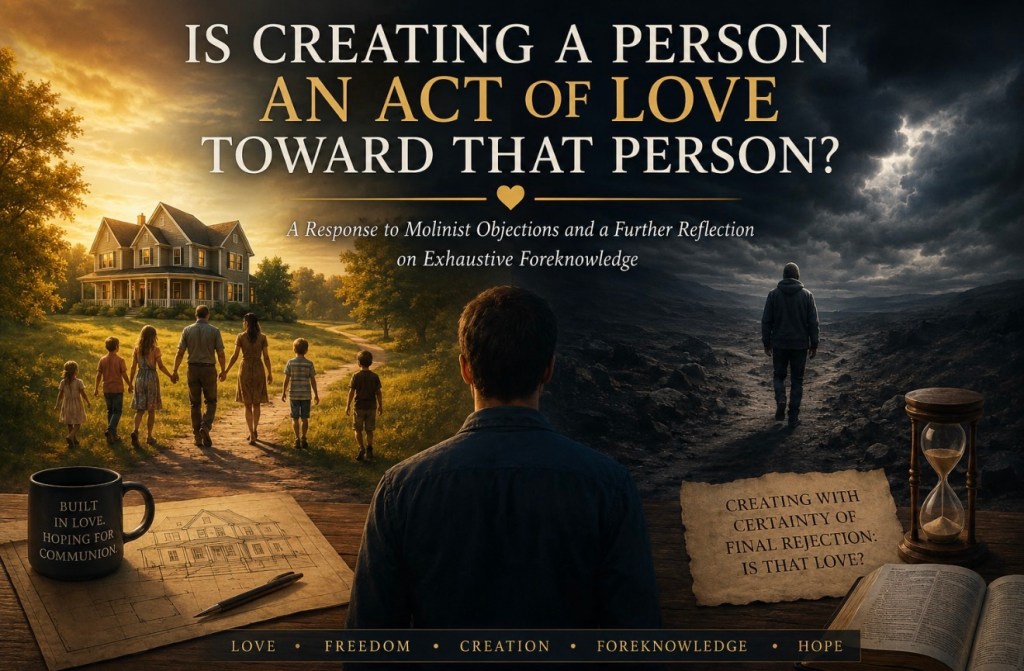
Since publishing my previous article, Does Exhaustive Foreknowledge Create a Problem for God’s Love? A Response to Provisionism, Open Theism, and the Purpose of Creation, I have been grateful for the thoughtful interaction it has generated.
Many of the responses have come from Molinists, and I genuinely appreciate the willingness of many within that tradition to engage the argument carefully and charitably. These conversations have helped clarify the central question being raised.
This discussion is also increasingly relevant because Leighton Flowers, one of the most influential voices within the Provisionist movement, has recently indicated that Molinism is the theological framework toward which he presently leans. Since one of the defining convictions of Provisionism has been the affirmation that God genuinely loves all people and desires all people to be saved, the question of whether exhaustive foreknowledge can consistently maintain those affirmations deserves careful consideration.
The purpose of this article is not to critique Molinism from a Calvinistic framework.
In fact, the argument begins with a conviction that stands in direct contrast to Calvinism:
God is agape love.
Everything that follows begins there.
The question is not whether God is sovereign.
The question is not whether God is powerful.
The question is not whether God knows the future.
The question is this:
If God loves every person, and if God creates every person freely, can the act of creating a person whom God eternally knows will never enter into loving communion with Him truly be understood as an act of love toward that person?
That is the question.
This Is Not a Question About Causation
Before addressing the objections, it is important to clarify what this argument is not saying.
This argument is not claiming that God’s knowledge causes human decisions.
The modal fallacy objection does not apply because the argument does not say:
“God knows someone will reject Him, therefore God causes them to reject Him.”
That would be incorrect.
Knowledge is not causation.
Human beings remain responsible for their choices.
Assume libertarian freedom.
Assume that every person who rejects God does so freely.
Assume that God never coerces a single human decision.
The question remains.
Why would a God who is love choose to create someone whom He already knows will freely reject the very purpose for which they were created?
The issue is not causation.
The issue is creation.
From Individuals to Worlds
One of the most common Molinist responses is that the question begins with a mistaken assumption.
The argument, they suggest, focuses too much on individuals rather than God’s actual creative act.
God does not create isolated persons.
God creates a world.
Within that world, human beings exercise libertarian freedom. They marry. They have children. They participate in God’s command to fill the earth and exercise dominion.
This response deserves to be taken seriously.
I agree that God creates a world.
However, we must ask what a world consists of.
A world is not an abstract reality detached from the people within it.
A world consists of particular persons, particular relationships, particular histories, and particular outcomes.
Therefore, if God possesses exhaustive foreknowledge, then choosing to actualize a particular world necessarily includes choosing every individual who will exist within that world.
The distinction between “creating a world” and “creating persons” does not remove the question.
A world is made of persons.
At this point, some Molinists may feel that the question itself is misplaced. They would argue that God’s primary creative act is not the selection of individuals but the actualization of a world containing free creatures. I understand that concern and have tried to frame the question in those terms. My argument, however, is that once a world is actualized, the question of God’s love must still be asked with respect to each individual who exists within that world.
If God eternally knows that certain individuals will exist, knows their choices, and knows their final rejection of Him, then choosing that world includes choosing a world containing those particular individuals.
The question remains:
How is creating this particular person an act of love toward this particular person if God already knows that person will never experience the loving communion for which they were created?
A Family Built for Communion
Perhaps a human analogy can help clarify the issue.
Imagine a married couple who have spent years dreaming about a large family.
They save their money.
They purchase a beautiful piece of land.
Together they design their dream home.
The home is intentionally created for communion.
They build twelve bedrooms because they hope to have twelve children.
They create a large kitchen where meals will be prepared together.
They purchase a dining room table large enough for everyone to gather.
They imagine birthdays.
They imagine Christmas mornings.
They imagine bedtime prayers.
They imagine family vacations.
They imagine growing old surrounded by the children they love.
Every room is prepared because they hope every child will flourish within the love of their home.
Every seat at the table exists because they desire every child to have a place.
Every bedroom exists because they desire every child to experience belonging.
Before construction begins, however, they somehow receive absolute certainty about the future.
They discover that if they proceed, they will have twelve children.
But they also know exactly what will happen.
Five of those children will remain in the home.
They will embrace their parents’ love.
They will experience the family relationship their parents dreamed of.
But seven of those children will reject the home.
They will reject their parents’ love.
They will view their parents’ guidance as restrictive.
They will refuse every invitation to remain.
They will leave.
Not because they were forced.
Not because their parents failed to love them.
Not because their parents failed to provide for them.
They freely choose another path.
And their parents know that despite every act of love, every sacrifice, every opportunity for reconciliation, these seven children will never return.
They know these children will experience deep suffering because of their own choices.
They know they will harm themselves.
They know they will harm others.
They know they will live lives far removed from the flourishing their parents desired for them.
Yet the parents proceed.
Now consider the question.
Would we say this decision was an act of love directed equally toward all twelve children?
Or would we say that the parents loved the family they hoped to have while knowingly bringing into existence children whose rejection and suffering were already certain?
Notice what is not being argued.
The seven children remain responsible for their choices.
Their freedom is real.
Their rejection is their own.
The question is not whether they deserve responsibility.
The question is whether bringing them into existence was itself an act of love toward them.
That is the question being asked of God’s creative act.
The Question Is Not Whether Existence Is Good
A common response to this argument is:
“So your conclusion is that God should not have created.”
That is not the argument.
Existence is good.
Creation is good.
Life is a gift.
However, existence is not the ultimate good for which humanity was created.
Humanity was created for communion with God.
Humanity was created to bear God’s image.
Humanity was created for participation in God’s Kingdom.
Therefore, the question is not whether temporary goods exist within a person’s life.
The question is whether knowingly bringing someone into existence who will never experience the ultimate good for which they were created is an act of love toward that person.
A parent does not love a child merely by giving them existence.
A parent loves a child by desiring their flourishing.
Existence is the gift.
Love is the purpose.
Freedom Explains Rejection, But It Does Not Explain Creation
Another common response is that genuine love requires genuine freedom.
Again, I agree.
A world capable of genuine love must contain the possibility of rejection.
Without that possibility, love becomes something less than love.
However, this answers a different question.
It explains why rejection is possible.
It does not explain why someone is brought into existence when their rejection is already known with certainty.
There is a difference between possibility and certainty.
Libertarian freedom explains why someone can reject God.
It does not explain why God knowingly creates someone whose rejection is already certain.
The existence of freedom explains the possibility of evil.
It does not fully explain the act of creation.
Could God Create a World Where All Choose Him?
Another important assumption must be addressed.
Could God create a world containing libertarian creatures in which every creature freely chooses communion with Him?
Some Molinists argue that perhaps no such world is feasible.
Perhaps every world containing genuine libertarian freedom necessarily includes some creatures who reject God.
This possibility deserves consideration.
However, even if this is granted, another question emerges.
God is not obligated to create.
God lacks nothing.
God does not create because He needs creation.
God creates freely out of love.
Therefore, the question remains:
If no world exists in which every free creature chooses God, why choose to create a world containing individuals whom God knows will never experience the purpose for which they were created?
The answer cannot simply be that God desired a world of free creatures.
Because the question remains:
How is creating each person within that world an act of love toward that person?
Is Love Simply Giving Someone What They Want?
Another important issue concerns the definition of love itself.
Some responses seem to suggest that love is primarily expressed through allowing a person to choose whatever they desire.
But love is not identical to unrestricted permission.
A loving parent does not define love as giving a child everything the child wants.
Sometimes love says yes.
Sometimes love says no.
Sometimes love allows consequences.
Sometimes love permits someone to experience the results of their choices in the hope that they will return.
But every loving action is ultimately ordered toward the good of the beloved.
Therefore, the question is not whether God allows people to choose separation.
He does.
The question is whether creating someone while knowing with certainty that they will ultimately choose separation is itself ordered toward that person’s good.
Freedom is part of love.
Freedom is not the definition of love.
Love seeks the flourishing of the beloved.
Does Open Theism Lead Toward Hopeful Universalism?
At this point, an important clarification must be made.
A universalist response to this discussion has rightly point out that if exhaustive foreknowledge is true, then the final rejection of those who are lost is not merely a possibility.
It is a settled reality.
This is precisely why the question is so significant.
The issue is not that God creates a world where rejection is possible.
A world containing genuine freedom must include that possibility.
The deeper question is whether God creates persons while already knowing with certainty that they will never experience the purpose for which they were created.
This is where open theism offers a fundamentally different framework.
Open theism does not necessarily require universalism.
Different open theists hold different views concerning final judgment, including annihilationism, conditional immortality, and hopeful universalism.
However, I believe hopeful universalism is the most natural conclusion when open theism is combined with the conviction that God is perfect agape love.
Why?
Because within open theism, future free decisions are not yet settled realities.
God knows every possibility.
God knows every consequence.
God knows every circumstance.
God knows every path.
But God does not create individuals while already knowing their final rejection as an unchangeable reality.
Every person who comes into existence is genuinely created for loving communion with God.
Every invitation of grace is genuine.
Every relationship remains capable of restoration.
Hopeful universalism does not claim with any kind of dogmatic certainty that every person will ultimately be reconciled.
Rather, it recognizes that if future free choices remain open, then God’s relentless love and persistent pursuit may ultimately win every heart. It not only recognizes that possibility but hopes for it without claiming certainty.
The difference is significant.
Exhaustive foreknowledge says:
“God creates people while already knowing the final outcome of every relationship.”
Open theism says:
God creates people while knowing every possible path and working toward the good of every person, but without knowing future free rejection as a settled reality.
This changes the question of creation itself.
A Family Built on Hope
Return once again to the family analogy.
Imagine the husband and wife who dream of twelve children.
They build their home.
They prepare every room.
They purchase the table.
They imagine their family gathered together.
But now remove exhaustive certainty about the future.
They do not know exactly what every child will choose.
They know their children will have freedom.
They know there will be struggles.
They know some children may wander.
They know some may reject the love they offer.
But they also know the possibility exists that every child will embrace the love they provide.
They build the home because love hopes.
They have children because relationship is worth the risk.
They create not because they know the ending.
They create because they hope for the relationship.
This is the difference.
The question is not whether freedom is valuable.
It is.
The question is whether love creates differently when rejection is a possibility versus when rejection is already a certainty.
Returning to the Central Question
This brings us back to where the discussion began.
Provisionism has consistently emphasized two important affirmations:
God loves all people.
God desires all people to be saved.
These convictions are deeply rooted in Scripture.
The question is whether exhaustive foreknowledge can consistently maintain them.
If God eternally knows that particular individuals will never experience the loving communion for which they were created…
If God freely chooses to create those individuals anyway…
If God knows their rejection before they exist…
Then what does it mean to say that God’s creative act toward those individuals is an act of love toward them?
An exhaustive-foreknowledge system may consistently affirm:
“God loves the world He chose to actualize.”
It may also consistently affirm that:
“God sincerely offers salvation to everyone who exists.”
But if we also affirm that God loves all people, that is, that God agape loves every individual person, then the question becomes unavoidable:
How is each person included in that world loved as that person?
The issue is not whether God loves the world.
The issue is whether God loves each person He creates.
Because if God is truly agape…
If agape love seeks the good of the beloved…
If humanity was created for loving communion with God…
Then the act of creation itself must be understood as an act of love toward those whom God creates.
That is the question exhaustive foreknowledge must continue to answer.
Perhaps the first question is not:
“What can God know?”
Perhaps the first question is:
“Why does a God who is love choose to create?”
Because the answer to that question determines how we understand everything else.
If God creates because He is love, then creation itself must be an expression of love toward every person created. The question is not whether exhaustive foreknowledge can explain how people reject God. It can. The question is whether it can explain why a God who is love knowingly creates those who will never receive the very love for which they were created.
 The Logos of Agape