
Part 1: Agapic Ontology — Is Love God’s Greatest Attribute, or God’s Very Nature?
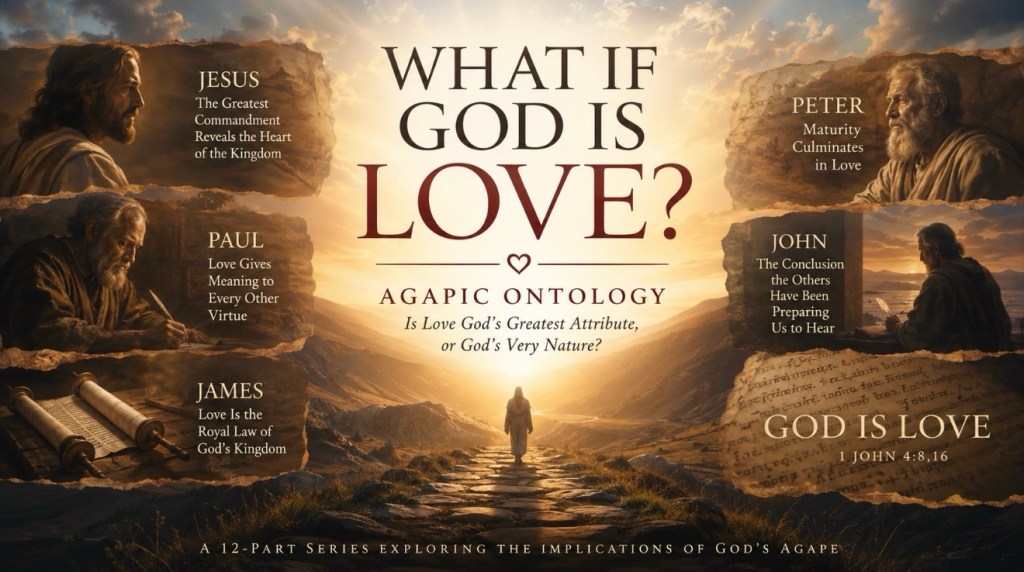
“God is love.”
(1 John 4:8, 16)
Few statements in Scripture are more familiar than these three words.
They comfort us when we grieve. They reassure us when we fail. They remind us that God is not distant or indifferent toward His creation.
Yet because these words are so familiar, we rarely stop to ask what John is actually saying.
John does not merely write that God loves.
He writes that God is love.
That is a remarkable claim.
Scripture says many things about God. God is holy. God is righteous. God is just. God is faithful. God is wise. God is sovereign. Every one of these is true.
But Scripture never says that God is holiness.
It never says that God is justice.
It never says that God is wisdom.
Only love receives that unique expression.
Why?
Many Christians answer that love is simply one attribute among many. God possesses love alongside His justice, holiness, wisdom, and power. Each attribute is equally fundamental.
But is that actually how the New Testament presents love?
This article argues that it is not.
The claim is not that holiness, justice, truth, or power are somehow less true of God.
Rather, the claim is that the New Testament consistently places Agape in a unique position. Agape is not merely another divine attribute. It is the reality that gives every other attribute its proper meaning.
In other words, if we follow the logic of Jesus and the apostles, the natural conclusion is not merely that God possesses Agape.
It is that God is Agape.
Before we begin, one clarification is important.
The New Testament uses several Greek words that we translate as “love.” The word that dominates its description of God’s character is agape—self-giving, faithful, covenantal love that seeks the good of another. This is the love revealed most perfectly in Jesus Christ laying down His life for the world.
So the question before us is not whether God has affection.
The question is whether Agape is the deepest reality of God’s own being.
Rather than beginning with John’s famous statement, let us set it aside for a moment.
Suppose we had never read 1 John.
Would the rest of the New Testament still lead us to conclude that God is Agape?
I believe it would.
Jesus: What Does the Greatest Commandment Reveal About God?
When Jesus was asked which commandment was greatest, He gave an astonishing answer.
“You shall love the Lord your God with all your heart… and… love your neighbor as yourself. On these two commandments hang all the Law and the Prophets.”
(Matthew 22:37–40)
Notice what Jesus does not say.
He does not say that love is merely one commandment among many.
He says everything else hangs upon it.
Every command God has ever given depends upon Agape.
Why?
Because laws reveal the character and purposes of the one who gives them.
Imagine a kingdom whose greatest law was military conquest.
That would tell us something about its king.
Imagine another kingdom whose highest law was wealth.
That too would reveal something about its ruler.
Jesus says the greatest command is Agape because Agape lies behind every other command God has given.
Justice matters because of Agape.
Holiness matters because of Agape.
Truth matters because of Agape.
The commandments are not arbitrary rules. They are expressions of God’s own character.
Jesus reinforces this only a few chapters later.
“A new commandment I give to you, that you love one another just as I have loved you.”
Then He adds something even more remarkable.
“By this everyone will know that you are my disciples, if you have love for one another.”
(John 13:34–35)
Think carefully about what Jesus is saying.
He could have identified His followers by many things.
Their theology.
Their worship.
Their miracles.
Their moral discipline.
Instead, He says the defining mark of His Kingdom is Agape.
Why would that be true?
Because kingdoms reflect their king.
If the defining characteristic of God’s Kingdom is Agape, then Agape must reveal something fundamental about the King Himself.
Even if Jesus had never uttered the words, “God is love,” His teaching naturally points us there.
Paul: Why Does Love Give Meaning to Every Other Virtue?
Paul approaches the same truth from an entirely different direction.
In 1 Corinthians 13 he imagines possessing every imaginable spiritual gift.
Prophecy.
Knowledge.
Miracle-working faith.
Extraordinary generosity.
Even martyrdom.
Then Paul makes one of the strongest statements in the entire New Testament.
Without Agape…
“I am nothing.”
“I gain nothing.”
Think about that.
Knowledge is good.
Faith is good.
Generosity is good.
Sacrifice is good.
Yet Paul says all of them become empty apart from Agape.
Why?
Because Agape is the reality that gives every other virtue its purpose.
Knowledge without Agape becomes arrogance.
Truth without Agape becomes cruelty.
Justice without Agape becomes vengeance.
Power without Agape becomes domination.
Agape does not replace these virtues.
It rightly orders them.
Paul reaches the same conclusion elsewhere.
After listing the virtues Christians should cultivate, he writes:
“Above all these put on love, which binds everything together in perfect harmony.”
(Colossians 3:14)
Notice the language.
Agape does not merely sit beside the other virtues.
It binds them together.
It unifies them.
It gives coherence to all the rest.
If every other Christian virtue depends upon Agape for its proper expression, then Agape occupies a unique place.
Even if Paul had never read John’s letter, his own theology naturally leads toward the conclusion that Agape stands above—not against—the other virtues because it is the reality that gives them life.
James: Why Is Love Called the Royal Law?
James gives us yet another perspective.
He writes:
“If you really fulfill the royal law according to the Scripture, ‘You shall love your neighbor as yourself,’ you are doing well.”
(James 2:8)
Why call love the royal law?
Because every kingdom has a supreme governing principle.
The royal law reflects the priorities of the king.
If Agape is the royal law of God’s Kingdom, then Agape tells us something about the One who reigns over it.
The highest law of God’s Kingdom is not arbitrary.
It reflects the character of its King.
Again, James never says, “God is love.”
Yet his language points us toward precisely that conclusion.
Peter: Why Does Spiritual Maturity End with Love?
Peter gives perhaps the most beautiful progression of all.
He describes the Christian life as a journey.
Faith.
Virtue.
Knowledge.
Self-control.
Perseverance.
Godliness.
Brotherly affection.
And finally…
Agape.
Why does Peter end there?
Because Agape is the goal.
Spiritual maturity is not merely becoming more knowledgeable.
Or more disciplined.
Or even more faithful.
It is becoming more like God.
If the entire journey of Christian formation culminates in Agape, then Agape is not simply another virtue among many.
It is the destination toward which every other virtue has been leading.
Peter never explicitly states that God is Agape.
But once again, the implication is difficult to escape.
John: The Conclusion the Others Have Been Preparing Us to Hear
Now we return to John’s famous words.
“God is love.”
Notice what has happened.
John is not introducing an entirely new idea.
Jesus has already shown us a Kingdom governed by Agape.
Paul has shown us that every virtue finds its meaning in Agape.
James has shown us that Agape is the royal law.
Peter has shown us that Agape is the goal of spiritual maturity.
John simply says aloud what the rest of the New Testament has been quietly implying all along.
God is Agape.
Not merely loving.
Agape.
More Than an Attribute
This brings us to the heart of the matter.
There is a profound difference between saying that God possesses Agape and saying that God is Agape.
To say God possesses Agape places love alongside His other attributes as one quality among many.
But the New Testament consistently gives Agape a role no other attribute receives.
Everything hangs upon it.
Everything is fulfilled through it.
Everything is unified by it.
Everything matures toward it.
And finally, God Himself is identified with it.
This does not diminish God’s justice.
It means His justice is the justice of Agape.
It does not diminish His holiness.
It means His holiness is the holiness of Agape.
It does not diminish His power.
It means His power is exercised through Agape.
His attributes are not competing with one another.
They are unified because they all flow from the same divine reality.
Why This Matters
Philosophers use the word ontology to ask the deepest question possible:
What is ultimately real?
Christians answer that ultimate reality is God.
But if the God revealed in Jesus Christ is Agape, then the deepest reality of existence is not raw power.
It is not abstract law.
It is not impersonal force.
It is self-giving, life-creating, covenant-keeping Agape.
That is what is meant by Agapic Ontology.
It is the conviction that Agape is not merely one characteristic of God.
It is the deepest reality of God’s own being, from which every other perfection is rightly understood.
If that is true, then we have not simply discovered one more doctrine.
We have discovered the lens through which every other doctrine must now be viewed.
And that raises a fascinating question.
If God truly is Agape…
What follows?
That is where we turn next.

