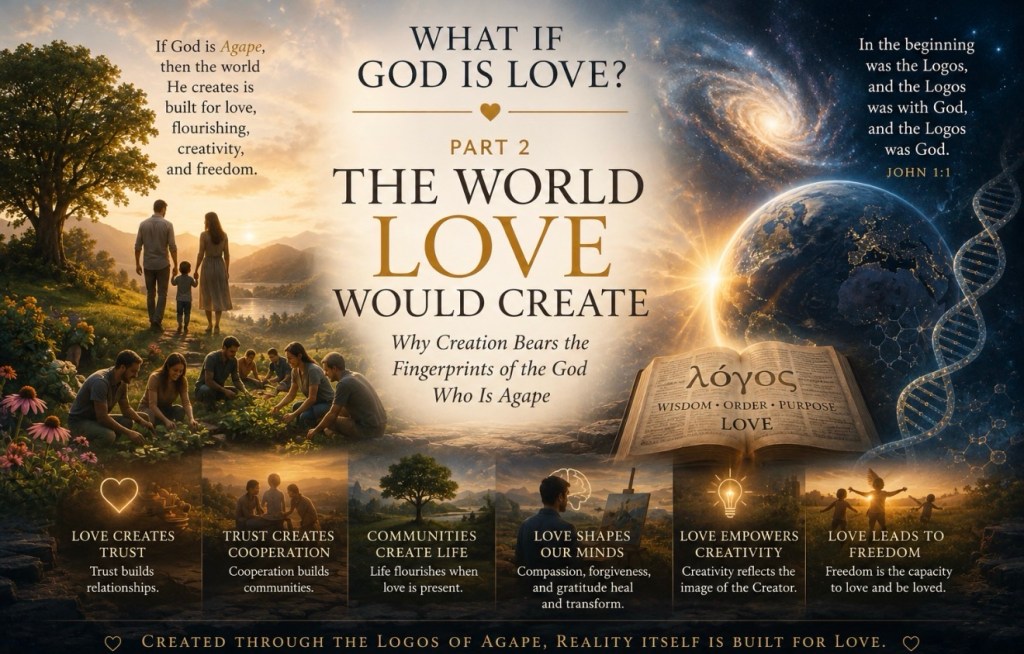
Part 2: The World Love Would Create
“Through Him all things were made; without Him nothing was made that has been made.”
John 1:3
If the first article in this series is correct, then we are immediately faced with another question.
If God is Agape, what kind of world would such a God create?
This is not merely a theological question.
It is a philosophical one.
Every worldview must eventually answer why reality looks the way it does.
Why do humans long for meaning?
Why do we recognize beauty?
Why do we admire self-sacrifice?
Why do justice, truth, compassion, and love feel like objective goods rather than mere personal preferences?
Why do relationships give life while isolation slowly destroys us?
These are not random questions.
They are clues.
If reality is ultimately nothing more than matter and motion, then these experiences are difficult to explain. Evolution may describe why certain cooperative behaviors were advantageous for survival, but it does not explain why we experience self-giving love as genuinely beautiful, why betrayal feels objectively wrong, or why we instinctively recognize that some ways of living are more deeply human than others.
Why should sacrificing one’s own life for another move us so profoundly?
Why should forgiveness feel greater than revenge?
Why should compassion appear nobler than domination?
If the deepest reality of the universe is indifferent, then these longings seem strangely out of place.
But if the deepest reality is Agape, everything begins to fit together.
The world begins to look exactly like the kind of world love would create.
The Fingerprints of Love
Consider what allows human life to flourish.
Children flourish when they are loved.
Marriages flourish through mutual self-giving.
Friendships deepen through trust.
Communities flourish through generosity.
Civilizations flourish through cooperation.
Even scientific discovery depends upon honesty, collaboration, and the faithful sharing of truth.
Take love away and these things slowly begin to collapse.
Families fracture.
Communities divide.
Trust disappears.
Violence increases.
Isolation grows.
This is not simply because people become less pleasant.
It is because reality itself appears to work against the absence of love.
The opposite is equally true.
Where genuine Agape is present, life expands.
Forgiveness heals wounds that revenge cannot.
Generosity creates abundance where selfishness creates scarcity.
Mercy restores relationships that punishment alone cannot repair.
Truth spoken in love transforms people in ways that truth spoken without love rarely can.
The biblical claim is not merely that God commands these things.
It is that reality itself has been structured in such a way that these things lead toward flourishing.
Love is not simply rewarded by God.
Love is woven into the grain of creation itself.
Wisdom Before Creation
Long before the New Testament was written, Scripture hinted that creation itself was not arbitrary.
In Proverbs 8, Wisdom is poetically described as being present with God before creation.
“The Lord brought me forth as the first of his works… I was beside him, like a master workman, and I was daily his delight.” (Proverbs 8:22, 30)
The point is not merely poetic imagery.
Creation is portrayed as being ordered through wisdom.
The universe is not chaos.
It possesses an intelligible order.
Reality makes sense because it was fashioned wisely.
This theme runs throughout the Old Testament.
The heavens declare God’s glory.
Creation reflects His wisdom.
The world possesses structure, purpose, and order because it comes from One who is wise.
But the New Testament takes this insight even further.
The Logos of God
John opens his Gospel with words that intentionally echo Genesis.
“In the beginning was the Logos, and the Logos was with God, and the Logos was God.”
The Greek word Logos carries enormous meaning.
It speaks of reason.
Wisdom.
Order.
Purpose.
The rational principle through which all things hold together.
John is not merely saying that Jesus existed before creation.
He is saying that creation itself came into being through the Logos.
Everything that exists bears the imprint of the One through whom it was made.
Paul says something similar when he calls Christ “the wisdom of God” (1 Corinthians 1:24), while also declaring that “all things have been created through him and for him” (Colossians 1:16).
John’s Logos.
Paul’s Wisdom.
Proverbs’ Wisdom.
These themes converge in Christ.
But now recall what the previous article established.
John does not merely tell us that the Logos is God.
Later in the same letter he tells us something even more astonishing.
God is Agape.
This changes everything.
If the Logos truly reveals God, then the Logos cannot be morally neutral.
The wisdom through which reality was created must reflect the very character of the One from whom it proceeds.
The order of creation is therefore not simply rational.
It is loving.
The Logos is the expression of divine Wisdom flowing from divine Agape.
Reality is ordered by the wisdom of love.
Why Reality Rewards Love
This helps explain something we all experience.
Reality consistently rewards the practices of Agape.
Not always immediately.
Not always painlessly.
But deeply and consistently.
Parents who lovingly sacrifice for their children usually raise healthier adults.
Communities marked by trust become stronger than communities ruled by suspicion.
Honesty builds relationships that deception eventually destroys.
Forgiveness breaks cycles of hatred.
Service creates unity.
Pride isolates.
Bitterness consumes.
Envy corrodes.
Hatred destroys.
These are not merely moral observations.
They are observations about reality itself.
The universe appears to possess an architecture that favors love.
This does not mean loving people never suffer.
Jesus loved perfectly and was crucified.
Rather, it means that even suffering love ultimately produces life in ways that selfishness never can.
The Cross itself becomes the supreme example.
From history’s greatest act of evil came history’s greatest act of redemption.
Love proved stronger than death.
That is not an accident.
It is the deepest pattern of reality.
Flourishing Is Not Arbitrary
This also explains why human flourishing cannot simply be reduced to pleasure or success.
People may accumulate wealth while becoming deeply miserable.
They may achieve fame while remaining profoundly lonely.
They may gain power while losing themselves.
Jesus warned of this when He asked,
“What does it profit a man to gain the whole world and forfeit his soul?”
The question only makes sense if human beings were made for something greater than acquisition.
We were made for communion.
The reason love leads to flourishing is because reality itself was created for communion.
We were not designed merely to survive.
We were designed to participate in the life of the God who is Agape.
The Next Question
If all of this is true, another question naturally follows.
If reality itself is structured by Agape…
why would God create creatures capable of rejecting it?
Why create beings who could choose selfishness over love?
Why create a world where genuine relationship requires genuine freedom?
Those questions lead directly to one of the most important themes in Scripture.
Freedom was never God’s final goal.
Freedom was the gift that made love possible.
That is where we turn next.

