Part 3: The Purpose of Freedom
From God’s Image to God’s Likeness
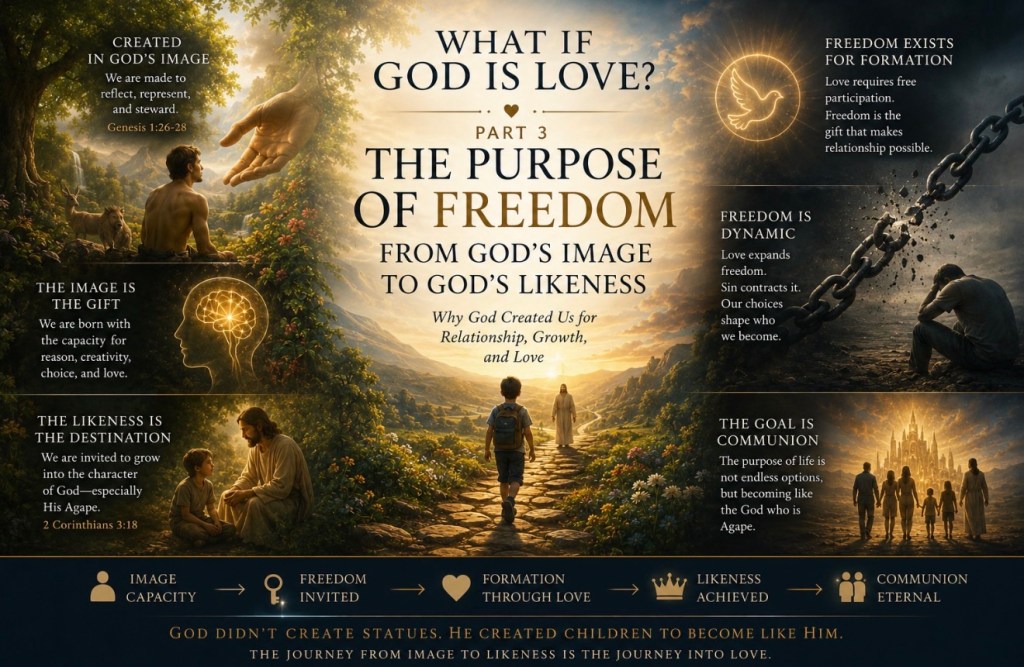
If God is Agape, why didn’t He simply create everyone already perfect?
If love is the deepest reality of existence, why create a world capable of pain, failure, rebellion, and suffering? Why not begin with heaven itself? Why not create humanity already incapable of sin?
For many people, these questions lie at the heart of the problem of evil. They assume that if God is both all-powerful and perfectly loving, then a world without the possibility of evil would have been the better choice.
But what if that assumption misunderstands the purpose of creation?
What if God’s goal was never simply to create morally flawless creatures?
What if His goal was to create sons and daughters capable of growing into His likeness through genuine relationship?
If the first two articles in this series are correct—if God is Agape, and if reality itself is the expression of His Agapic Logos—then the purpose of freedom begins to come into focus.
Freedom is not the goal.
Love is.
Freedom is the gift that makes love possible.
Humanity Was Created for More Than Existence
Genesis begins with one of the most familiar passages in Scripture:
“Let us make mankind in our image, according to our likeness…” (Genesis 1:26)
Most Christians read these two words—image and likeness—as though they mean the same thing. But Genesis intentionally uses two different Hebrew words.
The word translated image is tselem.
The word translated likeness is demut.
That should make us pause.
Why use two words if only one idea is intended?
Throughout the history of the Church, many theologians have recognized that these words point toward something larger than simple repetition. The distinction is especially prominent among many of the early Greek Fathers, who understood humanity as being created with God’s image while growing throughout life into God’s likeness.
Whether one ultimately accepts that distinction or not, it raises an important question.
What if Genesis is not merely telling us what humanity is?
What if it is also telling us what humanity was created to become?
That possibility changes the entire biblical story.
The Image Is a Gift
In the ancient world, a tselem was not simply a picture.
It was a representative.
Kings placed images of themselves throughout their kingdoms as visible reminders of their authority and rule.
Genesis makes a breathtaking claim.
Every human being—not merely kings or priests—is created as God’s image bearer.
Humanity was created to represent God’s reign within creation.
This means the image of God is far more than a statement about human value, important as that is.
It is also a vocation.
Human beings possess reason.
We imagine.
We create.
We speak.
We cultivate.
We govern.
We make moral judgments.
We enter into relationships.
Unlike the rest of creation, we are capable of consciously participating in God’s work within the world.
None of this is accidental.
If, as we argued in Part Two, all things were created through the Logos, then humanity’s capacity for reason, creativity, and meaningful choice reflects the Logos through whom we were made.
Genesis immediately connects God’s image with this calling.
After creating humanity in His image, God entrusts creation into human stewardship.
“Let them rule…”
The image is not merely something humanity possesses.
It is a responsibility humanity is invited to exercise.
God did not create human beings merely to receive His gifts.
He created them to participate with Him.
But participation raises another question.
Why give humanity this remarkable capacity?
Was freedom itself the goal?
The Likeness Is the Destination
Genesis does not stop with tselem.
Humanity is created in God’s image according to His likeness.
The Hebrew word demut points beyond what humanity is given toward what humanity is invited to become.
The image is the beginning.
The likeness is the destination.
Humanity begins life capable of reflecting God.
Humanity is invited to mature into the character of God.
This understanding transforms the way we read the entire biblical narrative.
God did not create finished statues.
He created children.
Children are not failures because they are immature.
They are immature because they are meant to grow.
The same is true of humanity.
From the beginning, creation appears designed for formation rather than instant completion.
The biblical story is therefore not simply about recovering what was lost.
It is about fulfilling what humanity was always created for.
And what is humanity growing toward?
Scripture gives a remarkably clear answer.
“God is Agape.” (1 John 4:8,16)
If God is Agape, then growing into God’s likeness means growing into Agape.
The journey from image to likeness is the journey from possessing the capacity to love toward becoming people whose lives are increasingly shaped by love.
The image gives us the capacity.
The likeness forms our character.
The image gives us freedom.
The likeness gives that freedom its purpose.
Freedom Exists for Formation
This leads us to one of the deepest questions in theology.
Why would God create beings capable of rejecting Him?
Many people answer by saying that love requires free will.
That is true.
But it is incomplete.
Freedom is not valuable simply because choices exist.
Freedom is valuable because love requires participation.
A relationship built entirely upon control may produce compliance.
It cannot produce Agape.
God did not desire creatures who merely performed the correct behaviors.
He desired sons and daughters capable of freely sharing His own life.
This is why freedom matters.
Not because choice itself is the highest good.
But because love cannot exist apart from meaningful participation.
Freedom is therefore not the destination of creation.
It is the beginning of the journey.
The goal has always been communion.
Freedom Is Dynamic
This is where many discussions of freedom stop too soon.
Freedom is often defined simply as the ability to choose between alternatives.
But Scripture presents something much richer.
Freedom is not merely something we possess.
Freedom is something we become.
Every choice shapes the person making that choice.
A person who repeatedly chooses honesty becomes more capable of honesty.
A person who repeatedly chooses generosity becomes more capable of generosity.
A person who repeatedly chooses forgiveness becomes more capable of forgiveness.
Love enlarges the soul.
Love expands the range of faithful possibilities available to us because love transforms the kind of people we become.
Sin works in exactly the opposite direction.
A lie becomes easier to tell the second time.
Bitterness becomes easier to nurture.
Pride blinds us.
Hatred makes reconciliation increasingly difficult.
What begins as a decision slowly becomes a habit.
What becomes a habit slowly becomes a character.
What becomes a character eventually becomes bondage.
Jesus describes this reality with striking simplicity:
“Everyone who commits sin is a slave to sin.” (John 8:34)
Notice what Jesus does not say.
He does not describe sin as the highest expression of freedom.
He describes it as the loss of freedom.
This means freedom is dynamic.
Love expands it.
Sin contracts it.
We are not simply making choices.
Our choices are making us.
God’s Freedom Is Perfect Freedom
This understanding also changes how we think about God’s freedom.
Sometimes people ask,
“If God cannot sin, is He really free?”
The question assumes that freedom is measured by the number of available options.
But Scripture presents a different vision.
God is not free because He can become something contrary to Himself.
God is free because nothing prevents Him from perfectly expressing who He is.
And who is He?
God is Agape.
Love does not imprison God.
Love is His life.
Love is His joy.
Love is His being.
This also helps answer another common misunderstanding.
Perfect love does not always produce only one possible action.
A loving parent may comfort.
Or correct.
A loving physician may operate.
Or wait.
A loving judge may show mercy.
Or impose consequences.
All of these may be loving depending upon the circumstances.
Love is not simplistic.
It is infinitely wise.
God’s freedom is therefore not the freedom to become hateful.
It is the limitless freedom to express perfect Agape in countless faithful ways.
The inability to hate is not a limitation of freedom.
It is the perfection of freedom.
Human beings lose freedom when sin prevents them from loving.
God possesses perfect freedom because nothing ever prevents Him from loving.
Why History Exists
This also explains why the biblical story unfolds across history rather than appearing fully complete in Genesis.
God is not simply distributing information.
He is forming people.
He walks with Abraham.
He wrestles with Jacob.
He teaches Israel.
He sends prophets.
He disciplines.
He forgives.
He restores.
He comes among us in Jesus Christ.
He pours out His Spirit.
Why?
Because character cannot simply be created.
It must be formed through relationship.
Love is learned by participating in love.
Wisdom is learned by walking with Wisdom Himself.
The goal of creation was never merely that humanity would exist.
The goal was that humanity would become.
Paul repeatedly describes believers as children growing toward maturity, heirs learning to live as members of God’s household, and people being conformed to the image of Christ.
This is not an interruption of God’s plan.
It is the fulfillment of it.
The Goal Was Always Love
We began by asking why God did not simply create everyone already perfect.
Perhaps the answer is that heaven is not merely a place.
Heaven is a people.
A people freely transformed into the likeness of the God who is Agape.
Creation begins with image.
History forms likeness.
The Kingdom completes the journey.
God did not create humanity merely to possess freedom.
He created humanity to grow through freedom into His likeness.
The goal was never endless choices between good and evil.
The goal was mature sons and daughters whose hearts have become so formed by Agape that love is no longer merely one choice among many.
It has become the deepest desire of who they are.
That is not the loss of freedom.
It is the fulfillment of freedom.
And perhaps that has been the purpose of creation from the very beginning.

