Part 4: Love Expands Freedom
Why Sin Slowly Makes Us Less Human
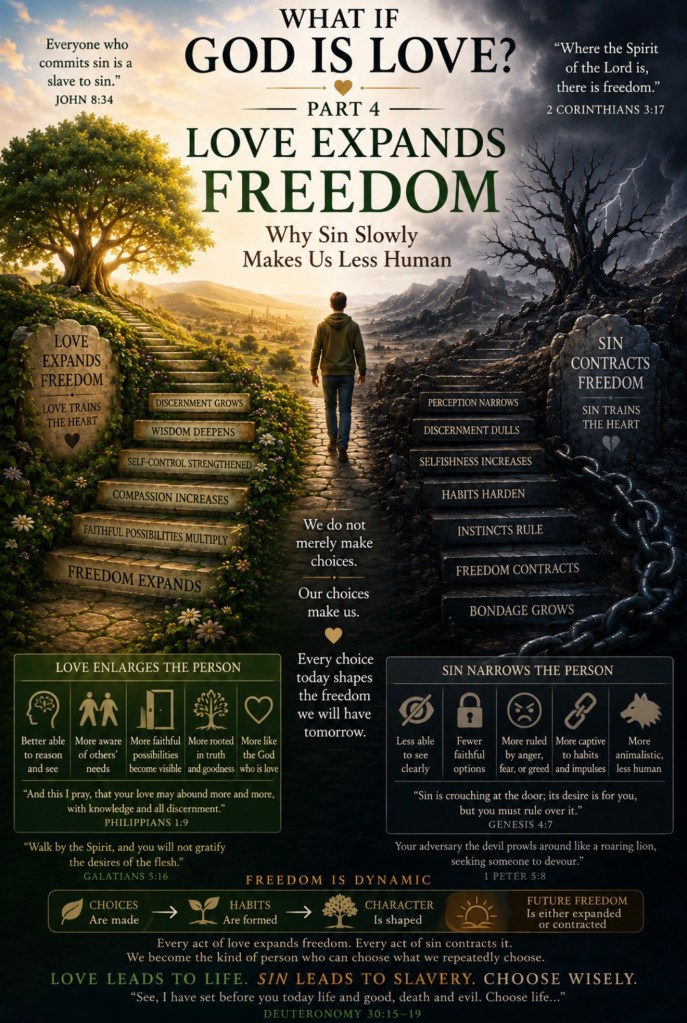
The previous article ended with a distinction that changes how we understand the purpose of human freedom.
Humanity was created in God’s image and according to His likeness.
The image was given.
The likeness was something humanity was created to grow into.
If God is Agape, then the destination of that growth is becoming increasingly like the God who is Agape.
But growth can move in two directions.
We can become more capable of living as the people we were created to be.
Or we can progressively surrender that capacity.
This means freedom is not merely something we possess.
Freedom is something we are becoming.
And that is why sin is so much more serious than simply breaking rules.
Sin does not merely make us guilty.
It can make us less human.
Freedom Is More Than Choice
We often imagine freedom as the ability to choose between alternatives.
The more options we have, the freer we must be.
But, as was noted in our last article) Scripture presents something deeper.
Jesus says:
“Everyone who commits sin is a slave to sin.”
(John 8:34)
Sin promises autonomy.
It produces slavery.
Paul makes the same point when he says that we become slaves of whatever we continually obey:
“Do you not know that if you present yourselves to anyone as obedient slaves, you are slaves of the one whom you obey?”
(Romans 6:16)
That means our choices do something to us.
We do not merely make decisions.
Our decisions help make us.
Every time we surrender ourselves to an impulse, we make it easier to surrender again.
Every time we resist an impulse in order to pursue what is good, we become more capable of doing so again.
Freedom is therefore dynamic.
It can expand.
And it can contract.
To understand why, we need to understand what Scripture means when it speaks about the flesh.
The Flesh Is Not the Body
This distinction matters.
Christianity has sometimes treated the body itself as though it were the problem.
But Genesis does not say that.
God created human beings as embodied creatures and declared His creation “very good” (Genesis 1:31).
The problem is not that we have bodies.
The problem is what happened to embodied humanity when sin and death entered the world.
After the Fall, God tells Adam:
“For you are dust, and to dust you shall return.”
(Genesis 3:19)
Mortality is the consequence of the fall and becomes part of the human condition.
And mortality changes everything.
We are embodied creatures who now know, at some level, that our bodies are dying.
We experience hunger because we need food.
Thirst because we need water.
Fatigue because our bodies require rest.
Pain because our bodies need protection.
Sexual desire because embodied creatures are designed for relationship and reproduction.
These desires are not inherently evil.
They are part of being human.
But once humanity is living under the power of death, those natural desires can become distorted by fear.
Hebrews describes humanity as living under this bondage:
“Through death he might destroy the one who has the power of death… and deliver all those who through fear of death were subject to lifelong slavery.”
(Hebrews 2:14–15)
This is an enormously important insight.
The problem is not simply that human beings have desires.
The problem is that fear of death teaches us to protect ourselves at almost any cost.
I am hungry, so I must secure food for myself.
I am afraid, so I must protect myself.
I am threatened, so I must defend myself.
I desire something, so I must obtain it.
I am vulnerable, so I must make myself safe.
The impulse itself may be perfectly natural.
But the flesh says:
Take care of yourself first.
Protect yourself first.
Satisfy yourself first.
Preserve yourself first.
And if someone else gets hurt in the process, so be it.
That is the direction of the flesh.
Paul describes this conflict repeatedly.
He contrasts those who live “according to the flesh” with those who live “according to the Spirit” (Romans 8:4–9).
He tells the Galatians that “the flesh desires what is contrary to the Spirit, and the Spirit what is contrary to the flesh” (Galatians 5:17).
The flesh is therefore not simply the physical body.
It is embodied human life disordered by sin and oriented toward self-preservation rather than self-giving love.
The Animal at the Door
This helps us understand one of the earliest descriptions of sin in Scripture.
After Cain becomes angry with Abel, God warns him:
“Sin is crouching at the door; its desire is for you, but you must rule over it.”
(Genesis 4:7)
The imagery is striking.
Sin is pictured like something crouching at the door, waiting to master Cain. The Hebrew verb describes something crouching, imagery that naturally evokes an animal waiting to spring on its prey.
Scripture is already giving us an image of sin as something animalistic that wants to master the human being.
And notice what God tells Cain.
“You must rule over it.”
The command is not:
“You must eliminate every desire.”
It is not:
“You must stop being embodied.”
It is:
Rule over it.
Cain was being called to exercise the very capacity humanity had been given in God’s image.
He could recognize his anger.
He could step back from it.
He could discern what it wanted to make him do.
And he could choose whether to surrender to it.
But Cain did not rule over his anger.
He surrendered to it.
And the result was murder.
The pattern is established remarkably early in Scripture.
An impulse arises.
The flesh gives that impulse authority.
The human being stops ruling the impulse.
And eventually the impulse rules the human being.
The New Testament returns to this same imagery.
Peter warns:
“Your adversary the devil prowls around like a roaring lion, seeking someone to devour.”
(1 Peter 5:8)
Again, predatory animal imagery.
Again, something seeking to master and consume the human being.
The biblical picture is remarkably consistent.
Sin and our adversary, do not merely seek to make us break a rule. Sin wants to become our master. It wants to consume us and reduce us to creatures governed by animalistic impulses rather than the wisdom and love for which we were created.
The Way of Cain
Jude makes this connection even more explicit.
After warning about people who have rejected the way of love and faithfulness, Jude says:
“Woe to them! For they have gone in the way of Cain.”
(Jude 1:11)
That phrase is easy to overlook.
But remember what happened with Cain.
God warned him that sin was crouching at the door.
Cain was told to rule over it.
Instead, Cain surrendered himself to his anger.
And that surrender eventually led him to murder his brother.
Jude now uses Cain as a picture of what happens when human beings repeatedly surrender themselves to destructive desires. They do not simply commit individual acts of sin. They begin walking in a way of life.
And then Jude gives us a remarkable description of what that looks like:
“These people blaspheme all that they do not understand, and they are destroyed by all that they, like unreasoning animals, understand instinctively.”
(Jude 1:10)
Notice the contrast.
Human beings were created with the capacity to reason, discern, reflect, and rule over their impulses.
But these people have become governed by what they know instinctively.
They are not being led by wisdom.
They are being led by impulse.
And Jude says that this very condition is to be “like unreasoning animals” and that condition “destroys them” and who they are meant to be.
The language is striking because it brings us back to the image in Genesis.
Sin crouches at the door.
Cain does not rule over it.
Cain instead becomes ruled by the impulse.
And Jude says that those who follow “the way of Cain” eventually become people governed by instinct like unreasoning animals.
The progression is therefore more serious than simply breaking a commandment.
The human being who was created to exercise wise dominion can surrender that capacity to the very impulses he was created to govern.
What begins as an impulse can become a choice.
The choice can become a pattern.
The pattern can become a way of life.
And the way of life can progressively diminish the very capacities that make human freedom possible.
This is why the biblical language of slavery is so important.
Sin does not merely ask us to do something wrong.
It seeks to become our master.
And when we continually surrender ourselves to instinct, fear, appetite, pride, or anger, we can become increasingly governed by those impulses rather than by wisdom, discernment, and love.
The tragedy is not that we become less embodied.
The tragedy is that we become less capable of living as the human beings we were created to be.
And that brings us to the deeper question:
What does sin actually do to a human being?
It does not erase the image of God.
But it can progressively impair our ability to express that image.
Sin makes us less human.
How Sin Makes Us Less Human
This is where an insight from George MacDonald and C. S. Lewis becomes remarkably relevant.
Both writers repeatedly portrayed sin as a movement toward dehumanization.
Lewis understood sinful humanity as increasingly governed by lower desires rather than reason and love.
MacDonald often expressed the idea even more vividly through his stories, in which human beings become increasingly animal-like.
That was not merely fantasy.
It expressed a theological insight.
MacDonald understood that when human beings continually surrender themselves to appetite, pride, fear, lust, greed, or violence, they begin to live beneath the humanity they were created to inhabit.
Consider an animal.
An animal experiences an impulse and responds to it.
It is hungry, so it seeks food.
It is threatened, so it flees or attacks.
It desires something, so it pursues it.
Human beings possess those same embodied instincts.
Again, the instincts themselves are not evil.
But human beings were created with something more.
We can step back.
We can reflect.
We can deliberate.
We can ask whether an impulse should govern us.
We can imagine the consequences of acting upon it.
We can consider another person’s needs.
We can ask:
What is true?
What is good?
What will this produce?
What does love require?
That is part of what makes us human.
The tragedy of sin is that we can surrender these capacities to the immediate demands of the flesh.
The hungry person becomes willing to take whatever they can get.
The angry person strikes before thinking.
The fearful person attacks whatever threatens them.
The lustful person reduces another human being to an object.
The greedy person sacrifices relationships for possessions.
The proud person refuses correction because admitting weakness feels threatening.
The human being who was created to govern creation becomes increasingly governed by appetite.
The image of God is not erased.
But the human being becomes increasingly incapable of exercising the capacities through which that image is expressed.
And so sin makes us less human.
Sin Contracts the World
This is why repeated sin changes more than behavior.
It changes perception.
The angry person begins to see threats everywhere.
The proud person becomes increasingly unable to imagine being wrong.
The resentful person loses the ability to imagine reconciliation.
The fearful person begins to interpret unfamiliar things as dangers.
The greedy person sees opportunities for acquisition where others see relationships.
The person ruled by lust begins to see people primarily as objects of desire.
The world has not actually become smaller.
The person’s capacity to see and perceive the world has become smaller.
And what we cannot see, we cannot meaningfully choose.
This is what makes the slavery of sin so profound.
Sin does not necessarily remove every theoretical option.
It makes fewer and fewer faithful possibilities visible to us.
James describes the progression this way:
“Each person is tempted when he is lured and enticed by his own desire. Then desire when it has conceived gives birth to sin, and sin when it is fully grown brings forth death.”
(James 1:14–15)
Notice the progression.
Desire.
Enticement.
Action.
Pattern.
Death.
Sin is developmental.
It grows.
And the more we surrender ourselves to it, the more deeply it shapes us.
Paul describes the result in Romans 1 as humanity becoming increasingly disordered in its thinking and desires (Romans 1:21–32).
The mind becomes “futile.”
The heart becomes darkened.
People exchange what is true for what is false.
They become increasingly governed by disordered desires.
This is not simply a legal problem.
It is a human formation problem.
We are becoming something.
And sin is forming us into people increasingly unable to live according to the purpose for which we were created.
The Image Is Not Erased
We need to be careful here.
When we say sin makes us less human, we are not saying that human beings cease to bear God’s image.
Scripture continues to affirm the image after the Fall.
After the Flood, God still grounds the prohibition against murder in the fact that humanity is made in His image (Genesis 9:6).
James likewise speaks of human beings as those “made in the likeness of God” (James 3:9).
The image remains.
What becomes impaired is our ability to express that image faithfully.
We still possess reason.
But we can surrender reason to impulse.
We still possess conscience.
But we can repeatedly silence it.
We still possess imagination.
But we can use it to justify ourselves rather than envision another way.
We still possess freedom.
But we can progressively surrender that freedom to habit.
The gift remains.
Its expression becomes disordered.
That is why salvation is not merely about changing our legal status before God.
God is healing a human being.
Love Heals What Sin Has Disordered
And now we can finally see why Agape expands freedom.
Love does not make us less embodied.
It does not require us to pretend our instincts do not exist.
Instead, love teaches us to govern our instincts rather than be governed by them.
The hungry person can choose to wait because another person needs the food more.
The angry person can choose patience because retaliation would destroy communion.
The frightened person can choose courage because someone else needs protection.
The person experiencing sexual desire can choose restraint because another person’s dignity matters more than immediate gratification.
The instinct remains.
But it no longer rules.
This is what maturity looks like.
We do not become more human by having fewer instincts.
We become more human by becoming increasingly capable of ordering those instincts toward what is good.
Paul describes this transformation as the work of the Spirit.
“Walk by the Spirit, and you will not gratify the desires of the flesh.”
(Galatians 5:16)
Notice that Paul does not say the desires disappear.
He says we learn to live differently in relation to them.
And then he describes the fruit of that Spirit:
“Love, joy, peace, patience, kindness, goodness, faithfulness, gentleness, and self-control.”
(Galatians 5:22–23)
Notice what he starts and ends with there. Of course he starts with agape love but what he ends with is also important as an outworking of love because he ends with self control (being able to rule over one’s self).
Self-control is particularly important here.
The Spirit does not destroy our humanity.
The Spirit teaches us to govern ourselves.
The flesh says:
I must have this now.
Agape asks:
What does love require?
The flesh says:
Protect yourself.
Agape asks:
How can I serve?
The flesh says:
Strike back.
Agape asks:
What would lead toward healing?
The flesh says:
Take.
Agape asks:
What can I give?
The movement from flesh toward Spirit is therefore a movement from reaction toward discernment.
From compulsion toward freedom.
From instinct ruling the person toward the person learning to rule the instinct.
From self-preservation toward self-giving love.
Love Makes Us Wiser
This is where the relationship between Agape and the Logos becomes especially important.
John tells us that all things were created through the Logos.
The Logos is divine Wisdom.
Humanity was created in the image of the Logos, and therefore human beings were given the remarkable capacity to reason, discern, imagine, create, and participate meaningfully in the ordering of creation.
But wisdom is not simply possessing information.
Wisdom is learning to see reality rightly.
And Agape teaches us how to see.
The more deeply we love, the more capable we become of stepping outside ourselves.
We begin to notice what another person is experiencing.
We become more patient before judging.
We become more willing to listen.
We become capable of imagining possibilities that our immediate emotions would never have suggested.
Love increases our ability to deliberate because love loosens the grip of self-interest.
This is why Paul prays that believers might have increasing wisdom and discernment:
“And this I pray, that your love may abound more and more, with knowledge and all discernment.”
(Philippians 1:9)
Notice the connection.
Love and discernment grow together.
Paul does not treat love as the opposite of wisdom.
Love produces wisdom.
The more Agape shapes us, the more capable we become of discerning what love actually requires.
That is precisely what the writer of Hebrews means when he describes mature believers as those whose powers of discernment have been trained through practice:
“Solid food is for the mature, for those who have their powers of discernment trained by constant practice to distinguish good from evil.”
(Hebrews 5:14)
Trained.
Practiced.
Matured.
This is formation.
We practice love until love begins changing how we perceive reality.
Love Creates Possibilities
This is why love does not produce one mechanical response to every situation.
Consider a parent who discovers that two children have both cheated on a test.
A parent ruled by anger may respond to both children in exactly the same way.
The rule was broken.
The parent is angry.
Swift and furious Punishment follows.
But a parent formed by Agape can stop.
Listen.
Discern.
Perhaps one child accidentally saw the answers, gave in to temptation, immediately confessed, and is genuinely ashamed and repentant.
Perhaps the other deliberately planned the deception ahead of time and remains unashamed and unrepentant.
The action was the same.
The circumstances were not.
And the children are not the same.
Love does not mean ignoring the wrongdoing.
It means becoming capable of responding to the actual situation rather than simply reacting to the immediate offense.
Perhaps one child needs forgiveness and increased accountability.
Perhaps the other needs serious discipline because consequences may be necessary for growth.
Both responses can flow from Agape.
The point is not that love produces one particular response.
It is that love creates room for discernment.
Love allows us to see more.
To consider more.
To imagine more.
To respond more creatively and more faithfully out of love for others.
A person ruled by anger may have only one response available to them.
A person shaped by Agape may see several possibilities and discern which one best serves truth, healing, growth, and communion.
That is why love expands freedom.
Love does not merely give us more choices.
Love makes more faithful choices possible.
Becoming More Human
This is the movement from image toward likeness.
The image gives us the capacity.
The Logos gives that capacity rational order.
Agape gives that order its purpose.
And the Spirit forms us through participation in that life.
Paul says we are to be transformed by “the renewal of your mind” so that we can discern God’s will (Romans 12:2).
He tells believers to “put on the new self, created according to the likeness of God in true righteousness and holiness” (Ephesians 4:24).
He tells us to “put on love, which binds everything together in perfect harmony” (Colossians 3:14).
The Christian life is therefore not simply learning more rules.
It is becoming the kind of person who can increasingly see others and perceive what love requires.
A child may need a rule telling them not to hurt another person.
A mature person increasingly understands why love makes that action unthinkable.
A mature Christian does not need an external command for every conceivable situation because Agape has begun shaping the way they perceive the world.
The person is becoming wiser.
More discerning.
More capable of seeing another person’s needs.
More capable of imagining and even creating faithful possibilities.
More capable of governing instinct.
More capable of choosing love.
More fully human.
Freedom Is Always Moving
Every day we are becoming someone.
No one accidentally becomes Christlike.
Likewise, no one usually becomes deeply hardened overnight.
Both are formed through countless small decisions.
Every act of Agape makes the next act of Agape more possible.
Every surrender to sin makes the next surrender easier.
Every choice is helping form the person who will make tomorrow’s choices.
Paul therefore tells us:
“Do not be deceived: God is not mocked, for whatever one sows, that will he also reap.”
(Galatians 6:7)
And then he gives us the positive direction:
“Let us not grow weary of doing good.”
(Galatians 6:9)
We are being formed.
The question is what is forming us.
Are we becoming more capable of stepping beyond instinct?
More capable of seeing another person’s perspective?
More capable of imagining reconciliation?
More capable of telling the truth when the truth costs us?
More capable of choosing generosity when selfishness would be easier?
More capable of responding rather than merely reacting?
If so, we are becoming more human.
We are not moving away from freedom.
We are growing into it.
This is why Paul can say:
“Where the Spirit of the Lord is, there is freedom.”
(2 Corinthians 3:17)
The Spirit does not merely remove a penalty.
The Spirit forms a person.
The Spirit heals what sin has disordered.
The Spirit teaches us to live from a deeper center than appetite, fear, pride, or self-protection.
The Spirit leads us toward the likeness for which the image was created.
Love makes us more capable of being human.
From Freedom to Bondage
But what happens when we choose not to love?
Not merely once.
Not merely when we fail.
But when we repeatedly choose the same selfish response, reject the same truth, and surrender ourselves to the same desires until the pattern begins to feel almost inevitable?
At some point, something changes.
What began as a choice can become a habit.
The habit can become a addictive pattern.
The pattern can become character.
And eventually, the person may discover that what once felt like freedom has become bondage.
This is why Paul can write:
“Do you not know that if you present yourselves to anyone as obedient slaves, you are slaves of the one whom you obey?”
(Romans 6:16)
The warning is not merely about what we do.
It is about what our actions are doing to us.
Every time we surrender ourselves to anger, resentment, greed, lust, pride, or fear, we are practicing a particular way of being human. And the more deeply that pattern becomes established, the harder it becomes to imagine responding differently.
The freedom God gave us has not vanished.
It has been contracted.
We have become increasingly enslaved to the very impulses we once had the capacity to step back from, examine, and choose whether to follow.
This is why Jesus’ words are so profound:
“Everyone who commits sin is a slave to sin.”
(John 8:34)
Sin does not merely make us guilty.
It makes us captive.
And Scripture has a name for what can happen when this process continues long enough.
Hardening.
A hardened heart is not simply a heart that made one bad decision. It is a heart that has repeatedly chosen a particular direction until that direction begins to shape the person themselves.
The biblical story gives us examples of people hardening their own hearts. It also speaks of God hardening hearts. Those statements must be understood carefully, because Scripture uses the language of hardening in more than one way.
And that matters.
Because when Christians hear the phrase “God hardens hearts,” many immediately assume they already know what that means.
But if freedom really is dynamic…
If love expands our capacity to see, discern, and choose…
And
If sin contracts that capacity…
And if repeated choices can gradually turn freedom into bondage…
then we need to slow down and ask what Scripture actually means when it speaks about a hardened heart.
There is far more going on in those passages than the simple idea that God arbitrarily makes someone unwilling to respond to Him.
That is where we will go next.

