
Part 6: Dynamic Omniscience
Why God Knows Different Hearts Differently
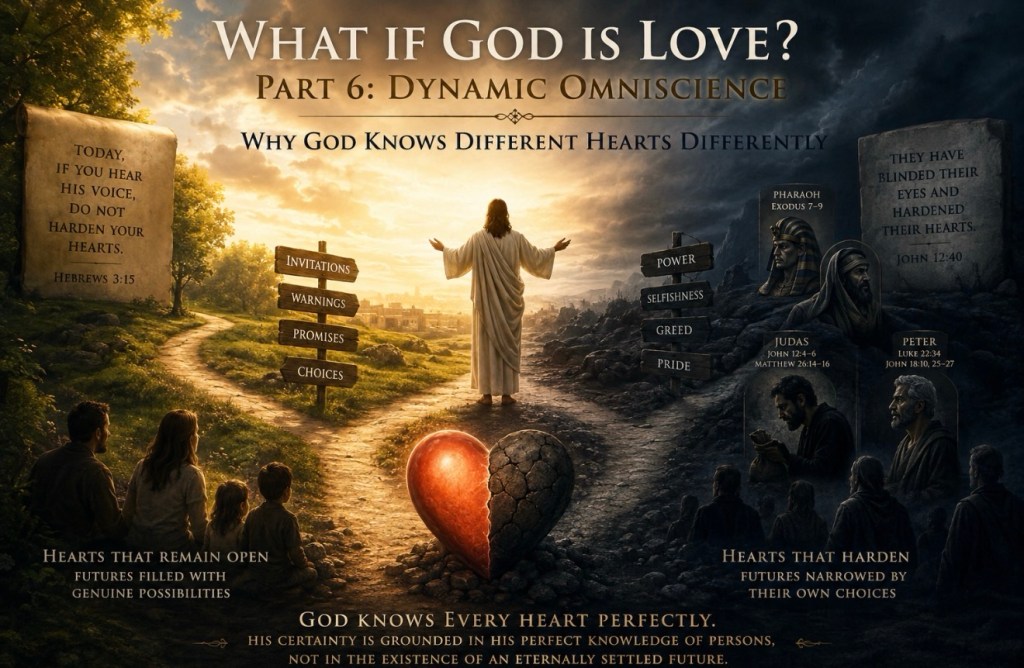
By now, this series has established a simple but profound truth.
God is Agape.
Reality reflects His love.
Freedom exists so that we may grow into His likeness.
Love expands our freedom.
Sin slowly surrenders it.
Hardening is not God’s first response to humanity. It is the tragic result of humanity’s repeated resistance to God’s loving invitation.
If all of that is true, then we are finally ready to ask a question that Christians have debated for centuries.
What kind of future does our God who is Agape Love create?
But before we ask how God knows, we first need to ask another question.
What kind of people does God actually create?
We Do Not Begin with Hearts of Stone
Many Christians have been taught that after the Fall humanity begins life spiritually incapable of responding to God.
Some describe this through the doctrine of total depravity.
Others emphasize original sin in ways that leave people unable to genuinely respond until God first changes them.
While these traditions rightly recognize that humanity is deeply affected by the Fall, I believe they begin in the wrong place.
The consequence of Adam’s rebellion is mortality (Genesis 3; Romans 5). We are born into a world where death reigns. Because we know our lives are fragile, we become tempted to grasp for security, pleasure, power, and possessions. The flesh constantly whispers that we must satisfy ourselves now because tomorrow is uncertain.
That bent toward selfishness is real.
But Scripture never says we are born with hearts already hardened into stone.
Instead, Scripture continues to affirm three remarkable truths.
We still bear the image of God (Genesis 9:6; James 3:9).
God’s law remains written upon the human heart (Romans 2:14-15).
Our conscience continues to bear witness to that law (Romans 2:15).
Even after Eden, human beings remain genuine image-bearers living between two voices.
The desires of the flesh pull us in one direction.
The Spirit, conscience, and truth continually call us in another (Galatians 5:16-17).
This is precisely why Scripture repeatedly urges us,
“Today, if you hear His voice, do not harden your hearts” (Hebrews 3:15).
That command only makes sense if our hearts are not already fully hardened.
Hardening is not where humanity begins.
It is something we tragically become.
The Bible Assumes Our Response Matters
Once we notice this, an astonishing pattern begins to emerge.
God almost always speaks to people as though their future remains genuinely open.
After the Fall, God tells Cain,
“Sin desires to have you, but you must rule over it” (Genesis 4:7).
God does not speak as though Cain is incapable of responding.
He warns him because Cain still possesses genuine freedom.
When God calls Abram, He invites him to leave everything familiar and trust Him (Genesis 12).
Joshua stands before Israel and declares,
“Choose this day whom you will serve” (Joshua 24:15).
Through Jeremiah, Ezekiel, Isaiah, Joel, and the other prophets, God repeatedly says,
“If you return…”
“If you listen…”
“If you repent…”
Jesus begins His ministry with the same invitation.
“Repent, for the Kingdom of Heaven has come near” (Matthew 4:17).
Again and again He asks,
“Will you follow me?”
The New Testament continues the pattern.
Paul pleads.
Peter exhorts.
James warns.
John invites.
Everywhere Scripture assumes that people are capable of responding to God’s gracious call.
The Bible is filled with invitations.
Conditional promises.
Warnings.
Tests.
Questions.
The overwhelming pattern is unmistakable.
God ordinarily relates to human beings as though their response genuinely matters.
Why God Tests People
This also explains why Scripture so often says that God tests people.
God tests Abraham (Genesis 22).
Israel is tested in the wilderness (Deuteronomy 8:2).
Throughout Scripture, testing reveals what is truly in the heart.
These are not theatrical performances.
They are moments of formation and revelation.
Imagine a young child beginning life.
No one knows exactly what kind of adult she will become.
She possesses countless possibilities.
Every decision begins shaping her character.
Each truthful choice makes honesty a little easier.
Each selfish choice makes selfishness a little easier.
Over time, the soul is being formed.
This is exactly what we have been exploring throughout this series.
Love expands freedom.
Sin contracts it.
Every act of love opens new possibilities.
Every surrender to selfishness closes them.
The future is not equally open for everyone because the condition of every heart is not the same.
Then Something Changes
But as we continue reading Scripture, another pattern begins to appear.
Sometimes God no longer speaks with invitations.
Sometimes He speaks with certainty.
These moments stand out precisely because they are so unusual.
Pharaoh.
Saul.
Joseph’s brothers.
Many of Israel’s leaders.
Judas.
Peter.
At first glance these stories appear completely different.
In reality they all share one common feature.
Each person has already hardened themselves toward a particular truth.
That is why these stories matter.
Not because they are the rule.
Because they are the exception.
Pharaoh
Long before God says He will harden Pharaoh’s heart, Pharaoh has already built an empire through oppression, slavery, and the murder of Hebrew infants (Exodus 1).
The Exodus narrative repeatedly tells us that Pharaoh hardened his own heart before Scripture ever describes God hardening him (Exodus 7-9).
By this point, Pharaoh’s love of power has become deeply rooted.
His future has narrowed.
God does not create Pharaoh’s rebellion.
He knows Pharaoh’s heart.
And because He knows Pharaoh’s heart, He knows how Pharaoh will respond.
Israel
Jesus’ ministry reveals the same heartbreaking pattern.
Standing over Jerusalem He weeps,
“How often I have longed to gather your children together… but you were not willing” (Matthew 23:37).
Notice the language.
Jesus does not rejoice that Israel rejected Him.
He grieves.
John tells us that although Jesus performed many signs, many still would not believe because Isaiah’s words had come to pass:
“They have blinded their eyes and hardened their hearts…” (John 12:37-40).
Paul later describes Israel as receiving “a spirit of stupor” (Romans 11:8).
But even here hardening is not the end.
Romans 11 insists it is temporary and serves God’s larger purpose of mercy.
Judas
Judas provides perhaps the clearest example of progressive hardening in the Gospels.
John tells us something remarkable long before Judas betrays Jesus.
When Mary anoints Jesus with expensive perfume, Judas objects.
John immediately tells us why.
“He did not say this because he cared about the poor but because he was a thief; as keeper of the money bag, he used to help himself to what was put into it” (John 12:4-6).
This is far more than an incidental detail.
John is showing us the slow formation of Judas’ heart.
His betrayal did not begin in Gethsemane.
It began years earlier through countless smaller choices.
Every act of dishonesty further narrowed his freedom.
Every theft made the next one easier.
Every surrender to greed shaped him into the kind of person who increasingly loved money more than loyalty.
By the time Judas bargains with the chief priests for thirty pieces of silver (Matthew 26:14–16), the betrayal almost feels tragically inevitable.
Jesus is not arbitrarily predicting Judas’ future.
He is perfectly reading the character Judas has been freely forming in front of Him for years.
The tragedy is not that God scripted Judas’ betrayal.
The tragedy is that Judas slowly surrendered the freedom to become someone else.
Peter
Peter’s story is different, but the principle is exactly the same.
Peter was not hardened by greed.
He was hardened toward a particular truth.
Throughout the Gospels, Jesus repeatedly teaches that the Messiah must suffer, be rejected, be killed, and then rise again (Mark 8:31; Matthew 16:21; Luke 9:22).
Just as importantly, Jesus continually teaches that everyone who follows Him must walk that same path.
“Whoever wants to be my disciple must deny themselves, take up their cross, and follow me.” (Matthew 16:24; Mark 8:34; Luke 9:23)
“Whoever does not carry their cross and follow me cannot be my disciple.” (Luke 14:27)
Peter heard these teachings again and again.
Yet every time Jesus spoke about suffering, Peter resisted it.
When Jesus first announced His coming death, Peter immediately rebuked Him.
Jesus’ astonishing reply was,
“Get behind me, Satan! You are not setting your mind on the things of God, but on the things of man.” (Matthew 16:22–23; Mark 8:32–33)
Peter wanted a victorious Messiah.
He wanted a kingdom without a cross.
He wanted glory without suffering.
Most importantly, Peter had not yet accepted that if the Messiah died, His disciples would also be called to lay down their own lives.
He had heard the teaching.
But he had not yet allowed it to reshape his heart.
By the time Jesus tells Peter,
“Before the rooster crows today, you will deny me three times.” (Luke 22:34)
Jesus is not revealing a timeless script that Peter has no choice but to perform.
He is speaking as the Master who has patiently watched His disciple wrestle with the same truth over and over again.
We see this only hours later in the garden.
When the soldiers come to arrest Jesus, Peter draws his sword and strikes the servant of the high priest (John 18:10).
This is not evidence that Peter is finally ready to suffer alongside Jesus.
It is evidence that he is still resisting everything Jesus has been teaching.
Peter still cannot accept a Messiah who conquers through self-giving love rather than violence.
More deeply still, Peter has not yet accepted what Jesus has repeatedly taught—that if the Messiah is arrested, rejected, and crucified, His disciples must be willing to walk that same road.
Peter reaches for the sword because he is still trying to prevent the cross.
Jesus reaches for the cross because He has already embraced it.
Jesus immediately rebukes Peter:
“Put your sword back into its place… Shall I not drink the cup the Father has given me?” (Matthew 26:52; John 18:11)
Only a few hours later, when Peter realizes that identifying himself with Jesus may mean sharing Jesus’ fate, he does exactly what Jesus said he would do.
He denies knowing Him.
Jesus did not cause Peter’s denial.
He understood the condition of Peter’s heart.
He knew Peter had not yet surrendered to the truth that love conquers through suffering rather than force.
And that is precisely why Peter’s story becomes one of the most beautiful in all of Scripture.
His denial is not the end of his story.
After encountering the risen Christ and receiving the Holy Spirit, Peter finally embraces the very truth he once resisted. The man who once denied Jesus to save his own life becomes the apostle who rejoices that he is counted worthy to suffer for Christ (Acts 5:41) and, according to the testimony of the early church, ultimately lays down his own life in faithful witness to the One he had once been afraid to follow to the cross.
Peter’s heart was not permanently hardened.
It was transformed.
And that is the hope woven throughout the entire biblical story.
God’s goal is never hardening.
God’s goal is always restoration.
The Difference
Notice what all of these stories have in common.
God speaks with certainty only after people have progressively surrendered their freedom.
That is exactly what we discovered in the previous two articles.
Love expands our vision.
Expanded vision opens possibilities.
Possibilities create room for discernment.
Discernment makes faithful freedom possible.
Sin reverses the process.
It contracts our vision, narrows our possibilities, impairs our discernment, and gradually turns freedom into bondage.
Hardening is what happens when that process becomes deeply established.
God’s certainty does not replace freedom.
It reflects the condition of the person He perfectly knows.
Observing the Biblical Narrative and What it’s Telling Us
At this point, a pattern should be impossible to ignore.
Scripture does not present God as speaking about every human being as though their future were already fixed and settled. Quite the opposite. Most of the time, He addresses people with genuine invitations, warnings, promises, and conditional statements because they truly stand before multiple possible futures.
The exceptions stand out precisely because they are exceptions.
Pharaoh.
Saul.
Much of Israel in Jesus’ day.
Judas.
Peter.
In every case, the prediction comes only after a long history of choices has formed a heart that has become progressively hardened toward a particular truth. God is not speaking to morally open people as though they have no real alternative. He is speaking to people whose own repeated choices have tragically narrowed their freedom until their response has become morally predictable.
This is why these passages do not require us to conclude that God or Jesus was simply looking down the corridors of time at eternally settled events.
Nor do they require us to believe that every future choice has existed as a fixed reality from eternity waiting to be foreknown.
Scripture itself provides a different explanation.
God knows hearts.
He knows what people have freely become.
He knows when a person remains genuinely open to multiple faithful possibilities, and He knows when years of resisting truth have narrowed those possibilities until only one course remains.
His predictions arise, not from an eternally frozen future, but from His perfect knowledge of persons as they truly are. God’s certainty is grounded in His perfect knowledge of persons, not in the existence of an eternally settled future.
Dynamic Omniscience
This brings us to what many theologians call Dynamic Omniscience.
I do not believe God’s knowledge is diminished.
I believe it is perfect.
God always knows reality exactly as it truly is.
He knows every possibility.
Every motive.
Every influence.
Every consequence.
Every softened heart.
Every hardened heart.
He never mistakes possibility for certainty.
Nor certainty for possibility.
Some people still possess a future filled with genuine possibilities.
Others have tragically narrowed their future through years of resisting truth.
God knows the difference perfectly because He knows every heart perfectly.
This is not a limitation of His knowledge.
It is the perfection of His wisdom.
The Freedom of God
But there is an even deeper reason God knows possibilities perfectly.
God does not merely possess freedom.
God is perfectly free.
Nothing has ever contracted His vision.
Nothing has ever distorted His perception.
Nothing has ever enslaved His desires.
God has never surrendered Himself to the flesh, to fear, to pride, to selfishness, or to sin. His perception of reality has never been narrowed by the very forces that progressively narrow ours.
This means that God does not merely see everything.
He perceives everything perfectly.
He sees every person as they truly are.
He understands every motive, every desire, every influence, every relationship, and every consequence.
And because His own freedom is perfect, He is never constrained to a single response by a contracted vision.
God can perceive every possibility genuinely available within any situation because He sees reality without distortion.
This is what makes divine wisdom so different from human wisdom.
We often fail to see possibilities because our own perception has become narrowed. Fear makes some possibilities invisible. Anger makes others invisible. Pride makes us unable to imagine that we might be wrong. Self-interest can prevent us from seeing what another person desperately needs.
Sin contracts our vision.
Agape expands it.
God’s vision has never been contracted.
His freedom has never been surrendered.
His perception has never been distorted.
Therefore His wisdom is perfect.
And this also reveals something beautiful about God’s purpose for humanity.
God does not merely want us to obey Him.
He wants us to become free like He is free.
He wants us to become people whose vision is increasingly shaped by Agape, whose perception is increasingly capable of seeing reality clearly, and whose wisdom is increasingly capable of discerning the beautiful multitude of loving possibilities available in any given circumstance, so that we can creatively choose how we will love. The more fully Agape shapes us, the less constrained we become.
This is also why the openness of the future matters.
The future is open to precisely the degree that God’s image-bearers remain genuinely free.
When we are free, multiple faithful possibilities can remain genuinely available. When sin contracts our freedom, those possibilities begin to disappear. When hardening becomes deeply established, our future can become increasingly predictable because our freedom has become increasingly constrained.
God does not celebrate that contraction of freedom.
He laments it.
When God knows what a hardened person will do, His certainty is not a declaration that this is how He wanted them to become. It is His perfect knowledge of what they have freely become. The fact that God knows a person’s future does not mean He desired that future to become inevitable.
God’s ultimate desire has always been the opposite.
He created image-bearers capable of becoming like Him: free, loving, discerning, creative, and fully alive. His purpose is not to close the future around us but to lead us into the fullness of freedom for which we were created.
This is why the Christian life is ultimately a movement toward freedom rather than away from it.
Paul says it plainly:
“It is for freedom that Christ has set us free.” (Galatians 5:1)
The goal is not simply that God make our decisions for us.
The goal is that He transforms us until we become the kind of people who can increasingly see, discern, and choose what is good.
We are being formed into the likeness of the God who is Agape.
And the more fully Agape shapes us, the more our vision expands, the more possibilities we can perceive, and the more freely we can respond to the world around us.
God knows every possible future because He knows every heart perfectly and perceives every possibility perfectly.
But He also knows every possibility because His own freedom and perception are perfect.
He is not merely the One who knows freedom.
He is the One who is perfectly free.
And He is leading us toward that same freedom.
The God Revealed in Jesus
Perhaps the greatest beauty of this understanding is that it sounds exactly like Jesus.
Jesus is not detached from human history.
He rejoices.
He marvels at unexpected faith (Matthew 8:10).
He grieves over unbelief (Mark 6:6).
He weeps over Jerusalem (Luke 19:41).
He laments that His people “were not willing.”
He interacts with people as a loving Father who genuinely desires their response.
That is precisely what we would expect if God truly is Agape.
Love does not manipulate.
Love invites.
Love warns.
Love disciplines.
Love grieves.
Love celebrates.
Love knows every heart perfectly and responds with perfect wisdom to each one.
This, I believe, is the picture Scripture consistently presents.
God is not watching an eternally fixed script unfold before His eyes.
He is the perfect Father who knows every possibility, every certainty, and every human heart exactly as they truly are.
And because His wisdom is infinite and His love never fails, He is fully able to accomplish His purposes without ever treating His image-bearers as anything less than genuinely free children whom He longs to become fully like Himself.
In the next article we will ask the natural question that now follows.
If God relates to genuinely free people in this way, how does biblical prophecy work?
As we will discover, prophecy is not evidence against this picture of God.
It is one of its greatest confirmations.

