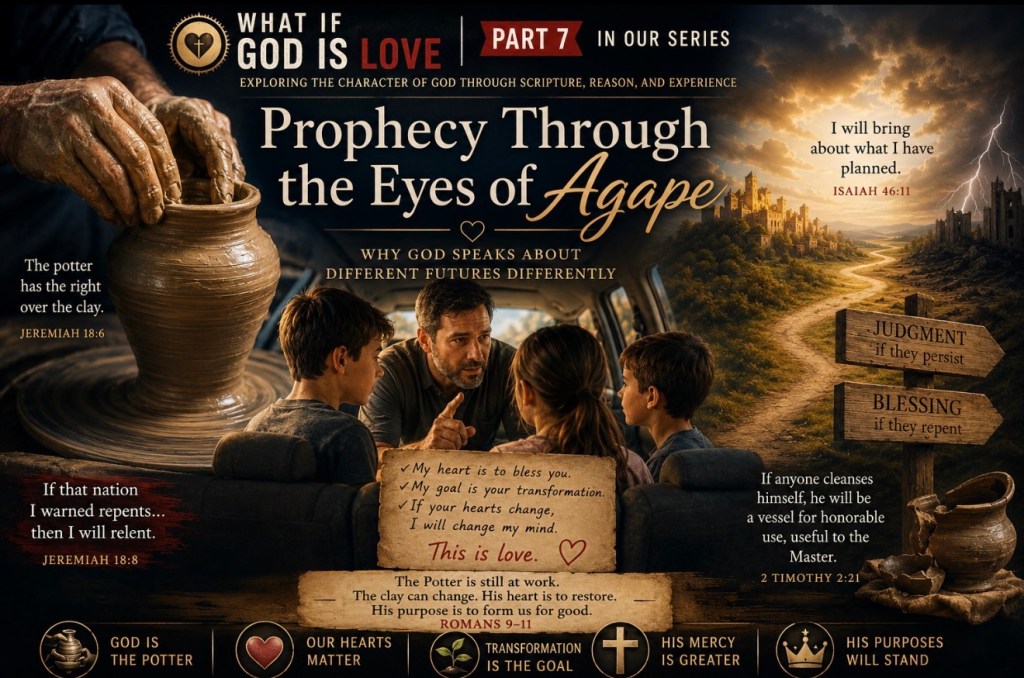
Part 7: Dynamic Prophecy Through the Eyes of Agape
Why God Speaks About Different Futures Differently
In the previous article, we discovered something remarkable.
God does not know every human future in exactly the same way.
He knows every heart perfectly.
Some hearts remain open to countless possibilities because they are still genuinely free to respond to truth.
Other hearts have gradually surrendered that freedom through years of resisting God until their future has become tragically predictable.
That explains why God sometimes speaks with invitations…
and other times with certainty.
But another question immediately follows.
If God relates to different hearts differently…
shouldn’t we also expect Him to speak about different futures differently?
I believe Scripture answers that question with a resounding yes.
In fact, I believe God Himself tells us exactly how we are meant to understand prophecy.
The surprising part is that most Christians have simply never been shown where.
The Passage Almost Everyone Overlooks
If someone asked you,
“Where does the Bible explain how prophecy works?”
what passage would you choose?
Most Christians immediately think of Revelation.
Others think of Daniel.
Some think of Isaiah.
Very few think of Jeremiah.
Yet it is Jeremiah that contains perhaps the clearest explanation in all of Scripture.
The Potter’s Heart
There is one passage in Scripture that, more than any other, has completely changed the way I understand prophecy.
Strangely enough, it is not primarily about prophecy.
It is about a potter.
And it is about the heart of a Father.
Before we ever hear God explain how prophecy works, He first tells Jeremiah to go watch a potter at work.
“Then I went down to the potter’s house, and I saw him working at the wheel. But the pot he was shaping from the clay was marred in his hands; so the potter formed it into another pot, shaping it as seemed best to him.” (Jeremiah 18:3–4)
Notice what happens.
The potter begins making one kind of vessel.
Then the clay becomes marred.
So the potter reshapes it into something else.
The potter is not the problem.
The clay is.
Yet the potter does not throw the clay away.
He patiently reshapes it.
That is the image God chooses before He ever begins talking about prophecy.
Why?
Because prophecy only makes sense once we understand the Potter’s heart.
As I reflected on Jeremiah, I realized I have lived this passage many times as a father. Several years ago I told my son that he could attend a youth camp he had been looking forward to for months.
I meant it.
The trip was planned.
Everything was ready.
Then something happened.
Over the following weeks he repeatedly mistreated his sister.
We corrected him.
We warned him.
We disciplined him.
Yet the behavior continued.
Finally I reached the point where I told him,
“The youth trip is canceled.”
I meant that too. I was not bluffing. If nothing changed, he was not going. But then something beautiful happened. His heart changed.
He became genuinely sorry.
He began treating his sister differently.
The issue had never really been the camp. The issue was always the kind of young man I was trying to help him become. So I changed my mind and I gladly reinstated the trip.
Some people hear that and think I changed my standards. I would say exactly the opposite. My standards never changed. My goal was never to take away camp. My goal was always to shape my son. The discipline changed because the heart changed. The announcement changed because the child changed.
Years later another memory came back to me while reading Jeremiah 18.
Our family had been planning a camping trip together after a long school year. Everyone was excited. I announced the trip because I genuinely wanted to bless my children. Then, in the weeks leading up to it, the constant fighting began. Every car ride became an argument. Every disagreement became a battle.
One afternoon I had finally had enough.
I pulled the car over.
I turned around and looked at all of them.
“The camping trip is off.”
I meant it. If they continued treating one another this way, we were not going.
There were tears.
There were protests.
Then, as we sat there, I remembered my son’s youth camp and I realized something.
My children already knew my heart. They knew I loved taking them on trips. They knew I wanted us to go camping. The discipline was never the destination. Their transformation was. So I reminded them.
“Do you remember when I canceled your brother’s youth trip?”
They all nodded.
“What happened?”
“You changed your mind and still let him go on the trip,” they answered.
“Correct, and why did I change my mind”
“He changed. He stopped being mean to me.” My daughter answered.
“Exactly.”
“So listen carefully. Right now I mean exactly what I said. The camping trip is canceled.
But you know me.
You know I want to take you.
If over the next couple of weeks you show me that your hearts have changed, you stop fighting all the time…
If you learn to love one another…
If you become the family your mother and I are trying to teach you, train you, and shape you into being, the family we know you can be…
Well then, I’ll gladly change my mind again.”
As I thought about that conversation, Jeremiah 18 suddenly came alive.
That is exactly what God is saying.
After showing Jeremiah the potter and the clay, the Lord explains the vision.
“If at any time I announce that a nation or kingdom is to be uprooted, torn down and destroyed, and if that nation I warned repents of its evil, then I will relent and not inflict on it the disaster I had planned.
And if at another time I announce that a nation or kingdom is to be built up and planted, and if it does evil in my sight and does not obey me, then I will reconsider the good I had intended to do for it.” (Jeremiah 18:7–10)
Sit with those words for a moment.
God Himself is teaching us how to read prophecy.
He says that His announcements of blessing and His announcements of judgment are both relational.
They are not detached predictions about an unchangeable future.
They are the words of a Father forming His children.
The future changes because people change.
Or because they refuse to.
That explains one of the most famous stories in the entire Bible.
Jonah never says,
“If Nineveh repents…”
He simply proclaims,
“Forty more days and Nineveh will be overthrown!” (Jonah 3:4)
Yet Nineveh repents.
And God relents.
Many readers treat this as though God changed the rules.
Jeremiah says He didn’t.
Jeremiah tells us this was always how God works.
The condition was already there because the Father’s heart was already there.
He was never looking for an excuse to destroy Nineveh. He was calling Nineveh toward repentance because He desired to spare it.
Once we see this, something remarkable happens.
Other passages begin to make sense.
Paul asks in Romans 9,
“Does not the potter have the right over the clay?” (Romans 9:21)
For centuries this verse has often been read as though Paul were describing God’s absolute freedom to assign fixed destinies to human beings but Paul’s metaphor did not begin with Paul. It began in the Old Testament and it gets its clearest explanation with Jeremiah. And in Jeremiah, the clay matters.
The vessel changes because the clay changes.
The Potter has the right to reshape the vessel because He never stops working with the clay.
Paul continues the story into Romans 10 and 11. Specifically he explains in Romans 11 that Israel has become hardened. Yet Paul refuses to say the story is over.
“They were broken off because of unbelief…” (Romans 11:20)
But then he immediately adds,
“And if they do not continue in their unbelief, they will be grafted in, for God is able to graft them in again.” (Romans 11:23)
The Potter is still working.
The clay is still being formed.
Even hardening is not presented as God’s final word.
Mercy is (see Romans 11:32).
Paul returns to the same image one last time when writing to Timothy.
“In a large house there are articles not only of gold and silver, but also of wood and clay… If anyone cleanses himself from what is dishonorable, he will be a vessel for honorable use, set apart as holy, useful to the Master and prepared for every good work.” (2 Timothy 2:20–21)
Notice what Paul does not say.
He does not say some people were eternally created as honorable vessels and others as dishonorable ones.
He says,
“If anyone cleanses himself…”
The vessel can change.
The Potter is still shaping the clay.
Suddenly Jeremiah, Romans, Timothy, Jonah, and the entire biblical story begin telling one beautiful story.
God is not merely announcing the future.
He is lovingly forming it.
He is forming nations.
He is forming history.
Most importantly…
He is forming us.
That is why prophecy is so often conditional.
Not because God is uncertain but because love is relational.
The Father does not simply declare outcomes.
He raises children.
Every promise…
Every warning…
Every blessing…
Every judgment…
Every prophecy…
Serves one great purpose.
To shape His children into people who freely reflect His own heart.
The Potter’s greatest desire has never been to discard the clay.
It has always been to form it.
With this in mind, perhaps the most beautiful part of Jeremiah 18 is not the principle itself, but the fact that God chose to reveal it.
Think about that.
God did not have to explain how He works.
He could have simply continued announcing blessings and judgments without ever telling us what lay behind them.
Instead, He pulls back the curtain and lets Jeremiah see a loving Father’s heart.
Why?
Because He wants His children to know that His announcements are not the final word.
He wants them to understand that He is still working with the clay, with them, and in the world.
He wants them to know that repentance matters.
That softened hearts matter.
That their response genuinely matters.
As I think back to that conversation in the car with my own children, I realize I could have simply said, “The camping trip is canceled,” and left it there. In fact I had done that several other times I did.
This time instead, I reminded them about their brother’s youth camp.
I wanted them to remember that I had changed my mind before—not because I was inconsistent, but because their hearts and behaviors were the whole point.
I wanted them to know there was still hope.
I wanted them to realize that if they truly changed, I would gladly relent.
That conversation was not about the camping trip. It was about my love for my children and the kind of family I longed for them to become. I cannot help but hear that same Father’s heart in Jeremiah 18.
God is not looking for reasons to carry out judgment.
He is looking for reasons to show mercy.
He is not explaining conditional prophecy because He delights in changing His announcements.
He is explaining it because He delights in changed hearts.
The Potter reveals His heart because He wants the clay to know that, as long as it remains in His hands, there is always hope of being reshaped.
But What About God’s Certain Promises?
Someone may object to this understanding of prophecy. But we need to recognize that what God reveals in Jeremiah is only one type of prophecy. Prophecy is dynamic. Sometimes prophecy comes in the form of a promise.
Some like to really emphasize this. They point out:
“But doesn’t Isaiah say God declares the end from the beginning?”
He does.
But notice the context in that Isaiah passage:
“I am God… declaring the end from the beginning… saying, ‘My purpose shall stand, and I will accomplish all my pleasure.’” (Isaiah 46:9-10)
Then God continues,
“What I have said, that I will bring about; what I have planned, that I will do.” (Isaiah 46:11)
Notice where the certainty comes from.
Not because every human decision already exists as a settled fact.
But because God Himself is faithful.
Isaiah is not saying that every event between the beginning and the end exists as an eternally fixed fact. The passage is making a much more direct claim: God knows what He intends to accomplish, and nothing can ultimately prevent Him from accomplishing it. The certainty belongs first to God’s purpose, not to every human decision along the way.
The emphasis falls repeatedly upon His own actions.
I will accomplish it.
I will bring it to pass.
I will do it.
For example, I can tell my children on Monday (lets call this the beginning of the week) that we will go to Church on Sunday and mean it and bring it to pass regardless of what they do in between Monday and Sunday. In that sense, I have declared the end of the week at the beginning of the week and I can declare it with certainty regardless of what they do throughout the week because I have the power to make it happen and that relies on me and my determinations not theirs. Lo and behold we go to church every Sunday. It is the same to an even greater extent with God.
There is a profound difference between God promising what He Himself will accomplish and God claiming every free human choice has always existed as a fixed reality.
His promises are certain because His character is certain.
His faithfulness guarantees His purposes.
Now, again, some will object with “Well doesn’t God make prophecies that involve certain people too?”
When God Speaks with Certainty About People
Yes, there are times when God speaks with certainty about certain human choices.
But by now, if you have been following along in this series, we already know why these examples make sense. In each of these cases, the people whose choices God states with such clarity have already hardened their hearts toward particular truths.
Pharaoh.
Judas.
Peter.
Much of Israel during Jesus’ ministry.
These are not people standing before God with hearts open to countless possibilities.
They are people who have progressively hardened themselves toward particular truths.
Pharaoh has surrendered himself to power.
Judas to greed.
Peter, though still redeemable, has hardened himself against the truth that the Messiah, and those who follow Him, must embrace the cross.
God is not reading from an eternal script.
He is reading hearts.
He knows what these people have become.
He knows how years of repeated choices have narrowed their freedom.
His certainty arises from His perfect knowledge of persons and the state of their hearts, not from an eternally set in stone future.
Why the New Testament Reads Prophecy So Differently
This also explains something many modern readers find confusing.
The New Testament writers frequently say that Jesus ‘fulfilled’ passages that, in their original context, were not explicit predictions about the Messiah.
At first, this can seem strange.
If prophecy simply means that God revealed a future event in advance, then we should expect the New Testament writers to point to an Old Testament passage that predicts something Jesus later did.
But that is not always what they do.
Instead, they often see something deeper.
They see patterns.
They see people, events, promises, and acts of God that become part of a larger story. An event can have a genuine meaning and fulfillment in its original historical context and still become a pattern that is repeated later in a greater and more complete way. The New Testament writers often call this “fulfillment.” Not because the original event was secretly a prediction of Jesus but because the pattern has reached its fullest expression in Him.
Consider one of Matthew’s clearest examples:
After Jesus returns from Egypt, Matthew writes:
“Out of Egypt I called my son.” (Matthew 2:15)
Matthew is quoting Hosea 11:1.
But Hosea is not describing Jesus.
In its original context, Hosea is looking backward at the Exodus.
Israel was God’s son.
God called Israel out of Egypt.
The Exodus was a real historical event, and Hosea is remembering what God had already done.
So how can Matthew say that Jesus fulfilled Hosea?
Because Matthew sees Jesus reliving Israel’s story.
Israel was God’s son who went down into Egypt and was brought out by God.
Jesus is God’s Son who goes down into Egypt and is brought out by God.
The earlier story becomes a pattern.
Jesus becomes the greater Son who embodies Israel’s story and brings it to its intended fulfillment. Matthew is not saying that Hosea secretly predicted that a baby named Jesus would one day travel to Egypt. He is saying something far more profound. The God who acted through Israel is now acting again through Jesus. The pattern has returned but this time, it has reached its fullest expression.
We see the same thing immediately afterward.
Matthew writes:
“Then what was said through the prophet Jeremiah was fulfilled: ‘A voice is heard in Ramah, weeping and great mourning, Rachel weeping for her children…’” (Matthew 2:17–18)
The passage comes from Jeremiah 31. In Jeremiah’s original context, Rachel’s weeping is connected to the suffering of Israel and the exile. Jeremiah is not standing in the sixth century BC and describing Herod’s massacre of children in Bethlehem. The historical situation is different. Yet Matthew recognizes the same pattern of sorrow surrounding the people of God. The grief that accompanied Israel’s suffering appears again as the Messiah enters the world. The earlier story becomes a lens through which the later story is understood.
And notice something important.
Matthew does not need Jeremiah to have been describing the exact future event in order for Jeremiah’s words to be fulfilled. The fulfillment occurs because the earlier pattern has appeared again, now within the story of Christ.
This is why biblical fulfillment is often much richer than prediction.
The Old Testament is not simply a collection of coded statements about things that had not yet happened. It is the record of God’s actions within history. And because God is consistent in His character and purposes, His actions create patterns.
Deliverance.
Exile.
Restoration.
Kingship.
Suffering.
Sonship.
Redemption.
These patterns recur throughout Scripture.
The New Testament writers look back at those patterns and recognize that God is now bringing them together in Jesus.
Jesus is the true Israel.
The greater Moses.
The faithful Son.
The righteous King.
The suffering servant.
The Passover Lamb.
The climax toward which Israel’s entire story has been moving.
This is also why Matthew can speak of Jesus fulfilling prophetic language that was never originally a prediction about Him in its original context.
The fulfillment is not always:
Prediction → Event.
Sometimes it is:
Pattern → Greater Pattern.
Sometimes it is:
Promise → Greater Expression of the Promise.
Sometimes it is:
Earlier Act of God → Later and Greater Act of God.
This way of reading Scripture was deeply at home within the Jewish world of the New Testament. The Scriptures were not read merely as isolated predictions waiting for isolated events. They were read as a unified story in which earlier acts of God could foreshadow and illuminate later acts of God.
That does not make the original meaning irrelevant.
Quite the opposite.
The original meaning is what creates the pattern.
The Exodus matters because God really delivered Israel.
Israel’s exile matters because God really disciplined His people.
Israel’s restoration matters because God really restored them.
Those historical acts become part of the vocabulary through which later acts of God can be understood. The apostles are therefore not forcing completely new meanings onto the Old Testament. They are recognizing that the God who acted there is the same God acting again here.
And this brings us back to prophecy.
If prophecy were simply God revealing a fixed sequence of future events, then much of the New Testament’s use of the Old Testament would be difficult to explain but if prophecy can also involve patterns, promises, relationships, and recurring acts of God, then fulfillment becomes something much more dynamic.
God does not need to predetermine every detail of history in order to bring His purposes toward fulfillment.
He can work dynamically within history.
He can respond to human choices.
He can warn.
He can relent.
He can redirect.
He can raise up one person and bring another down.
He can allow one possibility to close while opening another.
And through all of this, He can continue moving His larger purposes toward their intended fulfillment.
The pattern does not require every detail of the future to be fixed. It requires a faithful God who knows His creation perfectly and is wise enough to work within it. This is why the New Testament’s understanding of fulfillment is so important for understanding prophecy through the eyes of Agape.
God is not merely predicting history from outside of it.
He is participating in history.
He is forming it.
He is responding within it.
And He is continually bringing earlier patterns toward their fullest expression.
Prophecy, then, is not merely about telling us what will happen. It is about revealing what God is doing.
- Sometimes God warns us about what may happen if we continue down a particular path.
- Sometimes He promises what He Himself will accomplish.
- And sometimes He reveals a pattern of His redemptive work that will appear again in a greater form.
All three can be true because the God behind prophecy is not a distant observer of history.
He is the faithful Father working within it.
And once we see that, the New Testament’s use of Old Testament prophecy no longer looks like a collection of strange quotations taken out of context. It begins to look like what the biblical writers intended us to see all along.
One story.
One God.
One unfolding purpose.
And one pattern after another reaching its fullness in Christ.
The apostles are not arbitrarily forcing meaning onto the Old Testament. They are showing us that God’s story has always been moving toward Christ. Prophecy is often deeper than prediction. It is the unfolding of redemption itself.
Prophecy Invites Participation
Perhaps this is the most beautiful truth of all.
If Jeremiah 18 is correct…
then prophecy is not primarily about proving that history is already written.
It is about inviting people to participate in what God is doing.
Warnings invite repentance.
Promises inspire hope.
Prayer becomes meaningful.
Obedience matters.
Human response matters.
Love always seeks relationship.
This is exactly what we should expect if God truly is Agape.
Love does not merely announce the future.
Love invites people to help shape it.
The God Revealed in Jesus
When we read prophecy through the lens of Jeremiah 18, we discover something wonderful.
The prophets sound exactly like Jesus.
Jesus warns Jerusalem because He longs to gather her children as a hen gathers her chicks (Matthew 23:37).
He weeps before judgment falls (Luke 19:41).
He invites before He condemns.
He calls before He disciplines.
He stretches out His hands before He withdraws them.
The prophets have been revealing this same Father’s heart all along.
Dynamic prophecy is not a weaker view of prophecy.
It is a more relational one.
God warns because He hopes.
He promises because He is faithful.
He predicts behavior when hearts are hardened because He knows them perfectly.
He fulfills His purposes because His wisdom is infinite.
The future is not a frozen script unfolding before a distant observer.
If biblical prophecy were primarily intended to prove that God possesses exhaustive foreknowledge of a fixed future, we should expect Scripture to repeatedly give us unmistakable examples of God revealing future free human decisions simply because He already knows them as settled facts. But that is not how prophecy normally functions. Instead, we find warnings, conditional judgments, promises of what God Himself will accomplish, and patterns that reach their fullest expression later.
Prophecy reveals what God is doing and what He intends to accomplish without requiring every human decision along the way to have already been settled. It is the unfolding story of a faithful Father who continually works within the genuine freedom of His children to accomplish His loving purposes.
If God truly is Agape, then prophecy is not primarily about proving that God knows an unchangeable future.
It is about revealing the heart of a Father who loves His children enough to warn them, patient enough to relent when they repent, faithful enough to accomplish every promise He has made, and wise enough to bring redemption even through humanity’s worst failures.
That is not a weaker vision of prophecy.
It is a far more beautiful one.
And in the next article we will discover why this understanding of prophecy naturally leads to a richer understanding of God’s sovereignty, not as meticulous control over every decision, but as the perfect freedom and wisdom of the God who is able to accomplish His purposes without ever ceasing to be love.

