Part 8: Agapic Sovereignty
Why Love Is Stronger Than Control
In the last article we discovered something remarkable.
Biblical prophecy is not primarily about proving that history has already been written.
It reveals the heart of a Father who loves His children enough to warn them, patient enough to relent when they repent, faithful enough to accomplish every promise He has made, and wise enough to bring redemption even through humanity’s worst failures.
If that is true, another question naturally follows.
If God genuinely responds…
If God genuinely invites…
If God genuinely works within real relationships…
Then what does it actually mean to say that God is sovereign?
For many Christians, sovereignty has come to mean one thing above all else:
Control.
The more exhaustive God’s control, the more sovereign He must be.
According to this understanding, nothing can genuinely happen unless God has eternally determined it to happen exactly as it does. Every choice, every prayer, every tragedy, every kindness, every conversation unfolds according to one unalterable script because that is supposedly what sovereignty requires.
But Scripture paints a very different picture.
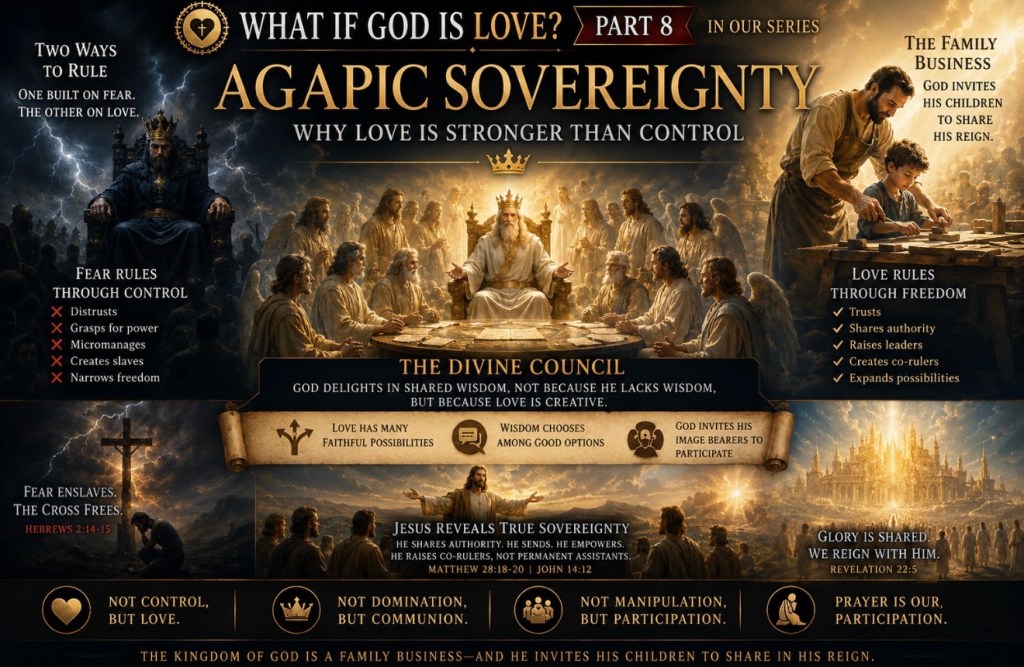
Rather than contrasting sovereignty with freedom, Scripture repeatedly contrasts two entirely different ways of ruling.
One rules through fear.
The other rules through love.
Everything that follows in the biblical story grows out of that difference.
Two Kinds of Kings
Imagine two kings.
One keeps absolute control over every decision.
No one is trusted.
Nothing happens without his approval.
His servants obey because they are afraid not to.
At first glance, this appears to be tremendous strength.
But beneath the surface lies something else.
Fear.
A ruler who cannot trust anyone is himself ruled by fear.
He fears losing control.
He fears failure.
He fears being disappointed.
His kingdom becomes an extension of his own insecurity.
Now imagine another king.
His people obey because they love him.
He teaches.
He equips.
He corrects.
He entrusts responsibility.
He delights to see others flourish.
He is no less involved than the first king.
In fact, he is far more engaged.
But his goal is not to create lifelong servants who cannot think for themselves.
His goal is to raise faithful rulers who share his heart.
Which king is truly greater?
The second.
Not because he exercises less authority, but because his authority is secure enough to be shared.
He does not need to cling to control in order to remain king.
His authority is secure enough to be shared.
This is precisely how Scripture presents the God who is Agape.
Fear Rules Through Control
This pattern is woven throughout the entire biblical story.
Immediately after humanity’s fall, fear enters the world.
Adam and Eve hide.
Cain murders his brother.
Nations build empires through violence.
Pharaoh enslaves.
Babylon conquers.
Rome crucifies.
Again and again, kingdoms ruled by fear seek greater control because fear always attempts to preserve itself.
The writer of Hebrews says something astonishing about the human condition.
Jesus shared our humanity “so that by his death he might destroy the one who holds the power of death—that is, the devil—and free those who all their lives were held in slavery by their fear of death.” (Hebrews 2:14–15)
Notice the diagnosis.
Humanity is enslaved not simply by death itself, but by the fear of death.
Fear becomes the great tyrant beneath every other tyrant.
Fear drives selfishness.
Fear drives greed.
Fear drives domination.
Fear drives violence.
Fear even drives many of the ways people attempt to govern one another.
This explains why Proverbs says,
“Better a patient person than a warrior, one with self-control than one who takes a city.” (Proverbs 16:32)
Scripture measures true strength very differently than the world.
Conquering a city may look impressive.
Conquering oneself is greater still.
The greatest ruler is the one who first rules his own heart.
Another proverb says,
“Like a city whose walls are broken through is a person who lacks self-control.” (Proverbs 25:28)
Without self-rule there can be no faithful rule over anything else.
This is exactly what humanity lost.
Created to govern creation, we first ceased governing ourselves.
Our fear began ruling us.
Love Rules Through Freedom
Against that backdrop, the sovereignty of God shines with breathtaking beauty.
God never rules from fear because He is never ruled by fear.
He fears neither death nor loss.
He never acts out of insecurity.
He never manipulates.
He never grasps for control.
Every action flows freely from His own character.
And His character is Agape.
John therefore reaches an astonishing conclusion.
“There is no fear in love. But perfect love drives out fear.” (1 John 4:18)
This is not merely describing human relationships.
It reveals God’s own life.
Perfect love contains no fear because fear has nothing left to protect.
God’s sovereignty is not His ability to control everything.
It is His perfect freedom to always act according to love.
Love does not diminish freedom. Love expands it.
The more clearly we see the possibilities for faithful love, the more freely we are able to choose among them.
There are countless faithful ways a loving Father may respond to His children.
He may encourage.
Correct.
Comfort.
Wait.
Discipline.
Forgive.
Restore.
Every one of these actions can arise from perfect love.
Love is not mechanical.
Love is infinitely creative.
This is why the biblical God continually responds without ever becoming inconsistent.
His character never changes.
His relationships genuinely do.
The Image of a Sovereign God
Once this is understood, Genesis suddenly becomes astonishing.
“So God created mankind in his own image… and God blessed them and said to them… ‘Fill the earth and subdue it. Rule…’” (Genesis 1:27–28)
The first thing God gives His image bearers is responsibility.
He shares His rule.
That immediately raises an important question.
If sovereignty means never sharing authority…
why does the sovereign God immediately share His?
The answer becomes obvious.
Because this is what love does.
Love delights in creating others capable of meaningful participation.
Even after humanity’s rebellion, Scripture continues treating us as genuine moral agents.
God tells Cain,
“Sin is crouching at your door… but you must rule over it.” (Genesis 4:7)
Moses tells Israel,
“I have set before you life and death… Now choose life.” (Deuteronomy 30:19)
Joshua declares,
“Choose this day whom you will serve.” (Joshua 24:15)
The biblical story never portrays humanity as incapable of all meaningful response.
Humanity is wounded.
Humanity is mortal.
Humanity is enslaved by fear.
But humanity is continually called back into genuine participation with God.
The problem is not that people were created unable to rule themselves.
The tragedy is that we surrendered that rule to fear.
The Family Business
For most of human history, parents did not simply hope their children would obey while growing up.
They hoped their children would one day help lead the family business.
If the family were shepherds, the children learned shepherding.
If the family built homes, the children learned construction.
Parents patiently shaped both character and wisdom until their sons and daughters could be trusted with increasing responsibility.
The family flourished when mature children shared in the work.
This ancient picture beautifully illuminates the biblical story.
From the beginning, God was never merely creating servants.
He was raising image bearers.
His purpose was never simply obedience.
It was maturity.
The Kingdom has always been about forming people who reflect the Father’s wisdom so deeply that they can faithfully participate in His rule.
Love does not hoard responsibility.
Love prepares others to share it.
The Opposite of a Micromanager
Most of us have experienced two kinds of leaders.
One constantly hovers.
Every decision must pass through them.
They rewrite your work.
Second-guess every idea.
Rarely trust anyone.
You may have responsibility on paper, but you possess almost no genuine authority.
Working under someone like that slowly drains initiative, creativity, and joy.
It begins to feel less like meaningful work and more like servitude.
Micromanagement often appears to be strength.
In reality, it is usually fear wearing the mask of leadership.
A leader who cannot trust others reveals that fear has already become the true ruler of his own heart.
The best leaders are very different.
They teach.
They coach.
They correct.
Then they step back.
Not because they care less.
Because they are raising leaders rather than permanent assistants.
Ironically, those organizations often flourish far beyond what any one person could accomplish alone.
The contrast could hardly be greater.
Fear clings to control.
Love creates co-rulers.
Once that contrast is seen, the biblical story suddenly comes into focus.
God is not the ultimate micromanager.
He is the perfect Father.
Jesus Reveals True Sovereignty
Everything reaches its clearest expression in Jesus.
Jesus possesses all authority.
Yet He constantly shares it.
He sends out the Twelve.
He sends out the Seventy-Two.
He gives them authority over disease, demons, and the proclamation of the Kingdom.
After His resurrection He declares,
“All authority in heaven and on earth has been given to me. Therefore go…” (Matthew 28:18–19)
Then He makes one of the most astonishing promises in all of Scripture.
“Whoever believes in me will do the works I have been doing, and they will do even greater things than these…” (John 14:12)
Why?
Because the Spirit will now dwell within God’s people.
The work of the Kingdom will spread throughout the world.
The King shares His own life with His people.
Authority is not diminished by being shared.
It is fulfilled.
This is what Agapic sovereignty looks like.
Love Shares Its Glory
This also helps us understand one of the Bible’s most beautiful words.
Glory.
In Scripture, glory is often associated with God’s royal presence, His reign, His majesty, and the visible manifestation of His kingship. Glory is not merely brilliance or honor. It is the weight and beauty of God’s own life made known as He reigns.
Remarkably, Jesus says to the Father,
“The glory that you have given me I have given to them.” (John 17:22)
Paul says we are heirs with Christ.
Peter says we become participants in the divine nature.
Revelation says we will reign with Him forever.
The point is breathtaking.
God does not guard His glory as something He fears losing.
He shares it.
The Father delights in sharing His reign with the Son.
The Son delights in sharing His reign with His people.
The Spirit delights in forming us into people who can faithfully receive that gift.
Love is not less glorious because it shares.
Love is most glorious because it can.
A Kingdom of Participation
Everything now converges.
The God who is Agape does not govern through fear because He has never been ruled by fear.
He governs through perfect love.
He creates image bearers.
He calls them to maturity.
He entrusts them with responsibility.
He patiently forms them until they can faithfully share in the family business.
Fear builds kingdoms of control.
Love builds kingdoms of communion.
Fear creates slaves.
Love raises sons and daughters.
Fear produces micromanagers.
Love produces co-rulers.
This is Agapic sovereignty.
Not solitary control.
Shared reign.
Not domination.
Participation.
Not insecurity.
Perfect freedom.
The Divine Council: How Love Governs
At this point, one final piece falls beautifully into place.
Throughout this series we have followed one simple question to its logical conclusion:
If God truly is Agape… what follows?
We have discovered that love creates freedom.
Love expands possibilities.
Love forms character.
Love respects genuine response.
Love speaks differently to different hearts.
Love governs without resorting to coercion.
If all of that is true, then we should expect God’s own way of governing the universe to reflect those same realities.
And remarkably, it does.
Throughout Scripture, God is repeatedly portrayed as surrounded by His heavenly council. He takes council to deliberate how He might rule and partner with spiritual beings, angels, prophets, judges, kings, apostles, and ultimately through His redeemed people. Throughout the biblical story, the picture is not that of a solitary ruler governing in isolation, but of a King who delights in sharing His deliberation and workings in the world with others.
This is not because God lacks wisdom.
Nor is it because He needs advice.
The all-wise God is never searching for information He does not possess.
Rather, the Divine Council reveals something profound about the very nature of love itself.
If every situation required only one possible expression of perfect love, then deliberation would have little purpose. But Scripture presents something richer.
Love is not mechanical.
Wisdom is not a formula.
Perfect love does not collapse every situation into one unavoidable course of action.
There can be multiple faithful ways of responding to the same situation, each genuinely consistent with love.
It opens many faithful possibilities in any given circumstance.
There are many ways to comfort.
Many ways to restore.
Many ways to teach.
Many ways to show mercy.
Many ways to accomplish justice.
Every one of them can faithfully express Agape.
The Divine Council beautifully reflects this reality.
God invites His image bearers, whom He has gifted with the freedom of Logos and deliberation, into genuine participation, not because He needs their wisdom, but because love delights in shared wisdom.
The King who possesses infinite wisdom nevertheless welcomes others to participate in His wise governance, allowing them to share in the joyful creativity of love as His purposes unfold.
This has been God’s heart from the very beginning.
This is why immediately after creating humanity in His image, He entrusts them with His own royal vocation.
“Let us make mankind in our image… and let them rule…” (Genesis 1:26)
The first vocation God gives humanity is not merely to obey.
It is to reign.
From the opening pages of Scripture, God reveals that His intention has always been to raise image bearers who freely participate in His loving rule over creation.
That purpose never changes.
By the end of Scripture, John sees the fulfillment of what began in Eden.
“They will reign forever and ever.” (Revelation 22:5)
The story begins with humanity being commissioned to rule.
It ends with humanity reigning alongside Christ.
Between Genesis and Revelation lies the story of a Father patiently forming His children until they are capable of sharing the family business.
Even now, Paul says that God has ‘raised us up with Christ and seated us with him in the heavenly realms in Christ Jesus’ (Ephesians 2:6).
Our participation in Christ’s reign is not merely future.
It has already begun.
Not yet in its fullness.
But genuinely.
The Kingdom, then, is not merely something God accomplishes while His children stand and watch.
It is something He lovingly invites them to share.
This is Agapic sovereignty.
Not a King anxiously and fearfully guarding His authority but instead a loving Father joyfully sharing it.
Not a kingdom sustained by control.
A kingdom flourishing through communion.
Not fear protecting power.
Love multiplying it.
Which leaves us with one final question.
If this is truly how God governs His Kingdom…
If He genuinely invites His children to participate in His wise and loving rule…
If we have already begun sharing in Christ’s reign…
Then what does that participation actually look like today?
Before we reign with Christ face to face…
How do we participate in His Kingdom now?
That question leads us naturally to the next article.
Because if Agapic sovereignty is true, then prayer is far more than simply talking to God.
It is one of the primary ways our Father invites His children to participate in the loving governance of His world.

