
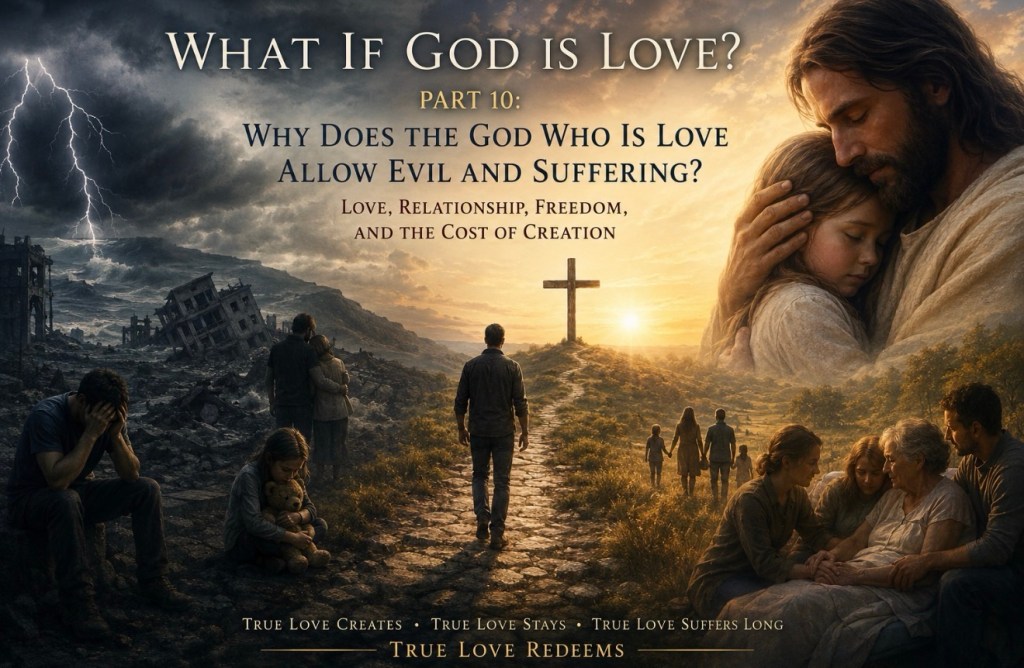
Part 10: Why Does the God Who Is Love Allow Evil and Suffering?
Love, Relationship, Freedom, and the Cost of Creation
Every worldview must eventually answer the same question.
Not merely, “Does suffering exist?”
Everyone agrees that it does.
The deeper question is this:
If reality is fundamentally good, why does it hurt so much?
We ask that question in hospital rooms.
We ask it at funerals.
We ask it beside the bed of a sick child.
We ask it when marriages collapse, friendships fracture, dreams die, and lives unfold in ways we never imagined.
It is one of humanity’s oldest questions.
For many people, it is the question.
It is also one of the primary reasons many reject Christianity altogether.
“If God is all-powerful and all-loving, why doesn’t He simply stop evil?”
It is a fair question.
In fact, if we have followed this series honestly, it is the question we have been moving toward from the very beginning.
But notice something important.
We could not have started here.
If we had begun the series with the problem of evil, we would have had nothing with which to answer it.
Everything we have discussed up to this point has been laying a foundation.
We have discovered that God is not merely loving.
God is Agape.
Creation reflects its Creator.
Freedom exists for formation.
Love enlarges freedom.
Hardening explains why freedom becomes increasingly enslaved.
God’s omniscience is perfectly suited for genuine relationships.
Prophecy reveals His wisdom rather than meticulous scripting.
His sovereignty is expressed through shared rule rather than exhaustive control.
Prayer invites us into that shared rule because love delights in participation.
Only now are we finally ready to ask:
If God truly is Agape, why does He permit evil and suffering?
Perhaps the first surprise is this.
The answer does not begin with humanity.
It begins long before creation itself.
Agape Before Creation
One misunderstanding must be avoided from the very beginning.
If suffering exists in our world, it is tempting to conclude that suffering somehow belongs to the very nature of love.
It does not.
Before anything was created…
before angels…
before stars…
before humanity…
before creation itself…
God already existed as Father, Son, and Holy Spirit.
And what was God’s life like?
It was already Agape.
The Father eternally gives Himself in love to the Son. The Son eternally gives Himself in love to the Father, and the Spirit eternally participates in this perfect loving communion.
Each gives themselves to the others.
Each delights in the others.
Each lives not for themselves but in perfect loving communion.
This eternal life is one of complete self-giving.
Perfect generosity.
Perfect joy.
Perfect fellowship.
Notice what is missing.
There is no jealousy.
No domination.
No selfish ambition.
No rivalry.
No loneliness.
No suffering.
That observation is important because it prevents us from making a serious mistake.
Agape does not require suffering.
If it did, then suffering would have existed eternally within God Himself before creation ever began.
Scripture never suggests such a thing.
What Agape does require is something else.
It requires self-giving.
Love always gives itself away.
That has always been true of God.
Creation did not teach God how to love.
God created because He already loved.
Yet once God freely chose to create beings genuinely distinct from Himself, something changed.
Not because God’s nature changed.
But because the objects of His love changed.
Now His love was directed toward creatures who were not already perfect.
Not already mature.
Not already fully formed.
And that changes everything.
Why Creation Changes Everything
One of the central arguments of this series has been that God did not create humanity in its final form.
Genesis tells us we were created in God’s image.
Scripture then spends the rest of its story inviting us toward His likeness.
That distinction matters.
Image is given.
Likeness is grown into.
We were never created as finished products.
We were created with the capacity to become.
That is exactly what mature love requires.
Imagine a husband and wife discussing whether they want children.
No loving parent says,
“We would love to have children…
…provided they never require patience.”
No one says,
“I hope they are born already mature.”
Everyone instinctively understands that children must grow.
They will misunderstand.
They will make mistakes.
They will misuse freedom.
They will require instruction.
Correction.
Forgiveness.
Encouragement.
Patience.
Parents know this before the child is ever conceived.
Yet they choose to love anyway.
Why?
Because mature sons and daughters are worth years of patient formation.
The goal is never perpetual childhood.
The goal is maturity.
Is this not exactly what Scripture says God is doing?
Paul writes that we are to grow into “the full measure of the stature of Christ.”
Peter tells believers to grow into maturity.
Hebrews rebukes Christians for remaining spiritual infants when they ought to have become teachers.
The entire biblical story assumes formation.
Growth.
Transformation.
Sanctification.
This is precisely why freedom was necessary.
God could create beings capable of becoming loving.
He could not create beings who had already become loving.
Character cannot simply be manufactured.
It must be formed.
Love must be chosen.
Wisdom must be learned.
Faithfulness must mature.
And wherever immature freedom exists…
patience becomes necessary.
Why Suffering Becomes Inevitable
Here we arrive at an important distinction.
Earlier in this series we argued that Agape requires vulnerability.
I now think we can state the truth even more precisely.
Agape requires communion.
Communion requires vulnerability.
And wherever genuine vulnerability exists…
the possibility of suffering becomes unavoidable.
That is not because suffering is good.
It is because love refuses to remain isolated.
Consider what happens whenever we genuinely love another person.
The moment someone becomes precious to us…
their joys become our joys.
Their grief becomes our grief.
Their suffering becomes our suffering.
Parents know this.
Spouses know this.
Close friends know this.
The deeper the love…
the greater the vulnerability.
Heartbreak is no longer merely a hypothetical.
Given enough time, enough relationships, and enough freedom, it becomes an unavoidable possibility.
Not because love has failed.
But because love has truly opened itself to another.
This helps explain something we all instinctively know.
Imagine again the husband and wife who long for children.
They already know those children will one day disappoint them.
They know there will be sleepless nights.
Misunderstandings.
Discipline.
Fear.
Tears.
Eventually, perhaps even grief.
Yet they do not conclude that love is therefore not worth giving.
They conclude exactly the opposite.
The child is worth the cost.
The same is true of every deep relationship.
No lasting marriage has ever existed without patience.
No genuine friendship has ever existed without forgiveness.
No healthy family has ever existed without endurance.
No community has ever flourished without people bearing one another’s burdens.
Communion is beautiful precisely because it binds lives together.
Yet once lives are truly bound together, one person’s suffering inevitably touches another.
Love no longer stands at a safe distance.
It enters another’s joys.
It enters another’s sorrows.
It willingly shares both.
This is why suffering should not surprise us in a world created by Agape.
God did not create suffering because suffering is good.
He created beings capable of communion.
And communion inevitably carries the possibility—and eventually the reality—of shared sorrow.
While the alternative would be a world with less suffering it also would have required a world with less vulnerability, less freedom, and therefore less ability to love.
Love does not delight in suffering.
Love delights in communion.
Yet wherever communion is real among free, growing, embodied creatures, suffering eventually becomes part of the story—not because love has failed, but because love refuses to remain distant from those it loves.
Why Evil Exists
This also helps us understand moral evil.
Not all suffering is evil.
Cancer is suffering.
Earthquakes are suffering.
Storms are suffering.
Disease is suffering.
These are tragedies.
But they are not moral choices.
Evil is different.
Evil occurs when persons freely act against the flourishing of another.
Murder.
Abuse.
Oppression.
Betrayal.
Hatred.
Exploitation.
These are not merely painful events.
They are corruptions of love.
They are freedom turned inward upon itself.
Earlier in this series we argued that freedom exists for love.
Here we discover its tragic counterpart.
The same freedom that makes forgiveness possible also makes revenge possible.
The same freedom that allows compassion also allows cruelty.
The same freedom that allows generosity also allows greed.
Some suggest that a loving God should simply prevent every evil action before it occurs.
At first, that sounds compelling.
Until we ask what kind of world would remain.
Imagine every lie becoming impossible to tell.
Every hateful thought immediately erased.
Every selfish decision automatically overridden.
Every violent act miraculously prevented before it could occur.
Would we still possess meaningful freedom?
Or would we merely possess the appearance of it?
Love cannot be coerced.
Neither can virtue.
If rejection becomes impossible…
acceptance also loses its meaning.
Kindness becomes instinct rather than character.
Faithfulness becomes programming rather than devotion.
Agape seeks something greater than mere behavioral compliance.
It seeks transformed persons.
Persons who freely become the kind of people who love because they have learned to love.
Evil, therefore, is never created by God.
It is always the corruption of the communion God created freedom to enjoy.
Agape builds communion.
Evil fractures communion.
Agape gives.
Evil takes.
Agape heals.
Evil wounds.
Agape seeks the flourishing of another.
Evil elevates self at another’s expense.
It possesses no creative power of its own.
It can only corrupt what love has first brought into existence.
Natural Suffering and a World Capable of Love
Yet moral evil is not the whole story.
Animals suffer.
Children suffer.
Natural disasters strike entire communities regardless of their moral choices.
How can these realities exist within a world created by Agape?
Part of the answer lies in the kind of world love intended to create.
Love does not merely require freedom.
Love also requires a world stable enough for freedom to become meaningful.
Fire warms homes.
It also burns forests.
Gravity allows us to walk.
It also makes every fall dangerous.
The same biological processes that permit growth, healing, and reproduction also permit disease, mutation, and death.
A world governed by stable, intelligible patterns makes love possible.
We can learn.
Trust.
Plan.
Build.
Raise families.
Keep promises.
Cultivate gardens.
Develop civilization.
Without such dependable order, freedom itself would become meaningless.
Yet those same stable patterns also make suffering possible.
That is one reason Scripture repeatedly celebrates creation’s order even while acknowledging its groaning.
There is another observation worth making.
Not everything experiences suffering in the same way.
A stone may break.
A tree may fall.
A mountain may erode.
But we do not normally say the mountain grieves.
Suffering appears to increase alongside consciousness.
The more richly a creature experiences reality…
the more richly it can experience both joy and pain.
That should not surprise us.
Throughout this series we have traced a progression.
Matter.
Life.
Consciousness.
Reason.
Conscience.
Freedom.
Agape.
Each new gift introduces new possibilities.
But each new possibility also introduces new vulnerability.
Matter can be broken.
Life can die.
Conscious creatures can suffer.
Persons can grieve.
Those capable of profound love become capable of profound loss.
Yet almost no one, having truly loved another person, sincerely wishes they had never loved at all.
Again and again humanity reaches the same remarkable conclusion.
Love is worth the risk.
Perhaps that intuition tells us something profound about reality itself.
The Cross: Where We Finally See What Agape Looks Like
Everything we have said so far leads to one unavoidable question.
Even if suffering is the inevitable cost of a world capable of love…
Even if evil is the inevitable possibility that accompanies genuine freedom…
Even if stable creation requires a world where natural suffering can occur…
How do we know this is really what God is like?
How do we know we have not simply invented a philosophical explanation for suffering?
The Christian answer is astonishing.
We do not ultimately discover God’s love by explaining suffering.
We discover God’s love by watching what God Himself does when suffering enters the world.
He enters it.
This may be the greatest surprise in all of Christianity.
Nearly every religion attempts to explain suffering.
Christianity certainly gives us reasons to think deeply about it.
But at its center, Christianity does something else entirely.
It tells us that God does not remain safely distant while His creation suffers.
He comes.
John writes,
“This is how we know what love is: Jesus Christ laid down His life for us…” (1 John 3:16)
Notice what John does not say.
He does not point us to creation.
He does not point us to miracles.
He does not point us to God’s omnipotence.
He does not point us to His omniscience.
He points us to the Cross.
Paul says exactly the same thing.
“God demonstrates His own love for us in this: while we were still sinners, Christ died for us.” (Romans 5:8)
Again…
How do we know God is Agape?
Because Christ suffered.
The fullest revelation that God is Love is not found in His preventing suffering.
It is found in His entering it.
That changes everything.
Many people ask,
“If God is love, why doesn’t He remove all suffering?”
Christianity responds with something far more profound than many of us expect.
God does not promise that His people will never suffer.
He promises they will never suffer alone.
Jesus never tells His disciples that following Him will eliminate pain.
In fact, He promises the opposite.
“In this world you will have trouble.”
Yet immediately afterward He says,
“But take heart. I have overcome the world.”
How?
Not by avoiding suffering.
By passing through it.
The Cross is not God’s exception to Agape.
It is Agape unveiled.
God with us.
Emmanuel.
Not only in a manger…
but on a cross.
Not only among the joyful…
but among the grieving.
Not only in celebration…
but in agony.
Even the details matter.
Jesus hangs between two criminals.
He does not suffer above humanity.
He suffers beside humanity.
He joins us in the deepest place of human pain.
The God who is Agape does not ask us to go somewhere He has never gone Himself.
He enters suffering before asking us to trust Him within it.
That is why the Cross has always stood at the center of Christian faith.
Not because suffering is good.
But because love refuses to abandon the beloved when suffering comes.
Love stays.
Love Suffers Long
Perhaps this also sheds new light on one of the most familiar passages in all of Scripture.
Paul begins his famous description of Agape with words we have heard countless times.
“Love is patient.”
Most of us read those words without giving them much thought.
Yet the Greek word Paul uses literally means,
Love suffers long.
What an extraordinary place to begin.
Paul could have started anywhere.
He could have begun by saying love is powerful.
Love is holy.
Love is wise.
Love is just.
Instead, the very first characteristic he chooses is long-suffering.
Why?
Because this is what love does.
Love remains present.
Love refuses to walk away.
Love continues giving itself even when the relationship becomes costly.
This has been true of God throughout the entire biblical story.
God patiently bears with Israel.
God patiently bears with humanity.
God patiently bears with every one of us.
And finally…
God bears our suffering in Christ Himself.
Long-suffering is not merely another virtue alongside the others.
It is one of the clearest manifestations of Agape.
Faithful parents know this.
Faithful spouses know this.
Faithful friends know this.
They continue loving when love becomes costly.
Not because pain is desirable.
But because the beloved is worth remaining with.
That is Agape.
Love Stays
As I have written these last two articles, I have realized something I had never fully seen before.
Only a few months ago, my own family entered one of the hardest seasons we have ever faced.
Within forty-eight hours my sixty-nine-year-old mother was told that the cancer discovered in her transplanted lungs could take her life within weeks.
Two days later, my sixteen-year-old son was diagnosed with a brain tumor, a brain aneurysm, and a Chiari malformation.
I prayed.
I trusted.
I hoped.
My mom died in December.
My son survived.
His tumor and aneurysm proved to be benign, and his surgery successfully corrected the Chiari malformation.
One prayer ended the way I desperately wanted.
One did not.
Yet strangely…
I believe everything I have written here more deeply now than I did before.
Not because suffering became easier.
It did not.
I still miss my mom.
I still wonder why my son had to endure what he endured.
Why should someone so young have to face the possibility and then actuality of a brain surgery?
Why should his mother, his family, and everyone who loves him have to walk through those terrifying weeks?
Those questions are real.
This article has not eliminated them.
But it has changed the way I understand them.
I no longer believe suffering proves that God has stopped loving.
I believe suffering reveals just how costly love has always been.
Where I See Agape Every Day
Several months after my mother’s death, my ministry also changed.
Today I serve as a hospice chaplain.
Every day I walk into rooms where families are preparing to say goodbye.
Every day I sit beside hospital beds.
Every day I pray.
Every day I witness grief.
People sometimes ask how I can do that work.
The answer is surprisingly simple.
Because I believe God is already there.
If I believed suffering proved God had abandoned people…
I could never do this.
If I believed suffering demonstrated that love had failed…
I would have chosen another vocation.
Instead, I spend my days walking into suffering because I believe that is exactly what Christ has always done.
Love stays.
Something else has become increasingly clear to me through this ministry.
One of the saddest realities hospice workers observe is withdrawal.
People who have experienced profound pain sometimes begin withdrawing from everyone around them.
It is understandable.
When we have been deeply wounded, isolation can feel safer than relationship.
We convince ourselves that if we stop loving…
perhaps we can stop hurting.
Yet experience consistently tells us something different.
Isolation does not heal us.
Instead, it deepens the pain.
Medical professionals know this.
Counselors know this.
Chaplains know this.
Sometimes the greatest ministry any human can give another is quite literally the ministry of presence.
This only makes sense if human beings were not created to exist alone in isolation.
The attempt to avoid every possible wound becomes a wound of its own.
Perhaps that should not surprise us.
If reality is fundamentally grounded in Agape…
then withdrawing from communion can never become our healing.
The deepest medicine for the human soul has never been isolation.
It has always been relationship.
This is why even in hospice, some of the most beautiful moments occur not when suffering disappears…
but when people refuse to let someone suffer alone.
A daughter holds her father’s hand.
A husband whispers one last “I love you.”
Grandchildren gather around a bedside.
Friends sing hymns together.
The suffering remains.
But something else enters the room.
Communion.
Presence.
Love.
Hope.
That is what Agape does.
It stays.
The God Who Is Love
If this series has argued anything, it is this.
God did not create evil because evil is good.
God did not create suffering because suffering is beautiful.
God created a world where communion could become real.
Where love could mature.
Where freedom could flourish.
Where sons and daughters could become like their Father.
Such a world inevitably carries risk.
It inevitably requires patience.
It inevitably involves long-suffering.
Yet when that suffering entered the world…
God did not stand at a distance explaining it.
He entered it.
He bore it.
He redeemed it.
And He now invites His people to do the same.
Not by solving every mystery.
But by remaining present.
By loving.
By comforting.
By carrying one another’s burdens.
By becoming living witnesses to the God who is Agape.
Perhaps that is why the Cross has never merely been the place where our sins were forgiven.
It is also the place where reality itself was finally unveiled.
This…
is what Love looks like.
Not avoiding suffering.
Entering it.
Not abandoning the beloved.
Remaining with them.
Not merely explaining evil.
Overcoming it through self-giving communion.
And perhaps that finally prepares us for one last question.
If God knew that creating a world capable of Agape would also be a world capable of suffering…
why create at all?
Why would Love choose to take that risk?
That is where we turn next.
 The Logos of Agape