Part 12: The Story Love Has Been Telling All Along
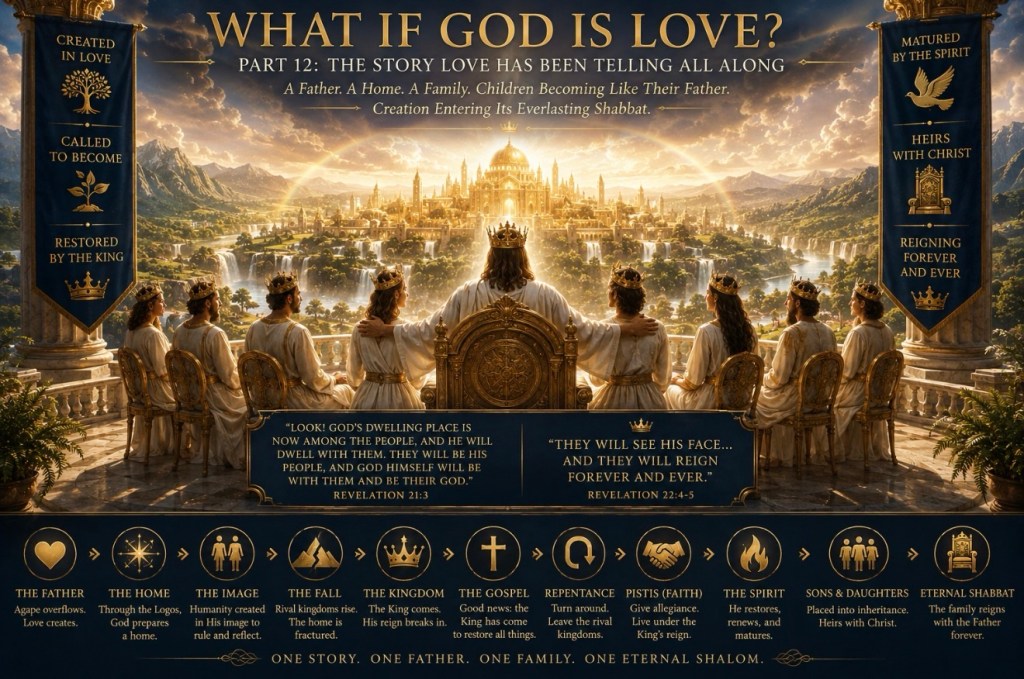
If God is Agape…
then Scripture is not ultimately the story of rules.
It is not merely the story of sin.
It is not even merely about the story of salvation.
It is the story of a Father building a home, raising a family, restoring His children, and bringing creation into its intended Shabbat.
That has been the thread running beneath every article in this series.
We began by discovering that creation itself was an act of love. God did not create because He lacked glory, worship, or companionship. Agape overflows. Agape shares itself. Agape creates because love delights in giving itself.
We saw that through the Logos, God prepared a home where His family could flourish. Humanity was created in His image—not as the finished product, but as children invited to grow into His likeness through freedom, conscience, and love.
Then we asked the question that inevitably follows.
If love always risks rejection…
why would God create such a world at all?
The answer was that Agape judged the possibility of an eternal family to be worth the possibility of heartbreak.
But that leaves one final question.
If this has always been God’s purpose…
why are we not already living in a home of Shabbat?
Why does the world so often feel like exile instead of Shabbat?
The rest of Scripture answers that question.
And remarkably…
it never abandons the purpose established in Genesis.
The Vocation We Lost
Many people assume humanity’s greatest problem is that we broke God’s rules.
Scripture certainly speaks about disobedience.
But the biblical story is much larger than that.
Humanity did not simply violate commandments.
Humanity abandoned its vocation.
From the beginning, men and women were created in God’s image.
As we have argued throughout this series, an image is more than resemblance.
An image represents.
Images make the invisible visible.
They extend the presence and reign of the one they represent.
Humanity was therefore created to extend God’s wise and loving reign throughout creation.
We were placed within God’s cosmic temple not merely to live there…
but to cultivate it.
To steward it.
To name creation.
To develop it.
To fill the world with the same Agape that already existed within God Himself.
Yet humanity was not only created in God’s image.
We were created to grow into His likeness.
Image was the beginning.
Likeness was the destination.
We were meant to mature until we freely loved as our Father loves.
Until Agape became our character rather than merely His.
That was our vocation.
To become the kind of sons and daughters through whom God’s loving reign would spread until all creation shared in His Shabbat.
The tragedy of Genesis 3 is therefore much deeper than eating forbidden fruit.
Humanity rejected the very purpose for which it had been created.
Throughout Scripture, it is evident that it uses several different words for what English simply calls “sin.” (For more on this, look for the Article on Sin in the Mistranslated series.)
Each one highlights a different aspect of humanity’s failure.
Sometimes sin is missing the mark.
We failed to become what we were created to become.
Sometimes it is transgression.
We crossed boundaries that protected life and communion.
Sometimes it is lawlessness.
We rejected God’s wisdom altogether and chose to define good and evil for ourselves.
These are not competing ideas.
They describe the same catastrophe from different angles.
Humanity did not merely become guilty.
Humanity became disordered.
The image was fractured.
The journey toward likeness stalled.
Communion gave way to alienation.
Trust became fear.
Self-giving became self-protection.
Agape gave way to self-preference.
The home God prepared was no longer functioning as it was designed.
Shabbat was broken.
That fracture reached far beyond individual human hearts.
It reshaped civilization itself.
Humanity no longer extended God’s Kingdom into creation.
Instead, we began constructing kingdoms of our own.
Kingdoms built on fear rather than trust.
On domination rather than service.
On power rather than love.
On self-exaltation rather than Agape.
The tower of Babel becomes the first great symbol of this new humanity.
Instead of spreading God’s blessing throughout the earth, humanity gathers to make a name for itself.
Instead of imaging God, humanity seeks its own glory.
The pattern continues throughout Scripture.
Egypt.
Assyria.
Babylon.
Rome.
Every empire repeats the same story.
Each promises flourishing apart from God.
Each offers security through power.
Each ultimately demands allegiance that belongs only to the Creator.
The biblical story therefore becomes much larger than individual sinners needing forgiveness.
It becomes the story of two rival kingdoms.
One built upon Agape.
The other built upon self.
One seeks communion.
The other seeks domination.
One produces Shalom.
The other produces endless conflict.
Every human heart eventually discovers itself standing between those two kingdoms.
God Did Not Abandon His Purpose
If that were the end of the story, Genesis would end in tragedy.
The family would remain scattered.
The home would remain broken.
Shabbat would become nothing more than a forgotten memory.
But Scripture refuses to end there.
One of the greatest misunderstandings in Christianity is the idea that the Fall forced God to invent a new plan.
As though creation failed…
and salvation became Plan B.
The biblical story says something entirely different.
God never abandoned His original purpose.
The purpose remained exactly the same.
A family.
A home.
Communion.
Shabbat.
Everything that follows Genesis is the story of God restoring what humanity abandoned.
This is why the central message of Jesus is not simply, “Your sins can be forgiven.”
His first proclamation is far larger.
“The Kingdom of God is at hand.”
That announcement is often reduced to an invitation to go to heaven after death.
But in Scripture, the Kingdom is God’s reign breaking back into the world that humanity surrendered to rival kingdoms.
It is God’s original purpose re-entering history.
The King has come.
Not merely to rescue isolated individuals.
To reclaim His creation.
To restore His family.
To renew His world.
To bring creation back toward its intended Shabbat.
Seen this way, the Gospel itself begins to look different.
Most people hear the word “gospel” and immediately think,
“How can I be saved?”
Certainly the Gospel includes salvation.
But in the New Testament, the Gospel is first an announcement before it is an invitation.
It is the royal proclamation that the true King has arrived.
His Kingdom has begun.
The rival kingdoms will not have the final word.
Creation is being reclaimed.
The family is being restored.
Shabbat is coming.
Salvation matters because it restores us to that larger story.
God is not merely saving souls from judgment.
He is restoring image bearers to their original vocation.
The Gospel is therefore not about escaping creation.
It is about restoring creation.
It is not about abandoning the home.
It is about bringing the home back to life.
Returning Home
If the King has come…
how should humanity respond?
Jesus answers with two words that have often been misunderstood.
The first is repentance.
Many hear repentance and imagine little more than feeling guilty.
But repentance is far richer than regret.
It means turning around.
Changing one’s mind because one has discovered that one has been walking in the wrong direction.
The prodigal son illustrates repentance perfectly.
His transformation did not begin when he reached his father’s house.
It began while he was still in the far country.
He came to himself.
He recognized that the life he had chosen could never become home.
Then he turned.
Repentance is not merely turning away from sin.
It is turning toward the Father.
It is abandoning the rival kingdoms and beginning the journey home.
But turning alone is not enough.
The New Testament immediately pairs repentance with another word that has often been flattened by English translation.
Faith.
Yet as we discovered earlier in this series, pistis means far more than intellectual belief.
One can believe a king exists while remaining loyal to another kingdom.
Pistis is allegiance.
It is entrusting oneself to the rightful King.
It is living under His reign.
It is participating in His Kingdom rather than merely agreeing with His existence.
That changes everything.
Christianity is not merely accepting certain theological propositions.
It is transferring our allegiance from the kingdoms of self to the Kingdom of Agape.
It is learning once again to live as children within the Father’s house.
The Gospel announces that the King has come.
Repentance turns us toward Him.
Faith gives Him our allegiance.
Only then can the restoration of the family truly begin.
Because the goal has never merely been forgiven sinners.
The goal has always been restored children.
Children Become Like Their Father
Everything we have seen so far now leads us to what may be the most beautiful thread running through all of Scripture.
If the Gospel is the announcement that the King has come to restore His Kingdom…
If repentance is turning around and coming home…
If pistis is giving our allegiance to the true King…
Then what, exactly, is God trying to make of us?
The answer is hidden in plain sight.
Most English Bibles simply use the word children.
But the New Testament quietly changes its vocabulary as the story unfolds.
It does not simply keep calling us “children.”
It moves.
And that movement tells the entire story of redemption.
We Begin as God’s Offspring
When Paul stood before the philosophers in Athens, he did something astonishing.
Surrounded by idols…
Standing before people who knew almost nothing of Israel’s Scriptures…
Paul did not begin by calling them strangers to God.
He did not even begin by calling them sinners.
Instead he quoted one of their own poets.
“For in Him we live and move and have our being… As some of your own poets have said, ‘We are His offspring.’” (Acts 17:28)
The Greek word Paul uses is genos.
It means offspring.
Origin.
Family line.
Paul’s point is remarkable.
These people did not know their Father.
They worshipped idols.
They had built lives around rival kingdoms.
Yet Paul still says they are God’s offspring.
They still bear His image.
They still owe their very existence to Him.
Every breath.
Every heartbeat.
Every moment of consciousness.
Every act of reason.
Every whisper of conscience.
Every longing for love.
All of it finds its source in Him.
“In Him we live and move and have our being.”
Humanity had not ceased being God’s offspring.
Humanity had become estranged from its Father.
Suddenly the story Jesus tells about the prodigal son begins to look much larger than one rebellious boy.
It is humanity’s story.
The son never stopped being his father’s son.
He simply forgot where home was.
He lived as an orphan while his father continued loving him.
That is the tragedy of Genesis.
The Fall did not erase the image of God.
It fractured our communion with the One whose image we bear.
We became estranged children living in our Father’s world while no longer recognizing our Father’s voice.
The Father Welcomes His Children Home
That is why John’s Gospel speaks the way it does.
John does not merely tell us that Jesus came to forgive sins.
He tells us something far more personal.
“He came to His own, and His own did not receive Him. Yet to all who received Him, to those who placed their pistis in His name, He gave the right to become children (tekna) of God.” (John 1:11-12)
Notice what John does not say.
He does not say God finally decided to love us.
Nor does he say humanity suddenly began existing.
We already existed.
We were already God’s offspring.
What changed was our relationship.
The estranged child comes home.
The orphan discovers he still has a Father.
The prodigal is embraced.
The dead son lives again.
Jesus Himself explains it this way.
When the prodigal returns, the father says,
“This son of mine was dead and is alive again; he was lost and is found.” (Luke 15:24)
The son had never ceased being his father’s offspring.
But now he is restored to the household.
This is exactly what John means by teknon.
A teknon is not merely someone who originated from a father.
A teknon is a child living within the Father’s family.
Receiving the Gospel is therefore much more than receiving forgiveness.
It is coming home.
The Father’s house was never abandoned.
The Father never stopped watching the road.
The Father never stopped hoping.
The Father never stopped loving.
The child simply turned around.
But the Story Does Not End There
For many Christians, this is where the story ends.
We have been forgiven.
We have become children of God.
Wonderful.
But Scripture keeps going.
In fact, Paul says creation itself is waiting for something more.
“For the creation waits in eager expectation for the revealing of the sons (huioi) of God.” (Romans 8:19)
Notice the change.
Paul does not say creation waits for children.
He says creation waits for sons.
Why?
Because children are meant to grow.
This has been true from the opening pages of Genesis.
Adam and Eve were not created as finished humanity.
They were created as the beginning of humanity.
Image was given.
Likeness was still ahead.
God did not place them in Eden because they had already arrived.
He placed them there because they were just beginning.
The Garden was not graduation.
It was the nursery of humanity.
God’s intention was never merely to populate Eden.
It was to raise a family.
That is why the New Testament speaks so often about growth.
Paul speaks of maturity.
Peter tells believers to grow.
Hebrews rebukes those who should have become teachers but remained spiritual infants.
The Christian life is not merely about remaining forgiven children.
It is about growing into the likeness of our Father.
That is what huios means.
Not simply a biological son.
A mature son.
A son who has become like his Father.
This is why Paul writes,
“Those who are led by the Spirit of God are the sons (huioi) of God… The Spirit Himself testifies with our spirit that we are children (tekna) of God. Now if we are children, then we are heirs…” (Romans 8:14, 16-17)
Paul intentionally uses both words.
We are children.
But we are being led toward mature sonship.
The Spirit is not merely keeping us forgiven.
The Spirit is raising us.
Sanctification suddenly looks completely different.
It is not simply becoming more moral.
It is becoming more like our Father.
More patient.
More faithful.
More truthful.
More merciful.
More self-giving.
More Agape.
This is what humanity was created for from the very beginning.
Sons and Daughters Who Inherit the Household
At this point another word quietly appears in Paul’s writings.
Unfortunately, it has been almost universally translated in a way that obscures what he was trying to say.
Our English Bibles usually translate huiothesia as adoption.
While that translation is understandable, it also creates a picture Paul probably never intended.
When most people hear the word adoption, they imagine someone who was never part of the family finally becoming part of the family.
But that is not the story Paul is telling.
Remember where we’ve already been.
Acts says all humanity is God’s offspring.
John says those who receive Christ become God’s children.
Paul has already said believers are children of God.
So if they are already children…
what exactly are they being “adopted” into?
The answer is…
they aren’t.
They are being placed.
In the ancient world, a father would publicly recognize that his son had reached maturity and was now ready to receive the family inheritance, represent the household, and help govern the family estate.
The child did not become part of the family that day.
The child had always belonged.
What changed was their role within the family.
This is what huiothesia literally means.
The placing of a son.
Or, as we might say today,
the placing of sons and daughters into their inheritance.
This is also why the language of huios should never be misunderstood as excluding women.
Throughout Genesis both men and women are created in God’s image.
Both receive the commission to rule creation together.
Throughout the New Testament all believers become God’s children.
And Paul makes the point explicit when he writes,
“There is neither Jew nor Greek, slave nor free, male nor female, for you are all one in Christ Jesus.” (Galatians 3:28)
The point of huios is not gender.
It is maturity.
The point of huiothesia is not becoming God’s child.
It is mature sons and daughters receiving their inheritance and taking their place within the Father’s household.
Suddenly Romans 8 becomes breathtaking.
Paul writes,
“You received the Spirit of huiothesia, by whom we cry, ‘Abba! Father!’ The Spirit Himself bears witness with our spirit that we are children (tekna) of God. Now if we are children, then we are heirs—heirs of God and fellow heirs with Christ…” (Romans 8:15–17)
Notice how carefully Paul moves.
Children.
Then heirs.
Not strangers becoming family.
Children growing up.
The Father has always been raising a family.
Now He is preparing that family to inherit His Kingdom.
The Whole Story Comes Together
Perhaps now we can finally see the Bible’s story as a single, beautiful whole.
It begins with a Father.
Not because God lacked anything.
Not because He needed worship.
Not because He desired servants.
But because Agape delights in sharing itself.
So through the Logos, God prepares a home.
A world ordered with wisdom.
A creation governed by dependable patterns.
A place where life could flourish.
A place where communion could become possible.
Then He creates humanity in His image.
Not yet in His likeness.
Humanity was never created merely to exist.
Humanity was created to become.
To mature.
To grow into the very character of the Father whose image it bore.
To learn His wisdom.
To embody His Agape.
To share His reign over creation.
But the story did not unfold as intended.
Instead of extending the Father’s loving rule throughout creation, humanity built rival kingdoms.
Instead of trusting the Father, we sought autonomy.
Instead of reflecting Agape, we preferred ourselves.
The home fractured.
The family scattered.
The children became estranged.
Yet the Father never abandoned His purpose.
He did not decide to build a different house.
He did not decide to start over with a different family.
The King Himself entered the story.
The Gospel announced not merely that sins could be forgiven, but that God’s Kingdom had arrived to restore everything sin had broken.
The invitation was simple.
Turn around.
Come home.
Give your allegiance to the true King.
Become once again what humanity was always created to be.
The estranged offspring become restored children.
The restored children mature into sons and daughters.
The family begins to resemble the Father once again.
And then Scripture reveals something even more astonishing.
The goal was never simply that the children would return home.
The goal was that they would one day help their Father govern the household He had prepared for them from the very beginning.
This is why Revelation does not end with redeemed people merely living in a perfect place.
It ends with the completion of the Father’s original purpose.
John writes,
“Look! God’s dwelling place is now among the people, and He will dwell with them. They will be His people, and God Himself will be with them and be their God.” (Revelation 21:3)
The Master Builder has returned to His home.
The Father dwells with His family.
Shabbat has finally arrived.
The work of preparing the house is complete.
The family has come home.
But remarkably…
that is still not the end.
John continues,
“They will see His face… and they will reign forever and ever.” (Revelation 22:4–5)
There it is.
The purpose hidden in Scripture from the very beginning.
The children do not merely live in the Father’s house.
They have grown.
They have matured.
They have become like Him.
They now share in the family inheritance.
They participate in the family vocation.
Together with Christ, they reign in the Father’s household forever.
The home has become everything it was always intended to be.
The Father is present.
The children have become like their Father.
Creation flourishes.
Harmony is restored.
Shabbat gives birth to everlasting Shalom.
Looking back now, every part of the story points in the same direction.
Creation was not about power.
The Fall was not merely about rule-breaking.
Israel was not chosen for privilege but for vocation.
The Kingdom was not an escape plan.
The Gospel was not merely about forgiveness.
Salvation was never simply rescue.
From beginning to end, Scripture has been telling one story:
How a Father restores His family so His home can finally become what love intended from the beginning.
Perhaps that has been the answer hidden in plain sight from the opening pages of Scripture.
God is Agape.
Agape created through the Logos.
The Logos created image bearers.
Agape invited them into likeness.
Sin fractured the home.
The King came to restore it.
The Gospel announced its return.
Repentance turned us around.
Allegiance walked us home.
The Spirit restores estranged offspring into beloved children and patiently matures those children into sons and daughters who resemble their Father.
And one day the Master of the house will dwell once more with His family.
Not simply because they have returned.
But because they have become the kind of people who can share His life forever.
That is the Kingdom of the Logos of Agape.
A Father.
A home.
A family.
Children becoming like their Father.
Creation entering its everlasting Shabbat.
Its eternal Shalom.
If God is Agape Love perhaps…
Perhaps that was the story Scripture was telling all along.
Perhaps this was always the ending Love has always been working toward.
And
Perhaps this was always the only story Scripture could have been telling all along.

