
Part 13: The Risk of Love
Universalism? What Happens If the Prodigals Do Not Come Home?
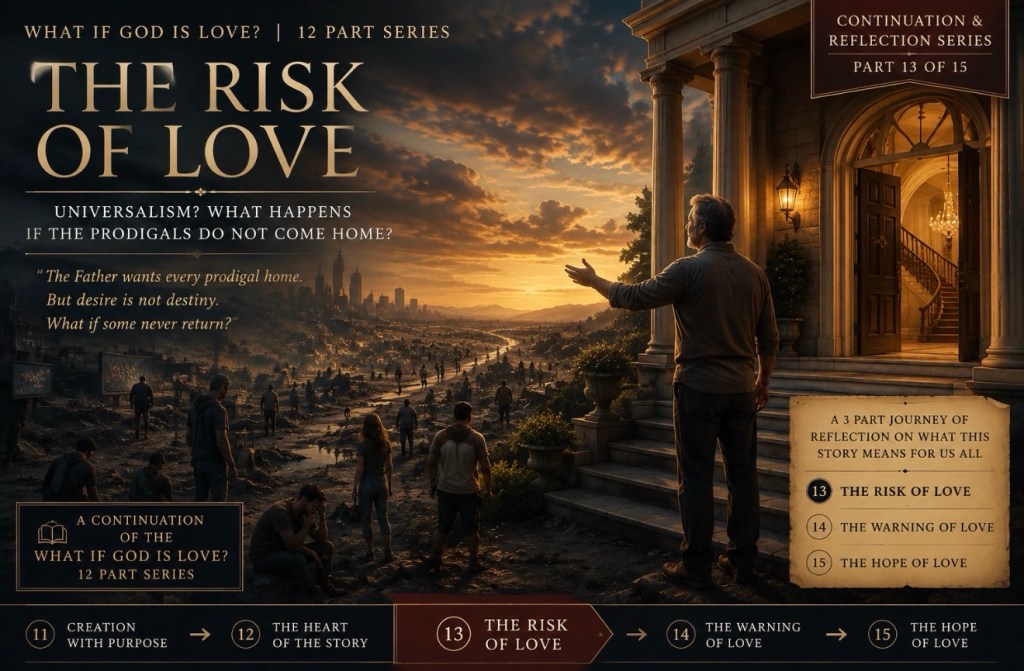
The last article ended with a beautiful picture.
The Father is home.
The family has returned.
The children have grown into the likeness of their Father.
The inheritance has been received.
Creation has entered its Shabbat.
God dwells with His people.
And the children reign with Him forever.
It is difficult to imagine a more beautiful ending.
In fact, if you have followed this series from the beginning, you may have noticed something almost unsettling about the way Part 12 ended.
It sounded a lot like universalism.
And perhaps that is because it described exactly what God wants.
The Father wants His children home.
He wants His family restored.
He wants every prodigal to return.
He wants creation healed.
He wants His children to become everything they were created to become.
He wants Shalom.
He wants communion.
He wants the house full.
That is the story Love has been telling all along.
But there is an important question we have not yet answered.
Is the story God wants the story that must happen?
Or, to put it another way:
Does God’s desire that every prodigal come home mean that every prodigal will come home?
That question changes everything.
Because Part 11 told us that Love decided the possibility of heartbreak was worth the possibility of communion.
Part 12 showed us what Love ultimately hopes that communion will become.
Now we have to look honestly at the other side of the risk.
What if some of the children never come home?
The Father and His Prodigals
Jesus gives us one of the most beautiful pictures of God in all of Scripture in the story we call the Parable of the Prodigal Son.
A father has two sons.
The younger son comes to him and asks for his inheritance.
He wants what belongs to the household.
But he wants it now.
He wants to take what the father has prepared for him and use it according to his own wisdom.
So the father gives him what he asks for.
The son leaves.
He travels to a distant country.
He takes the inheritance that was meant to belong within the household and spends it however he pleases.
Eventually, everything is gone.
The son finds himself hungry, humiliated, and far from home.
And then something changes.
He comes to himself.
He remembers his father.
He remembers home.
He turns around.
He begins the journey back.
And then Jesus gives us one of the most astonishing images in Scripture.
The father sees him while he is still far away.
The father does not wait at the door with folded arms.
He runs.
He embraces his son.
He kisses him.
He calls for the finest robe.
A ring.
Sandals.
A feast.
The father does not merely allow the prodigal to return.
He celebrates his return.
“This son of mine was dead and is alive again; he was lost and is found.” (Luke 15:24)
That is the Father’s heart.
But there is something we often miss.
The story only tells us about one prodigal who returns.
Jesus does not tell us what happens to every prodigal.
And that matters enormously when we begin thinking about the story of humanity.
Because perhaps the prodigal son is not merely a story about one rebellious child.
Perhaps it is a miniature version of the entire human story.
The First Prodigal
Go back to the beginning.
In Part 11, we saw that God did not create humanity merely to exist.
He created us as His image bearers.
He placed us within His home.
He gave us a vocation.
He gave us freedom.
And He intended that we would grow.
We were meant to become mature sons and daughters, eventually sharing in the inheritance and responsibility of the household.
The Father had prepared the home.
The children were meant to grow into the kind of people who could share it with Him.
But then humanity reached for something before it was ready.
Genesis 3 tells us that the serpent offered humanity a different vision of wisdom.
“You will be like God.”
The irony is almost unbearable.
They were already created in God’s image.
They were already invited into God’s likeness.
They were already on the path toward becoming what they were created to be.
But they wanted to take the inheritance on their own terms.
They wanted wisdom without dependence.
They wanted the gift without the Giver.
They wanted to become like God without trusting God.
The first prodigal left home.
And humanity followed.
Adam and Eve were not simply two people who made a bad decision.
They became the beginning of a humanity that would learn to live in the far country.
And their children would be born there.
Then their children’s children.
Then ours.
Billions upon billions of human beings have entered the world already living east of Eden.
We did not personally choose the world into which we were born.
But we were born into it.
We inherited a fractured creation.
We inherited disordered desires.
We inherited systems built around domination and fear.
We inherited the tendency to define good and evil according to ourselves.
We inherited the far country.
We are, in a very real sense, children of the prodigal.
Born in the Far Country
This gives us a different way of hearing Paul’s words in Ephesians.
Paul describes humanity as being “dead in trespasses and sins” and says that we were “by nature children of wrath.” (Ephesians 2:1–3)
Those words have often been interpreted primarily as a statement about God’s attitude toward us.
But what if Paul is describing something much deeper?
Humanity chose autonomy.
God allowed humanity to experience the consequences of autonomy.
The biblical story repeatedly describes this kind of divine judgment as God giving people over to what they have chosen.
Paul uses exactly that language in Romans 1.
“God gave them over.”
Not because God suddenly stopped loving them.
But because love does not force communion.
There comes a point when the Father allows the child to experience the far country he has chosen.
The tragedy is that the far country eventually begins to shape the child.
What began as freedom becomes slavery.
What began as independence becomes alienation.
What began as the desire to define good and evil becomes an inability to recognize goodness.
What began as a choice against God becomes a pattern of life.
And eventually the person can become so accustomed to the far country that home no longer feels like home.
That is why the biblical language of death is so significant.
The prodigal in Jesus’ story was physically alive.
But his father called him dead.
Why?
Because he was living outside the life for which he had been created.
He was alive in one sense.
But he was not living the life of the household.
He was lost.
He was alienated.
He was not flourishing.
And when he returned, the father called it life.
“This son of mine was dead and is alive again.”
That is what salvation means.
It is not merely being rescued from a penalty.
It is being rescued from the far country.
It is being brought home to the life for which we were created.
The Father Has Never Stopped Calling
And yet the most remarkable thing about the story of humanity is that the Father did not simply close the door.
He could have allowed the prodigal to disappear into the far country.
Instead, Scripture becomes the story of a Father continually calling His children home.
Again and again, God speaks through prophets.
Again and again, He warns.
Again and again, He invites.
Again and again, He says:
Turn.
Return.
Come home.
Live.
Jeremiah describes God as a potter working with clay.
The vessel is being formed.
But then something happens.
The vessel becomes marred.
And God reshapes it.
Then God explains something about His own relationship with humanity that is absolutely crucial to understanding everything that follows.
“If at any time I declare concerning a nation or a kingdom that I will pluck up and break down and destroy it, and if that nation… turns from its evil, I will relent of the disaster that I intended to do to it.” (Jeremiah 18:7–8)
Notice what God is saying.
A declaration of judgment does not necessarily mean a declaration of irreversible destiny.
The future remains responsive.
The story remains open.
The Father can say,
“If you continue down this road, it ends in destruction.”
And simultaneously say,
“But you do not have to continue down this road.”
That is not contradiction.
That is the very nature of conditional judgment.
The Father is not pretending the far country is safe.
He is warning His children because He wants them home.
The Gospel Is the Father’s Call Home
This is why the Gospel matters.
Humanity is not merely a collection of guilty individuals waiting to discover whether God will punish them.
We are a family of prodigals living in a world we were never created to call home.
And the Gospel is the announcement that the Father has not abandoned His children.
The King has come.
The road home is open.
The Kingdom is near.
Repent.
Turn around.
Come home.
Give your allegiance to the rightful King.
Receive the Spirit.
Learn again how to live as children of the Father.
This is why Jesus’ first proclamation was not simply,
“Your sins can be forgiven.”
His proclamation was:
“The Kingdom of God is at hand.” (Mark 1:15)
The Kingdom is the Father’s household coming back into view.
It is the world being restored to the purpose for which it was created.
It is the far country being reclaimed.
It is the Father beginning to gather His children.
Salvation is therefore much bigger than escaping punishment.
Salvation is coming home.
It is becoming alive again.
It is beginning the journey from image toward likeness.
It is learning once again what it means to live as a child of God.
But Here Is the Question We Cannot Avoid
And now we have arrived at the question that Part 12 left hanging.
Suppose the Father wants every prodigal home.
Suppose He truly desires every child to be restored.
Suppose He is working throughout history toward that restoration.
Does that mean every prodigal will return?
We need to be careful here.
There is an enormous difference between saying,
“God wants this to happen,”
and saying,
“God has guaranteed that this will happen.”
We have spent much of this series arguing that God is Agape.
Love desires communion.
Love desires the good of the beloved.
Love does not delight in destruction.
That is why Scripture can speak so plainly about God’s desire.
God says:
“Do I take any pleasure in the death of the wicked? … Rather, am I not pleased when they turn from their ways and live?” (Ezekiel 18:23)
And again:
“I take no pleasure in the death of anyone, declares the Sovereign LORD. Repent and live!” (Ezekiel 18:32)
Peter tells us that God is patient, “not wanting anyone to perish, but everyone to come to repentance.” (2 Peter 3:9)
Paul says that God “wants all people to be saved and to come to a knowledge of the truth.” (1 Timothy 2:4)
These are not reluctant statements.
They do not sound like a Father who secretly wants some of His children to remain in the far country.
They sound exactly like what we would expect if God is Agape.
He wants them home.
Every one of them.
But Desire Is Not Destiny
Here is where Dynamic Omniscience becomes essential.
The argument is not simply:
“Maybe God doesn’t know.”
The argument is much more specific.
If the future free choices of creatures are not yet settled realities, then there is a meaningful distinction between what God knows as present reality and what God hopes will become future reality.
God knows the child who is currently in the far country.
He knows the child’s heart.
He knows the child’s history.
He knows the child’s possibilities.
He knows the roads available to that child.
He knows where those roads lead.
He knows what will happen if the child continues walking in a particular direction.
But He does not need to possess exhaustive certainty that a future free choice will occur before that choice actually becomes reality.
And that changes the meaning of hope.
Imagine the father in Jesus’ parable standing at the edge of his property.
He sees the road.
He knows his son is gone.
He knows where the road leads.
He knows the son could come home.
He desperately wants him to come home.
But if the son’s return is genuinely free, the father cannot make the son’s decision for him without changing the nature of the relationship.
The father can watch.
He can wait.
He can prepare the house.
He can send someone to search.
He can call his son’s name.
He can keep the light burning.
But he cannot force the son to love home.
That is what makes the father’s hope meaningful.
Billions of Prodigals
Now enlarge the story.
Imagine that the father is not waiting for one son.
Imagine he is waiting for billions.
Billions of sons and daughters.
Billions of people who bear his image.
Billions of children born into the far country.
Billions who do not even know they have a home.
Some will hear the Father’s voice.
Some will turn.
Some will begin the journey.
Some will return and discover that the Father has been waiting all along.
And some will hear the invitation and refuse it.
Some will turn around and then wander away again.
Some will become so comfortable in the far country that they no longer believe there is anything worth returning to.
And some may continue walking away.
This is where the beauty of the story becomes heartbreaking.
Because if God is Love, then He does not look at these people as statistics.
He looks at them as His children.
Every one of them.
The person sleeping under a bridge.
The addict who cannot seem to escape the thing destroying him.
The woman whose bitterness has consumed her.
The man whose pride has made him incapable of asking forgiveness.
The child who has learned hatred before learning love.
The person who has spent an entire lifetime running from God.
The person who thinks God has never wanted them.
The person who has never heard the Gospel.
The person who has heard it a thousand times and refuses it every time.
They are not merely “the lost.”
They are someone’s son.
Someone’s daughter.
They are image bearers.
They are children who belong to a Father who wants them home.
And suddenly the question of universal restoration becomes much more than a theological debate.
It becomes personal.
What If They Do Not Return?
This is the question we must finally allow ourselves to ask.
What if the younger son never comes to himself?
What if he never looks toward home?
What if he spends everything and simply keeps walking?
What if he becomes so deeply attached to the far country that he no longer desires the Father’s house?
What if freedom can be used against the very purpose for which freedom was given?
And most frighteningly:
What if a person can continue choosing the far country until the far country finally destroys them?
We cannot answer that question yet.
That is where the next article will take us.
But we can say something important already.
The possibility of a child refusing to come home does not mean the Father wanted the child to remain away.
The possibility of destruction does not mean God desired destruction.
The possibility of death does not mean the Father created the child for death.
Quite the opposite.
It is precisely because the Father created the child for life that He warns the child about death.
It is precisely because the Father created the child for communion that He warns about alienation.
It is precisely because the Father wants the child home that He keeps saying:
Turn around.
Come home.
Live.
And so that answers the obvious question:
“Does God want everyone to be saved?”
Scripture has answered that question.
Yes.
He does.
The harder question is:
“What happens to the children who refuse to come home?”
And though that question is painful, that is what God through Scripture insists we understand. And so that is where we turn next.

