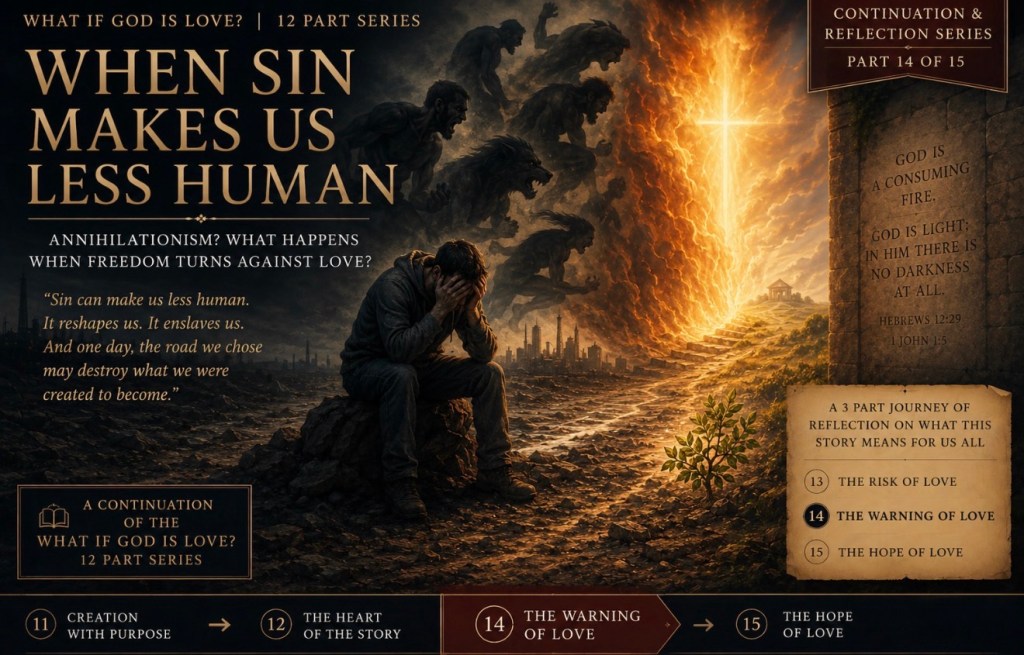
Part 14: When Sin Makes Us Less Human
Annihilationism? What Happens When Freedom Turns Against Love?
Part 13 ended with a question that is difficult to ask because we already know how much the Father wants the answer to be different.
What happens to the children who refuse to come home?
We have already established something important.
God wants them home.
Every one of them.
The Father does not delight in the death of His children. He calls them to turn and live. He wants all people to be saved. He is patient, not wanting anyone to perish.
The invitation remains open.
The road home remains open.
The Father continues calling.
But what happens when a prodigal keeps walking away?
What happens when the far country is no longer merely a place the child is visiting, but becomes the life the child is choosing?
And what happens when the freedom God gave for the purpose of becoming like Him is repeatedly turned against the very purpose for which that freedom was given?
This is where we need to return to something we explored earlier in this series.
Sin does not merely make us guilty.
Sin makes us less human.
And if that is true, then the consequences of sin may be far more serious than we have sometimes imagined.
The Far Country Changes Us
The prodigal son left his father’s house with an inheritance.
He was still his father’s son.
He still bore the family name.
He still carried everything his father had given him.
But the farther he traveled from home, the more the far country began to shape him.
That is the terrifying thing about sin.
We often imagine sin as a series of isolated decisions.
I do something wrong.
Then I do something wrong again.
Then I ask forgiveness.
Then I try harder.
But Scripture gives us a much deeper picture.
Sin becomes a trajectory.
What begins as a choice can become a habit.
A habit can become a pattern.
A pattern can become a bondage.
A bondage can become a form of slavery.
And eventually the person who thought they were exercising freedom may discover that they are no longer very free at all.
Paul says,
“Do you not know that if you present yourselves to anyone as obedient slaves, you are slaves of the one whom you obey?” (Romans 6:16)
That is a profound statement about human freedom.
We are not simply creatures who make choices.
Our choices are also making us.
Every time we choose something, we become slightly more like the person who makes that choice.
Choose generosity, and generosity becomes easier.
Choose forgiveness, and forgiveness becomes more natural.
Choose truth, and truthfulness begins to shape our character.
But the same principle works in the other direction.
Choose hatred often enough, and hatred becomes easier.
Choose vengeance repeatedly, and vengeance begins to feel justified.
Choose deception long enough, and eventually honesty can feel threatening.
Choose lust repeatedly, and other human beings can gradually become objects rather than persons.
Choose greed long enough, and enough is never enough.
Sin does not merely violate the person we were created to become.
It gradually forms us into someone else.
That is why Paul can speak of people becoming slaves to sin.
And that is why Scripture so often connects sin with death.
The question is not merely:
“What punishment will God give me if I keep doing this?”
The deeper question is:
“What will I become if I keep doing this?”
When Freedom Becomes Slavery
This is what we were beginning to see back in Part 4.
God gave humanity freedom because Love cannot be programmed.
But freedom was never given merely so that we could do whatever we wanted.
Freedom was given so that we could become.
We were created in God’s image.
We were meant to grow toward God’s likeness.
The purpose of freedom was formation.
And that means freedom can be used in ways that expand our humanity or ways that diminish it.
Love expands our capacity to see.
Sin contracts it.
Love expands our ability to understand another person.
Sin turns the other person into an obstacle, an enemy, an object, or a possession.
Love teaches us to restrain our instincts for the sake of another.
Sin teaches us to obey our instincts at the expense of another.
And eventually, something frightening can happen.
We can become so accustomed to obeying our desires that we lose the ability to govern them.
We thought we were becoming more free.
We were actually becoming less capable of freedom.
When the Image Begins to Disappear
This is where the biblical language becomes startling.
Humanity was created in the image of God.
We were given something uniquely human.
We were created with the capacity to reason, to understand, to deliberate, to recognize what is good, to choose according to wisdom rather than merely according to instinct.
The ancient Christian tradition often spoke of this in terms of the Logos.
Human beings are rational creatures because we were made by and for the divine Logos.
Our ability to reason is not incidental to our humanity.
It is part of what makes us human.
And yet Scripture repeatedly describes sin as a process in which this capacity begins to collapse.
Paul says that those who reject God become “futile in their thinking” and that “their foolish hearts were darkened.” (Romans 1:21)
He describes people who exchanged truth for a lie.
They knew something, but refused to live according to what they knew.
And eventually their thinking itself became distorted.
This is not merely intellectual ignorance.
It is something deeper.
The person begins to lose the capacity to perceive reality according to the good for which they were created.
The mind becomes increasingly captive to desire.
Reason becomes the servant of appetite.
Wisdom gives way to impulse.
The human being begins to live less like a person capable of self-giving love and more like a creature simply following whatever instinct is strongest in the moment.
And Scripture actually uses that exact imagery.
“Like Unreasoning Animals”
Jude says that there are people who “revile whatever they do not understand” and then adds:
“Whatever they understand naturally, like irrational animals, they are destroyed by these things.” (Jude 10)
Jude immediately connects this trajectory to Cain.
“They have gone in the way of Cain.” (Jude 11)
That is not accidental.
Cain’s story is one of humanity’s earliest pictures of what happens when desire, resentment, and anger are allowed to take control.
God warns Cain:
“Sin is crouching at the door. Its desire is contrary to you, but you must rule over it.” (Genesis 4:7)
Cain does not.
The desire takes hold.
And Cain kills his brother.
Jude looks at people who have followed that same trajectory and describes them with the language of irrational animals.
Peter goes even further.
He describes certain people as:
“irrational animals, creatures of instinct, born to be caught and destroyed.” (2 Peter 2:12)
Think about that language.
Creatures of instinct.
The very thing that was supposed to distinguish humanity from the beasts begins to disappear.
The image is being obscured.
The Logos is being ignored.
Reason is being surrendered.
Desire becomes master.
The person who was created to govern their appetites becomes governed by them.
The person who was created to exercise dominion becomes dominated.
The person who was created to reflect the character of God becomes increasingly conformed to the impulses of the creature.
This is why sin is so much more terrifying than merely breaking a rule.
Sin can make us less human.
And if we continually surrender ourselves to it, there may eventually come a point where the person we were created to become has been almost entirely consumed by the person we have chosen to become.
Different Prodigals, Different Roads
And this will not look exactly the same in every person.
That matters.
There is no single form that the far country takes.
One person may surrender themselves to greed.
Another to lust.
Another to hatred.
Another to pride.
Another to addiction.
Another to violence.
Another to power.
Another to resentment.
Another to the need to control everyone around them.
The particular sin may look different.
But the underlying trajectory can be the same.
The person hands themselves over.
And eventually what they have handed themselves over to begins to hand them over to its own consequences.
Imagine a prodigal who has become addicted to drugs.
The Father has not stopped calling.
The Father has not stopped saying,
“Come home.”
The Father has not stopped loving the child.
But the child refuses to return.
The Father warns:
“This will destroy you.”
But the child continues.
The Father allows the child to remain in the far country.
Not because He wants the child there.
Not because He has stopped loving the child.
Not because He is indifferent to what happens.
But because Love does not turn freedom into coercion.
And eventually the consequences of the child’s choices may become catastrophic.
The addiction can destroy the body.
It can destroy relationships.
It can destroy judgment.
It can destroy the person’s ability to care about anything except the next opportunity to satisfy the addiction.
And one day, tragically, the very thing the Father warned about may happen.
The child overdoses and dies from the thing he refused to leave.
The Father did not need to strike him.
The Father did not need to invent some additional punishment.
The road itself led to death.
Or imagine another prodigal who has surrendered himself to vengeance.
He has been hurt.
Perhaps terribly.
The Father calls:
“Come home.”
But the child refuses because coming home would require him to release the hatred.
The Father says:
“I will not allow vengeance to rule my house.”
The child answers:
“Then I will stay away.”
The Father warns:
“This path will destroy you.”
But the child surrounds himself with others who share his hatred.
He seeks opportunities for revenge.
He becomes increasingly violent.
Eventually the violence he has embraced catches up with him.
Perhaps he dies while attempting to kill someone else.
Again, the Father did not need to reach down from heaven and destroy him.
The destruction was already present in the road he had chosen.
This is what it means for God to “give people over.”
The frightening judgment of Romans 1 is not necessarily that God actively makes people evil.
It is that God can allow people to experience the consequences of what they insist on choosing.
And sometimes those consequences are themselves destructive.
The Father says:
“Come home.”
The child says:
“No.”
The Father says:
“Then at least understand where this road leads.”
And the child keeps walking.
What, Then, Is the Wages of Sin?
Now we can finally hear Paul’s statement in Romans 6 with fresh ears:
“For the wages of sin is death, but the gift of God is eternal life in Christ Jesus our Lord.” (Romans 6:23)
Notice the contrast.
Death.
Life.
Not:
eternal conscious existence in torment versus eternal conscious existence in bliss.
Death versus life.
That distinction appears throughout Scripture.
God tells Adam:
“Dust you are, and to dust you shall return.” (Genesis 3:19)
God tells Ezekiel:
“The soul who sins shall die.” (Ezekiel 18:4, 20)
James says:
“Sin when it is fully grown brings forth death.” (James 1:15)
Paul says:
“If you live according to the flesh you will die.” (Romans 8:13)
And Jesus Himself says:
“Whoever seeks to save their life will lose it.” (Matthew 16:25)
The biblical picture is remarkably consistent.
Sin leads to death.
Life comes from God.
Immortality is not simply something every human being possesses by nature.
Paul says that God “alone has immortality.” (1 Timothy 6:16)
And when he describes resurrection, he says that the mortal must “put on immortality.” (1 Corinthians 15:53)
Immortality is received.
Life is received.
The gift of God is eternal life.
This is the foundation for what Christians have called conditional immortality or conditional mortality.
The idea is simple:
Human beings are not inherently immortal souls who must exist forever no matter what.
Rather, eternal life is God’s gift.
Those who remain in communion with God receive life.
Those who finally and completely reject the source of life do not possess an independent immortality that forces them to exist forever.
They die.
And if that is what Scripture means, then the traditional question changes.
We are no longer asking:
“How long will God keep a rebellious person alive so that they can suffer?”
We are asking:
“What happens when a creature finally and completely separates itself from the One who is Life?”
The biblical answer may be much more straightforward than we have allowed ourselves to consider.
Death.
The Destruction of the Wicked
The language throughout Scripture is striking.
Psalm 1 says that the way of the wicked “will perish.” (Psalm 1:6)
Psalm 37 repeatedly says that the wicked will be destroyed, perish, vanish like smoke, and be no more. (Psalm 37:20, 38)
Malachi describes the coming judgment as a fire that consumes the wicked like stubble.
“They will be ashes under the soles of your feet.” (Malachi 4:1–3)
Jesus speaks of the broad road that leads to destruction. (Matthew 7:13)
He warns:
“Fear him who can destroy both soul and body in Gehenna.” (Matthew 10:28)
Notice what Jesus does not say.
He does not say that God can preserve both soul and body forever in Gehenna.
He says God can destroy both.
John 3:16 gives us perhaps the most famous contrast in the entire New Testament:
Whoever believes in the Son has eternal life, but whoever rejects Him will perish.
Life.
Perishing.
Paul says that those who live according to the flesh will die.
He speaks of those whose end is destruction. (Philippians 3:19)
He speaks of the “eternal destruction” that comes upon those who refuse the Gospel. (2 Thessalonians 1:9)
And Peter uses that astonishing language we have already seen:
“Like irrational animals, creatures of instinct, born to be caught and destroyed.” (2 Peter 2:12)
Even Revelation calls final judgment the second death. (Revelation 20:14; 21:8)
The final enemy is not eternal life in torment.
It is death itself.
And Scripture’s final vision is not of immortal wickedness existing forever alongside God’s kingdom.
It is of God removing death itself.
“The last enemy to be destroyed is death.” (1 Corinthians 15:26)
Even Jesus’ Parables Point This Way
Jesus repeatedly uses images of things being removed rather than eternally preserved in misery.
The weeds are burned.
The branches that do not bear fruit are thrown into the fire.
The tree that does not bear good fruit is cut down.
The wicked servant is destroyed.
The enemies of the king are killed.
The unrepentant are separated from the righteous.
These images are not gentle.
They are warnings.
But they are warnings precisely because the danger is real.
Jesus is not saying:
“Do not worry. Sin is ultimately harmless.”
He is saying:
“Sin leads somewhere.”
And where it leads is death.
The Fire of Love
This is where the biblical imagery of fire begins to make sense in a very different way.
Scripture does not only say that God judges with fire. It says that God is “a consuming fire.” (Hebrews 12:29)
And Scripture also says:
“God is light; in Him there is no darkness at all.” (1 John 1:5)
How can these things be true of the God who is Love?
Perhaps because fire and light help us understand something about what Love does.
Fire burns away what cannot remain.
Light drives out darkness.
The closer something comes to the fire, the more that which cannot withstand the fire is consumed. The more completely darkness is exposed to light, the less darkness remains.
And this is precisely how Scripture describes God’s work in us.
His judgement is not the opposite of His Love.
His judgement is the fiery discipline of His Love at work.
He burns away what is destructive.
He exposes what is hidden.
He brings darkness into the light.
He purifies.
He restores.
He makes His children holy.
Because Love is not passive.
God is not static or stagnant. God is Love. God is light. God is a consuming fire. His very nature is dynamic, active, and alive.
And that creates a terrifying possibility.
What happens when the thing being exposed to the light has become almost entirely darkness?
What happens when the thing being placed in the fire has become nothing but impurity?
What happens when a human being has surrendered so completely to sin that the very capacities that make them distinctly human have been consumed by it?
We have already seen the language Scripture uses for this.
Jude describes people as “irrational animals” who are destroyed by the very things they have pursued. (Jude 10)
Peter describes them as “irrational animals, creatures of instinct, born to be caught and destroyed.” (2 Peter 2:12)
The image is difficult precisely because it is so tragic.
They were created for Logos.
They were created for reason.
They were created for relationship.
They were created for communion.
They were created to become like the Father.
But they surrendered themselves to instinct.
They surrendered themselves to darkness.
They surrendered themselves to the far country.
And eventually there may come a point where there is nothing left that can participate in the life for which they were created.
At that point, what would Love do?
I have seen something like this before.
Not in exactly this way.
But I have seen the question.
I have seen it as a chaplain at the bedside of dying people.
I have stood with mothers whose children were victims of violence, watching them weep as they said, “Let him go.”
I have stood beside families of people whose addictions had nearly destroyed their bodies, watching them agonize over whether to continue extraordinary measures.
I have stood beside spouses and children who had to decide whether to withdraw life support because they knew the person they loved would never again have the life they knew.
And I have heard something remarkable in those moments.
Sometimes the person is technically still alive.
The machines are still working.
The heart may still be beating.
The body may still be capable of being sustained.
But the people who love them most sometimes say:
“That isn’t really them anymore.”
“That’s not the life they would want.”
“Please don’t make them keep going like this.”
And we understand why.
Hospitals have a number of ways of helping people make these decisions before a crisis occurs. A DNR, or “Do Not Resuscitate” order, tells medical professionals not to attempt CPR if a person’s heart stops. An advance directive is a document in which a person explains what kinds of medical treatment they would or would not want if they become unable to speak for themselves.
And sometimes a person also names someone they trust to make those decisions for them.
Why that person?
Ideally, it is not simply whoever happens to be available.
It is the person they believe knows them, loves them, and understands what they would want better than almost anyone else.
In other words, when we cannot speak for ourselves, we often entrust the decision about when to let us go to the person we believe loves us enough to know when continuing to sustain our existence would no longer be loving.
I have watched loved ones make that decision.
And it is almost never because they want the person to die.
They make it because they love the person.
They know that keeping a body functioning is not necessarily the same thing as preserving the life that person would want to live.
Sometimes letting go is the more loving choice.
We understand this even more readily when it comes to animals.
We can love an animal deeply. A beloved pet can be part of a family. And yet when an animal is suffering beyond recovery, we can recognize that keeping it alive merely to prolong its suffering is not necessarily kindness.
We let it go.
Why?
Because existence by itself is not the highest good.
Life is more than biological functioning.
And an animal, however precious, does not possess the same Logos, reason, creativity, moral agency, and capacity for communion that human beings possess.
We recognize that sustaining mere biological existence is not always loving.
So now return to the terrifying language of Jude and Peter.
What if Scripture is warning us about human beings who have surrendered themselves so completely to sin that they have become like “unreasoning animals”?
What if the image is not simply that they have behaved badly?
What if it is describing what they have become?
The person created to reason has surrendered reason.
The person created to govern desire is governed by desire.
The person created to give love has surrendered himself to hatred.
The person created for communion has chosen isolation.
The person created for life has continually chosen death.
And eventually, perhaps, there is nothing left to sustain.
The fire of Love burns away what cannot live.
The light of Love exposes what cannot remain.
And if there is nothing left that can participate in the life of Love, then Love does not need to preserve that existence forever.
It can finally let it go.
This is not because God has stopped loving the prodigal.
It is because God is Love.
The Father does not delight in the death of His child.
He never wanted the child to become this.
He called.
He warned.
He waited.
He invited.
But Love will not turn darkness into light by pretending that darkness is light.
And so the biblical picture begins to come together.
Sin leads to death.
Life is God’s gift.
Immortality is something God gives, not something humanity possesses independently of Him.
The person who continually rejects Love becomes less and less capable of participating in Love until, finally, there may be nothing left that can live.
And if that is where the road of sin ultimately leads, then the end is not eternal life in misery.
It is death.
The second death.
Annihilation.
The immortality offered by God is lost, and the mortal creature finally dies.
That is the terrifying end Scripture warns us about.
And yet…
Do we know for certain that any particular person has actually reached that end?
That is the question we will explore next.
What if sin continues to deform them until they can no longer recognize the road home?
What if they finally become what they have spent their lives becoming?
And therefore the risk that God in Love took when he created humans comes to fruition. Conditional mortality become real and all those who reject Father’s offer to come home are annihilated by dying the second death.
All this is true…
In the loss that we would fill over someone overdosing or being murdered by gang violence they themselves has chosen, becomes real the heartbreak that God is warning, and was aware could happen becomes reality.
And it all very well could…
But here is where the question becomes even more difficult.
If the future is genuinely open, if God does not exhaustively know the future free choices of His creatures, then is this final destruction actually certain for any particular prodigal?
That is the question we will have to face next.

