
Part 15: The Hope of Love
Universal Restoration? What Happens If Love Never Gives Up?
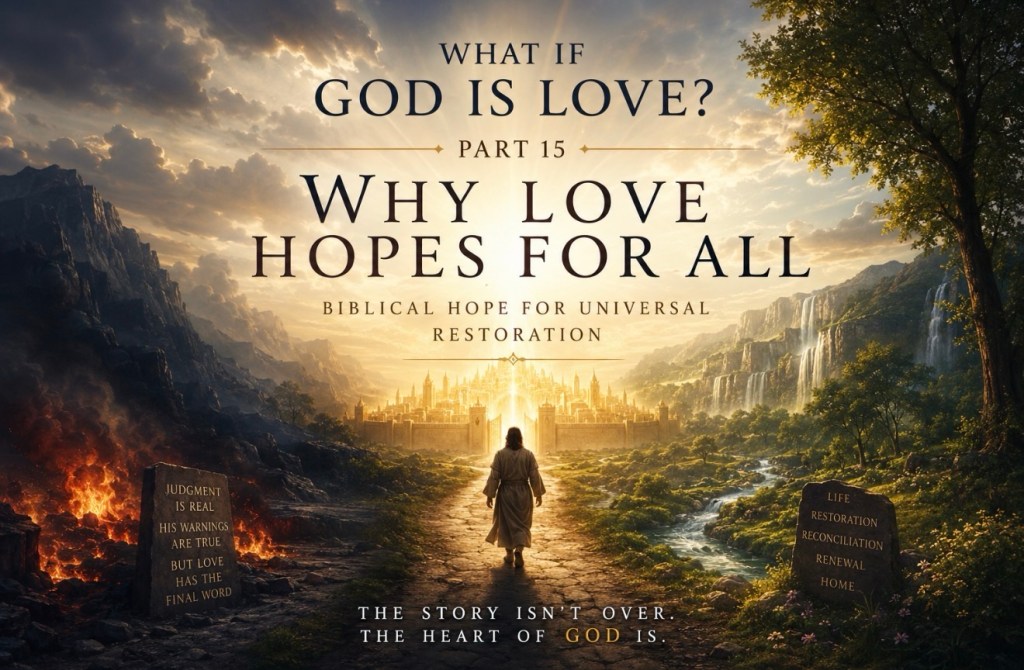
Part 14 ended with a terrifying possibility.
Sin can deform us. It can make us less human. It can enslave the very freedom God gave us. And if a person continually gives themselves over to darkness, there may eventually come a point where there is nothing left that can participate in the life for which they were created.
The end of that road may be death.
The second death.
Annihilation.
Conditional mortality.
But Part 14 ended with another question.
Do we know for certain that any particular person has actually reached that end?
That question matters enormously.
Because if we do not know that, then something remains.
Hope.
Not wishful thinking.
Not the denial of judgment.
Not the assumption that everyone will inevitably be saved regardless of what they choose.
Hope.
The possibility that the story of any particular prodigal may not yet be finished.
And that brings us to the final question of this series.
If God really is Love, what does Love hope for?
Destruction Is a Destination, Not Necessarily a Census
There is a passage Jesus spoke that has often been treated as one of the strongest arguments against the hope of universal restoration.
Jesus says:
“Enter through the narrow gate. For the gate is wide and the road is broad that leads to destruction, and many enter through it. But the gate is narrow and the road is difficult that leads to life, and only a few find it.”
Matthew 7:13–14
Read in the way we have traditionally heard it, the meaning seems obvious.
Most people are going to destruction.
Only a few will be saved.
But notice what Jesus actually says.
The verbs describing those entering the roads are present tense. Jesus is describing what is happening before His hearers.
Many are entering the broad road. Few are finding the narrow one.
That is different from saying:
“Here is the final statistical distribution of humanity for all eternity.”
Jesus is describing the spiritual landscape in front of them.
The broad road is crowded.
The narrow road is not.
And that makes perfect sense as a warning.
Jesus is saying:
Look at the road people are choosing. Look at where it leads. The road you are walking matters.
A warning about where a road leads is not necessarily a declaration that everyone currently walking that road will inevitably reach its destination.
In fact, the warning exists precisely because the destination can still be avoided.
If Jesus says, “This road leads to destruction,” the loving response is not:
“Well, then everyone on it must be destined for destruction.”
The loving response is:
“Then get off the road.”
That is why Jesus gives the warning.
The warning is an invitation.
And this brings us back to one of the most important principles we have developed throughout this series.
Biblical prophecy is often an invitation to change the future.
The Potter and the Clay
To understand why, we need to return to the passage that lies behind Paul’s discussion in Romans 9.
Jeremiah goes to the house of a potter. He watches the potter working with clay. The vessel being formed does not turn out as the potter intended, so the potter reworks the clay and makes another vessel.
Then God gives Jeremiah the meaning:
“Like clay in the hand of the potter, so are you in my hand.”
Jeremiah 18:6
And then God says something astonishing.
If God announces that He will uproot, tear down, and destroy a nation because of its wickedness, but that nation turns from its evil, God says that He will relent concerning the disaster He had announced.
And the reverse is also true.
If God announces that He will build and plant a nation, but that nation turns to evil, God says He can relent concerning the good He had promised.
This is not a minor observation.
It fundamentally changes how we should read biblical declarations about the future.
God can announce destruction without destruction being inevitable.
He can announce blessing without blessing being unconditional.
The announcement itself can be part of God’s work of changing what happens next.
The warning is not a failure of prophecy.
The warning is the prophecy doing what it was intended to do.
God tells people where their present trajectory is heading so that they can change their trajectory.
That is what we called agapic prophecy earlier in this series.
God’s prophetic warnings are relational. They are spoken into a relationship that is still alive. They reveal where a particular course of action leads. And because the people involved still possess freedom, the warning itself can become the means through which the course changes.
Jeremiah 18 gives us a pattern for understanding divine announcements.
And Paul appears to understand that pattern very well.
“Prepared for Destruction”
This is where Romans 9 becomes particularly important.
Paul writes:
“What if God, although choosing to show his wrath and make his power known, bore with great patience the objects of his wrath, prepared for destruction?”
Romans 9:22
For many readers, this sounds like the ultimate statement of divine determinism.
God has decided who the objects of wrath are.
God has prepared them for destruction.
Their fate is settled.
But that is not the only way to read Paul’s words. In fact, when we place the verse within the larger biblical and Pauline context, the picture points in a very different direction.
The Greek participle translated “prepared for destruction” does not itself explicitly identify who performed the preparation.
But grammar does not exist in a vacuum.
The context does.
And the context throughout Romans strongly supports understanding these people as having prepared themselves for destruction through their own trajectory.
We have already seen Paul’s explanation of God’s wrath in Romans 1.
Paul says that God’s wrath is being revealed against human wickedness.
And then he repeatedly explains what that wrath looks like.
God gave them over to the desires of their hearts.
God gave them over to degrading passions.
God gave them over to a depraved mind.
Paul’s explanation of divine wrath is not primarily God exploding in rage and arbitrarily inflicting destruction upon people.
God’s wrath is revealed as God allowing people to experience the consequences of what they insist upon choosing.
He gives them over.
And notice what Paul says in Romans 9.
God is bearing with these objects of wrath with great patience.
That combination matters.
Wrath and patience are operating together.
God allows the consequences of their trajectory while continuing to bear with them.
That makes sense if the destruction is connected to what they themselves have become.
And the surrounding biblical imagery reinforces this.
Jeremiah 18 has already shown us the clay becoming malformed and the potter responding to what has happened.
The passage explicitly connects announced destruction with the wickedness of those involved, while also showing that repentance can change the outcome.
Then Paul uses the same vessel imagery again in 2 Timothy:
“If anyone cleanses himself from what is dishonorable, he will be an instrument for special purposes, made holy, useful to the Master and prepared to do any good work.”
2 Timothy 2:21
Notice the human participation.
“If anyone cleanses himself.”
The individual is not merely a passive object being arbitrarily assigned a destiny.
The person participates in what the vessel becomes.
This fits perfectly with what we argued in Part 14.
Sin is not merely something God punishes.
Sin is something we become.
People can progressively deform themselves through their choices. They can surrender freedom. They can become increasingly incapable of participating in the life for which they were created.
So when Paul says that these people are “prepared for destruction,” the larger context gives us good reason to understand that preparation as something they have done to themselves through their persistent rebellion.
God does not need to predetermine their destruction.
Their own trajectory can prepare them for it.
And yet even here Paul emphasizes God’s patience.
That is the remarkable tension.
They are preparing themselves for destruction while God is patiently bearing with them.
That is not the portrait of a God who delights in destroying His enemies.
It is the portrait of a God who allows freedom to have consequences while continuing to hope for something different.
Judgment Does Not Mean Abandonment
This distinction becomes important when we think about judgment more broadly.
The New Testament contains many warnings about destruction.
People will perish.
People will be destroyed.
People will face judgment.
Some will experience the consequences of their rebellion.
We should take those warnings seriously.
But judgment does not necessarily mean abandonment.
That distinction is already visible in the biblical language surrounding the realm of the dead.
We need to be careful here because Scripture does not give us a detailed systematic map of the afterlife.
But it does give us images that suggest that physical death is not simply identical with the final consummation of God’s purposes.
Sheol in the Old Testament and Hades in the New Testament can function as language for the realm of the dead. The dead await what comes next.
For those who belong to God, the New Testament contains remarkably beautiful language about being with Christ. Paul can speak of being “away from the body” and “at home with the Lord” (2 Corinthians 5:8), and of departing “to be with Christ” (Philippians 1:23). Jesus tells the repentant criminal, “Today you will be with me in paradise” (Luke 23:43).
The Christian hope has therefore never merely been that death stops hurting.
It is that death does not separate us from Love.
But Scripture also contains imagery of judgment in the realm of the dead.
Jesus’ story of the rich man and Lazarus in Luke 16 is particularly striking. We should not turn a parable into a literal geography lesson about the afterlife, but Jesus nevertheless portrays conscious existence, moral awareness, distress, comfort, and separation following death.
Whatever else we make of the imagery, it makes one thing clear:
Physical death does not necessarily mean that God’s dealings with a person are simply finished.
And this matters because we have spent this entire series asking what judgment means if God is Love.
If judgment is merely retribution, then we have a profound theological problem.
But if judgment can be disciplinary, if it can expose the consequences of sin and confront a person with what they have become, then judgment itself can remain ordered toward restoration.
A loving father may discipline a child precisely because he wants the child restored to the family.
The discipline may be painful.
The separation may be real.
The consequences may be serious.
But the father has not stopped loving the child.
We should be careful not to turn that analogy into a detailed description of the afterlife. Scripture does not give us permission to do that.
But it does help us recognize a possibility that fits the larger biblical portrait:
Judgment can be real without Love giving up.
And that brings us to something even larger.
The Biblical Story Keeps Moving
The intermediate state is not the same thing as the age to come.
Much Christian theology has treated everything after physical death as though it belongs to one static category called “eternity.”
But the New Testament normally tells a more dynamic story.
There is this age.
There is the coming age.
And Paul can even speak of “the coming ages” (Ephesians 2:7).
This is why language surrounding aiōn and aiōnios deserves care. These words are related to the language of an age or ages. Their precise meaning depends upon context, and the words themselves do not settle every theological question about duration.
That does not mean that everything described as aiōnios must therefore be temporary.
It means something simpler.
The Greek word itself cannot do all the theological work for us.
We need to ask what happens in the age being described, what God’s judgment accomplishes, and what Scripture says about God’s purposes beyond it.
Because the resurrection belongs to something enormous.
It belongs to the coming of God’s Kingdom.
It belongs to the resurrection of the dead.
It belongs to the renewal of creation.
It belongs to the fulfillment of the prayer Jesus taught us to pray:
“Your kingdom come. Your will be done, on earth as it is in heaven.”
This is the Christian hope.
Not escaping the earth.
Not abandoning creation.
Not becoming disembodied spirits forever.
The hope is that God will finally establish His reign here.
Creation will be renewed.
The dead will be raised.
God will dwell with humanity.
Death itself will be defeated.
Paul describes creation as groaning while it waits for liberation from its bondage to decay and for the revelation of God’s children (Romans 8:18–25).
Peter speaks of “the restoration of all things” (Acts 3:21).
Paul says Christ’s resurrection is the beginning of a greater resurrection harvest and looks forward to the day when Christ has defeated every enemy, with death itself being the last enemy destroyed (1 Corinthians 15:20–26).
God is not abandoning the world He made.
He is finishing what He began.
Revelation and the Restoration of Creation
There is an important caveat here.
I do not think Revelation as a whole should be treated as though it were a straightforward book of predictive prophecy from which we can construct a detailed systematic theology of the eschaton. There are many legitimate Christian readings that understand significant portions of Revelation as addressing events, powers, and conflicts in its own historical context rather than giving us a chronological description of the distant future.
So I do not want to build this argument on the assumption that every image in Revelation is a literal prediction of something still waiting to happen.
But there is an important reason to look at Revelation 21–22.
Virtually every Christian reading of these chapters recognizes them as a vision of the consummation of Christian hope. Whatever one believes about the chronology or interpretation of the preceding chapters, Revelation’s final vision is unmistakably presented as the fulfillment of the biblical story.
And at the macro level, that vision completes an arc that runs all the way back to Genesis 1.
The Bible begins with God creating.
It ends with God dwelling with humanity in renewed creation.
That is why these chapters matter here.
Revelation 21 gives us the breathtaking picture of the New Jerusalem descending from heaven to earth.
God dwells with humanity.
Death is defeated.
Mourning and pain are passing away.
Creation is being renewed.
Then Revelation 22 gives us the river of the water of life flowing from the throne of God and of the Lamb. The tree of life stands beside it, and its leaves are “for the healing of the nations.”
Think about that imagery.
The Kingdom is not portrayed as God abandoning creation.
It is portrayed as God’s life flowing outward.
The river flows.
The tree bears fruit.
The nations are healed.
God’s presence fills creation.
This is the biblical story coming full circle.
The world God created in Genesis is not discarded.
It is restored.
And the imagery of the nations is particularly striking.
The nations come into the light of God’s presence.
The tree of life provides healing for the nations.
Whatever else we conclude about the details, the vision is saturated with restoration.
This is remarkably consistent with Paul’s hope in Romans 8.
Creation groans.
Creation waits.
Creation is liberated.
God’s children are revealed.
And finally, creation is healed.
The end of the biblical story is therefore not merely:
“Who gets into heaven?”
It is:
“What does God do with the creation He made?”
And the answer is breathtaking.
He restores it.
But Scripture Gives Us Two Directions
And yet we cannot stop there.
Because we have to be honest.
Scripture gives us passages that point toward destruction.
And Scripture gives us passages that point toward universal restoration.
We cannot simply erase either set.
Jesus speaks of the broad road leading to destruction.
Paul speaks repeatedly of people who are perishing.
Scripture warns that sin leads to death.
Part 14 demonstrated why we should take those warnings seriously.
Annihilation is not a theological invention designed to make Christianity less frightening.
It is a genuine possibility arising from the biblical language of death, destruction, and the consequences of sin.
But then we encounter the other side.
God desires all people to be saved (1 Timothy 2:4).
God does not want anyone to perish (2 Peter 3:9).
Jesus says He will draw all people to Himself (John 12:32).
Paul says that through Christ God was pleased “to reconcile to himself all things” (Colossians 1:20).
He describes God’s purpose as bringing “unity to all things in heaven and on earth under Christ” (Ephesians 1:10).
He says:
“As in Adam all die, so in Christ all will be made alive.”
1 Corinthians 15:22
And Paul declares:
“At the name of Jesus every knee should bow, in heaven and on earth and under the earth, and every tongue acknowledge that Jesus Christ is Lord.”
Philippians 2:10–11
These passages are not trivial.
They are not a handful of obscure verses.
They form a remarkable biblical pattern.
God desires all to be saved.
God desires none to perish.
God intends to reconcile all things.
God intends to unite all things in Christ.
Every knee bows.
Every tongue confesses Jesus as Lord.
And Revelation gives us a vision of renewed creation, death defeated, God dwelling with humanity, and the nations receiving healing.
If someone says that these passages sound hopeful about universal restoration, we should not argue with them.
They are.
But neither can we erase the warnings of destruction because we prefer the hopeful passages.
So what do we do with both?
Perhaps the answer lies in the pattern we have already established.
Romans 8–11: The Pattern in Paul
Romans 8 gives us Paul’s great vision of hope.
Creation is groaning.
God’s children are awaiting their full revelation.
Creation itself will be liberated.
We await the redemption of our bodies.
And nothing in all creation can separate God’s people from the Love of God in Christ Jesus.
Then Paul turns to the agonizing question of Israel.
What about those who appear to be outside the promise?
Has God’s word failed?
And Paul does something fascinating.
He reaches backward to the Potter and the clay.
Romans 9 invokes the imagery of Jeremiah 18.
The clay is still being worked.
Paul speaks about vessels of mercy and vessels of wrath.
But the argument does not end there.
Romans 10 continues the invitation.
Romans 11 speaks about people being broken off and then grafted in again.
And Paul says something that is almost impossible to miss:
“God is able to graft them in again.”
Romans 11:23
Again.
Those who had been broken off are not necessarily beyond restoration.
Then Paul reaches the climax:
“For God has bound all people over to disobedience so that he may have mercy on them all.”
Romans 11:32
All.
Not because Paul has forgotten judgment.
Not because human response no longer matters.
But because Paul has followed God’s relational purposes all the way to their deepest point.
Mercy on all.
And then he erupts into worship:
“Oh, the depth of the riches of the wisdom and knowledge of God!”
That matters.
Romans 8 begins with hope.
Romans 9 gives us the Potter.
Romans 10 continues the invitation.
Romans 11 shows people being broken off and grafted in again.
And Romans 11 ends with God’s purpose of mercy on all.
That is not a random collection of ideas.
It is a trajectory.
And it brings us directly to the heart of the question.
Ezekiel Reveals the Father’s Heart
There is a passage that captures the tension we have been discussing with extraordinary clarity.
God says through Ezekiel:
“As I live, declares the Lord GOD, I have no pleasure in the death of the wicked, but that the wicked turn from his way and live; turn back, turn back from your evil ways, for why will you die, O house of Israel?”
Ezekiel 33:11
We should slow down here.
God is not denying that the wicked may die.
The surrounding chapter is explicitly concerned with judgment, responsibility, warning, and the consequences of wickedness.
The possibility of judgment is real.
But notice what God chooses to tell us about His heart.
“I have no pleasure in the death of the wicked.”
What does He want instead?
“That the wicked turn from his way and live.”
And then comes the plea:
“Turn back, turn back from your evil ways, for why will you die?”
That is not the language of a God who takes pleasure in destruction.
It is the language of a Father who genuinely wants His children to live.
And within the dynamic understanding of God and the future we have developed throughout this series, that distinction matters enormously.
God is not merely watching a fixed future unfold while describing His desire for repentance as though it were an unrealized wish He already knows cannot happen.
He is relating to free creatures whose responses genuinely matter.
He knows where their present trajectory leads.
He can warn them.
He can judge when they persist in evil.
He can allow the consequences of their choices to unfold.
And yet He can genuinely continue to desire their repentance.
That is exactly what Jeremiah 18 gives us.
God can announce destruction because destruction is where a particular path leads.
But the announcement itself can become part of the means by which the path changes.
And Ezekiel tells us why.
Not because God enjoys destruction.
Not because He secretly hopes the wicked will die.
But because He wants them to turn and live.
Ezekiel therefore does not prove that every wicked person will necessarily repent.
It reveals something different and, in this discussion, just as important.
It reveals what God wants for every wicked person.
Turn.
Live.
Come home.
God Is a Hopeful Universal Restorationist
Now we can say something bold.
God is a hopeful universal restorationist.
I do not mean that God has secretly determined that everyone must repent.
I do not mean that human freedom is an illusion.
I do not mean that judgment is unreal.
I do not mean that annihilation is impossible.
I mean something simpler and, I think, deeply biblical.
God hopes for the restoration of every one of His children.
That is what Ezekiel reveals.
“I have no pleasure in the death of the wicked.”
“Turn back, turn back from your evil ways.”
“Why will you die?”
God does not merely tolerate the possibility of repentance.
He desires it.
He does not merely permit life.
He calls the wicked toward it.
And this is consistent with everything else we have seen.
God desires all people to be saved.
God does not want anyone to perish.
God desires mercy on all.
God intends to reconcile all things in Christ.
God promises healing for the nations.
The final biblical vision is saturated with God’s presence, restoration, life, and healing.
Taken together, these passages reveal something remarkably consistent.
God’s heart is always moving toward restoration.
The fact that God allows His creatures to refuse that restoration does not change what He desires.
And that is precisely what makes the hope meaningful.
If God simply overrides every refusal, then restoration is guaranteed, but freedom becomes an illusion.
If God simply abandons everyone who refuses Him at the first opportunity, then judgment may be clear, but His persistent Love becomes difficult to recognize.
But the God revealed throughout this series does neither.
He warns.
He waits.
He disciplines.
He invites.
He gives creatures over to the consequences of their choices.
He calls them back.
And He keeps desiring life.
That is what I mean by hopeful universal restoration.
It is not a prediction about the final statistical outcome of humanity.
It is a description of the Father’s heart toward every person He has made.
God can genuinely desire every person to come home without guaranteeing that every person will choose to do so.
He can genuinely hope for every prodigal while still allowing the possibility that some prodigals will refuse.
He can warn about destruction without desiring destruction.
He can discipline without abandoning.
He can judge without ceasing to love.
Love does not always get what it desires. But Love always desires what is good for the one it loves.
I Have to Admit Something
And here is where I need to admit something.
There are times when I have these conversations with someone who believes in annihilation, and I think:
You know what? Maybe they’re right.
Maybe there really will be vast numbers of human beings throughout history who continue choosing destruction.
Maybe God will finally allow them to have what they have persistently chosen because Love cannot force someone to become something they refuse to become.
Maybe conditional immortality really is the final answer for many.
And then I have the same conversation with someone who hopes for universal restoration, and I think:
You know what? Maybe they’re right too.
Maybe God really will continue to wait.
Maybe He will continue to reveal Himself.
Maybe He will continue to discipline.
Maybe He will continue to invite.
Maybe He will continue to pursue His children through age after age until, without ever coercing them, He finally succeeds in bringing every prodigal home.
Maybe they are right.
I find myself moving from one possibility to the other.
And perhaps that is exactly where humility should leave us.
Because neither position allows me to proclaim certainty about something Scripture itself does not make completely certain.
I can believe annihilation is genuinely possible without declaring that I know who will be annihilated.
I can hope for universal restoration without declaring that I know everyone will ultimately choose it.
I can take both sets of passages seriously without pretending that I have solved every mystery of the age to come.
Perhaps that is not a failure of theology.
Perhaps it is faithfulness to the limits of what God has revealed.
The Freedom of Hope
This is also why hopeful universal restoration must never be confused with guaranteed universalism.
If God is Love, Love does not coerce.
Imagine a father who desperately wants all of his children to come home.
He can plead.
He can warn.
He can discipline.
He can keep the door open.
He can tell them again and again that they are loved and that there is a place for them at the table.
But he cannot make their love genuine by forcing them to choose it.
That is the same tension we have been tracing throughout this entire series.
God’s desire can be universal.
His invitation can be universal.
His grace can be universal.
His hope can be universal.
And yet the response of the creature can remain genuinely free.
That is why hopeful universal restoration is not the claim:
“Everyone will be saved.”
It is the claim:
“I have no reason to stop hoping that everyone will be saved.”
Those are very different statements.
The first claims knowledge about the outcome.
The second expresses confidence about God’s heart.
The Humility of Hope
This is where I think we need to practice humility in our eschatology.
To say with certainty that everyone will be restored risks failing to take seriously the warnings God has given us.
Destruction matters.
Judgment matters.
Sin really can deform a person.
Freedom really can be surrendered.
Conditional mortality may truly be the tragic end of some who persistently reject the life for which they were created.
God means what He says when He warns us.
But certainty works both ways.
To say that some people must ultimately be annihilated risks failing to take seriously the passages that paint a radically hopeful picture of universal restoration.
Those passages matter too.
God’s desire to save all matters.
His purpose to reconcile all things matters.
His declaration that He has bound all over to disobedience so that He might have mercy on all matters.
The healing of the nations matters.
Every knee bowing matters.
Every tongue confessing Jesus as Lord matters.
God means what He reveals about those things too.
Perhaps the mistake is assuming that taking one set of passages seriously requires us to make the other set disappear.
It does not.
We can take the warnings seriously without surrendering hope.
We can take hope seriously without denying the warnings.
We can say:
Judgment is real.
And:
God desires mercy.
We can say:
Some may finally choose death.
And:
Until that end has actually come, we have no reason to stop hoping for life.
What We Can Know
We may not know exactly how every age unfolds.
We may not know exactly what happens between death and resurrection.
We may not know whether every person will eventually repent.
We may not know precisely when or how judgment reaches its final conclusion.
But we do know something.
God wants every human being reconciled to Him.
We know it because God is Love.
We know it because God desires all people to be saved.
We know it because God takes no pleasure in the death of the wicked.
We know it because Jesus teaches us to love our enemies.
We know it because the Father in Jesus’ parable watches for the prodigal.
We know it because the Shepherd goes looking for the lost sheep.
We know it because the woman searches for the lost coin.
We know it because Paul says that God intends to reconcile all things in Christ.
We know it because Paul ends his great argument in Romans 11 by revealing God’s purpose of mercy on all.
And we know it because the biblical story ends where it began to point us all along: with God dwelling with humanity, creation restored, death defeated, and the nations receiving the healing that flows from God’s presence.
The question is not whether God wants the prodigal home.
He does.
The question is whether every prodigal will eventually choose to come home.
And that is precisely why I use the phrase hopeful universal restoration.
I am not saying:
“I know everyone will be saved.”
I am saying:
“I have no reason to stop hoping that everyone will be saved.”
If God Hopes for All, Shouldn’t We?
Perhaps this is where the argument finally becomes personal.
If God is a hopeful universal restorationist, shouldn’t we be?
Not certain universalists.
Hopeful universal restorationists.
There is a difference.
We can warn people about destruction without hoping they experience it.
We can believe judgment is real without desiring anyone to be judged.
We can acknowledge annihilation as a genuine possibility without celebrating it.
We can hope for universal restoration without pretending that human freedom is irrelevant.
We can hold both the warning and the hope.
We can say:
“The road you are walking really does lead to destruction.”
And then immediately say:
“So turn around.”
We can say:
“Judgment is real.”
And:
“God desires mercy.”
We can say:
“Some may finally choose death.”
And:
“Until that end has actually come, we have no reason to stop hoping for life.”
Because that is what Love does.
Love warns.
Love waits.
Love disciplines.
Love invites.
Love hopes.
And Love keeps the door open for as long as there is still someone who might walk through it.
Perhaps we will someday discover that every prodigal finally comes home.
Perhaps we will discover that some finally choose the darkness so completely that there is nothing left to restore.
Perhaps the reality will be more complicated than either of us can presently imagine.
But whatever the final shape of the ages may be, one thing has become increasingly clear throughout this entire series.
The Christian hope is not ultimately built upon our ability to predict the future.
It is built upon our knowledge of the One who holds the future.
And the One who holds it is Love.
So I will take the warnings seriously.
I will take the promises seriously.
I will take the visions seriously.
I will take human freedom seriously.
I will take judgment seriously.
And I will take hope seriously.
I will not claim to know more than God has revealed.
But neither will I hope for less than God Himself hopes for.
Because if God is Love…
and if Love hopes for the restoration of every one of His children…
then perhaps the most faithful response is not certainty about how the story ends.
Perhaps it is to become people who hope for the ending Love hopes for.
All of them home.
All of them healed.
All of them reconciled.
All of them freely choosing the communion for which they were created.
Perhaps every prodigal comes home.
Perhaps not.
But if God is Love, I will keep hoping that they do.

