A World That Makes Sense
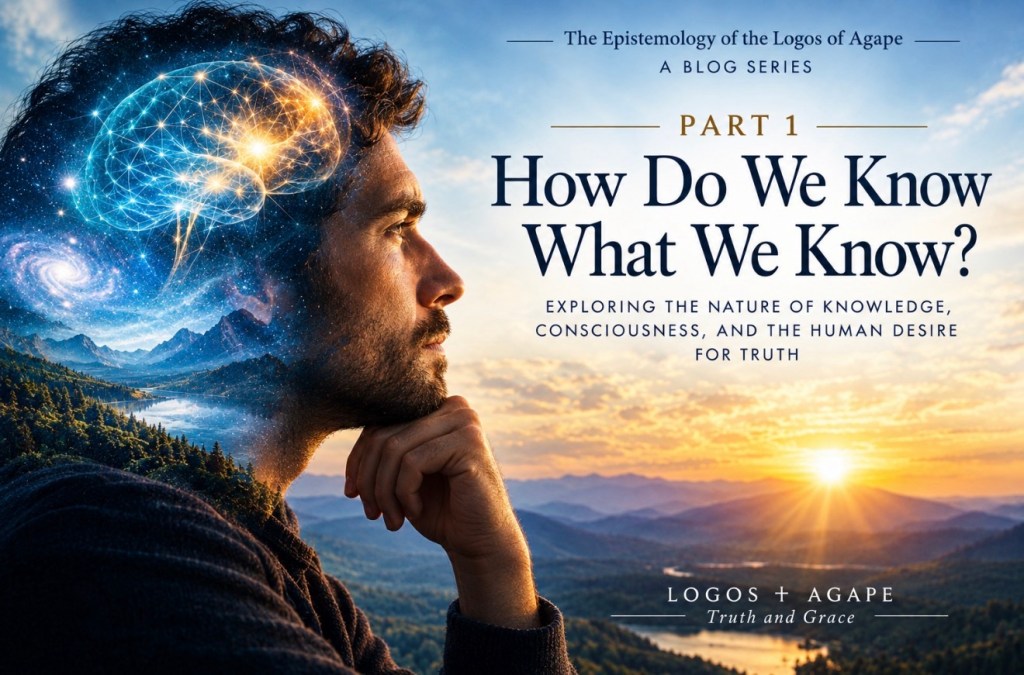
The Question Beneath the Question
There is a question beneath almost every theological argument:
How do we know what we know about God?
The question becomes especially important when Christians disagree about Scripture. One person says Scripture is the ultimate authority. Another says Scripture must be interpreted through Jesus. Another appeals to tradition, reason, experience, or the Church. Eventually, the question underneath all of it emerges:
What gives us the ability to recognize truth in the first place?
This is where a true epistemology must begin.
Before asking what Scripture tells us about God, we have to ask how human beings recognize anything as true, good, beautiful, meaningful, or worthy of belief.
That is the true starting epistemological question.
Epistemology is the study of how we know what we know. It asks what counts as knowledge, how we distinguish truth from error, what enables us to recognize something as true, and what we should do when different sources of knowledge appear to conflict.
These questions become especially important when the subject is God. If God exists, how could human beings recognize God’s revelation as revelation? What would make one claim about God ring true while another strikes us as false?
Therefore the place to begin is not with the book but instead we should begin with ourselves.
The Human Knower
Every conviction, judgment, and conclusion about the world passes through some process of knowing.
We see.
We hear.
We remember.
We compare.
We reason.
We interpret.
We trust.
We doubt.
We change our minds.
And yet none of us begins from nowhere.
We begin inside our own experience.
We inherit language, culture, assumptions, memories, relationships, fears, hopes, and expectations. We encounter a world that is already here and try to make sense of it.
Human knowledge is therefore both remarkable and limited.
We can know things.
But we can also be wrong.
Few philosophical statements are more famous than René Descartes’ conclusion:
“I think, therefore I am.”
Descartes was attempting to find something that could survive radical doubt. If everything could be questioned, perhaps the act of questioning revealed at least one certainty: there must be a thinker doing the questioning.
Whatever we think of Descartes’ larger project, he identified something fundamental about human consciousness.
We don’t merely experience reality.
We know that we are experiencing reality.
We can turn our attention back upon ourselves and ask what we are doing, why we believe what we believe, and whether we might be mistaken.
That capacity is extraordinary.
Human beings can examine their assumptions, recognize contradictions, discover that something once believed was false, and revise their understanding in light of new evidence. We can even ask whether our methods of knowing are reliable.
Socrates famously expressed the importance of this kind of examination:
“The unexamined life is not worth living.”
An unexamined life can simply inherit its beliefs. It can absorb the assumptions of its culture and mistake familiarity for truth. Examination creates the possibility of freedom.
But Socrates’ statement leaves us with a deeper question:
Why is the examined life worth living?
Examination can help distinguish truth from error, but it does not by itself tell us what makes a human life worth living.
We can know more without becoming better.
We can accumulate information without acquiring wisdom.
We can describe reality without knowing what we ought to do with our knowledge.
The question of knowing is never entirely separate from the question of living.
Knowing Without Omniscience
Human beings are capable of genuine knowledge, but they are not omniscient.
We see reality from somewhere. We possess particular experiences and limited information. Our memories can fail, our perceptions can deceive us, and our reasoning can be distorted by assumptions we do not recognize.
We can be sincere and still be wrong.
None of this means knowledge is impossible. It means that knowing is something finite creatures do.
We know some things directly. We infer others. We trust witnesses, weigh evidence, compare interpretations, recognize patterns, and make judgments. Sometimes, years later, we realize that we were seeing only part of the picture.
That does not make everything we once knew worthless.
It means we were witnesses to reality from a limited perspective.
A Witness, Not an Oracle
Perhaps this gives us our first useful category:
Human beings are witnesses.
A witness can misunderstand what happened, remember imperfectly, lack important information, or sincerely tell the truth as they understand it while still getting part of the story wrong.
But witnesses are not therefore useless.
Human civilization depends upon testimony. We learn from people who saw things we did not see, studied things we did not study, discovered things we had not discovered, and experienced things we have never experienced.
We test those testimonies against other evidence. We compare them, question them, and revise our understanding.
Through that process, imperfect witnesses can lead us toward genuine knowledge.
We are finite creatures, situated within history and seeing through particular perspectives. Yet we are capable of seeing something real.
Our limitations do not make knowing meaningless.
They make humility necessary.
But this leaves us with an even stranger question:
If human beings are capable of knowing reality, why is reality capable of being known?
The Strange Fact That Reality Is Comprehensible
We are finite creatures living inside a universe we did not create, using minds we did not design, attempting to understand a reality that existed before we became conscious of it.
And somehow, remarkably, we can understand it.
We can describe physical laws, discover mathematical relationships, recognize patterns, construct explanations, predict events, and communicate discoveries to people who have never personally experienced them.
We can stand on one small planet and ask questions about galaxies billions of light-years away.
Why should reality be intelligible to us at all?
Why should the human mind be capable of recognizing order in the world?
Why should mathematics correspond so remarkably to structures discovered in physical reality?
Albert Einstein reflected on this problem in his 1936 essay Physics and Reality:
“The eternal mystery of the world is its comprehensibility.”
And he went further:
“The fact that it is comprehensible is a miracle.”
Einstein was not offering a simple argument for religion. He was pointing to something more fundamental.
We did not create the universe or design its physical laws. We did not choose the mathematical relationships governing matter, energy, space, and time.
And yet human beings can discover those relationships, formulate them mathematically, test them, and use them to predict things never directly observed.
The better we become at understanding reality, the more astonishing it becomes that reality is understandable at all.
When Mathematics Begins to Look Mysterious
The physicist Eugene Wigner famously called this problem The Unreasonable Effectiveness of Mathematics in the Natural Sciences.
Wigner was asking why mathematics works so extraordinarily well as a language for describing physical reality.
Near the conclusion of his famous essay, he wrote:
“The miracle of the appropriateness of the language of mathematics for the formulation of the laws of physics is a wonderful gift which we neither understand nor deserve.”
Mathematics is, in one sense, something human beings do. We create definitions, construct systems, manipulate symbols, and reason from abstract relationships.
Yet those abstractions repeatedly correspond to structures discovered in a physical universe that existed before we thought about them.
We do not simply impose mathematics upon reality and make it work by definition.
Reality answers back.
Equations make predictions. Experiments confirm them. Patterns discovered in one context describe phenomena in another.
The universe seems to possess an order that can be expressed through mathematical relationships.
Neither Wigner nor Einstein was saying that science had failed. They were noticing something the success of science makes impossible to ignore:
Reality is not only there. It is intelligible.
We Are Not Inventing the Order
There is a difference between saying that human beings create models of reality and saying that reality itself has no order apart from those models.
Scientific theories are human constructions. They can be incomplete, replaced, or refined. But the reality being modeled is not.
Something outside us constrains our thinking.
We cannot simply decide that gravity works differently tomorrow. We cannot vote on the speed of light. We cannot reason the universe into becoming something other than what it is.
Reality corrects us.
We propose an explanation, and reality either cooperates with it or it doesn’t. We revise our understanding and try again.
The world is not infinitely malleable before the human mind.
It pushes back.
And yet, remarkably, it also yields.
It can be investigated, described, and understood.
There appears to be some correspondence between the structure of reality and the structure of human reasoning. That correspondence is one of the great mysteries beneath everything we call knowledge.
The Question Is Older Than Christianity
Christians did not invent the question of whether reality possesses an underlying rational order.
Long before the New Testament, Greek philosophers wrestled with the relationship between human reason and the order of the cosmos.
One of the most important was Heraclitus of Ephesus, who lived around the turn of the fifth century BCE.
His writings survive only in fragments, but one word appears in several of them and became enormously important in the history of Western thought:
Logos.
The Greek word logos can mean a word, speech, account, explanation, reason, or rational expression.
In one famous fragment, Heraclitus writes:
“Listening not to me but to the Logos, it is wise to agree that all things are one.”
He does not simply say, “Listen to Heraclitus.” He directs attention away from himself.
Listen, he says, not merely to me, but to the Logos.
Whatever precisely Heraclitus meant by the term, the idea is striking. There is something beyond private opinion, something to which human beings can listen, an intelligible reality that does not become true simply because someone believes it.
Elsewhere, Heraclitus writes:
“Although the Logos is common, most people live as if they had their own private understanding.”
The Logos is common.
Truth is not something each person privately manufactures. Reality is not whatever someone happens to think it is. There is something shared, something larger than individual perspective.
And yet human beings can fail to perceive it.
That brings together the two sides of the mystery we have been tracing:
Human beings are capable of genuine knowledge while also being capable of genuine error. There is a reality outside us possessing an order we can sometimes recognize.
The problem is not merely whether we can think.
The problem is whether we are thinking in accordance with reality.
Logos Is Not Yet an Answer
When Christians hear the word Logos, we immediately think of the opening of John’s Gospel.
We will get there.
But not yet.
It would be easy to read the entire Christian meaning backward into Heraclitus. Heraclitus was not secretly writing the Gospel of John.
The Greek philosophical concept of logos developed over centuries, through multiple thinkers and schools, acquiring different meanings in different contexts.
What matters for now is simpler:
Human beings have long recognized the possibility that reality possesses an intelligible order and that human reason is somehow capable of participating in the recognition of that order.
We have not answered the question.
We have only given the mystery a name.
Logos.
From Knowing to Meaning
Once we begin thinking about intelligibility, another question emerges.
Suppose the universe really is ordered. Suppose reality is intelligible. Suppose our capacity for reason is somehow suited to discovering that order.
What follows from that?
An intelligible universe is not automatically a meaningful universe.
The fact that we can understand something does not tell us what we should do with that understanding.
We can understand how to build a weapon, manipulate another person, exploit a weakness, or increase efficiency while making human beings miserable.
Knowledge by itself does not tell us what knowledge is for.
That brings us back to the question Socrates left us with:
Why examine our lives?
Why seek truth?
Why care whether our beliefs correspond to reality?
Why should understanding matter?
Human beings seem to want more than information.
We want wisdom.
We want to know what matters, how we should live, what is worth pursuing, and what kind of people we should become.
The questions now begin to touch one another:
Why is reality intelligible?
And:
Why does our capacity to understand reality matter for the way we live?
We have moved from the question of knowledge toward something deeper.
The Trail Ahead
At the beginning of this exploration, the fundamental question seemed to be:
How do we know what we know?
Following that question has revealed something stranger.
We are finite, fallible witnesses to reality. Yet reality appears to possess an intelligible order that our minds can recognize.
We discover mathematical relationships that existed before we recognized them. We discover patterns that constrain our theories. We discover that reality is not simply a chaotic collection of unrelated events.
There is structure.
There is coherence.
There is intelligibility.
And human beings can participate in recognizing it.
That does not yet prove Christianity. It does not prove that the universe has a personal source. It does not even prove that the word Logos names the ultimate explanation.
Those are questions still ahead.
For now, the mystery is enough:
Why does reality make sense?
And why are we the kind of creatures capable of recognizing that it does?
Perhaps our ability to recognize truth tells us something about the kind of creatures we are. Perhaps the intelligibility of reality tells us something about the kind of world we inhabit.
And perhaps knowing is not the end of the story.
Perhaps knowing is what makes something else possible.
What can we become because we can know?
That is where the next part of this journey begins.
 The Logos of Agape