
Part 11: Why Create at All?
The Purpose of Creation
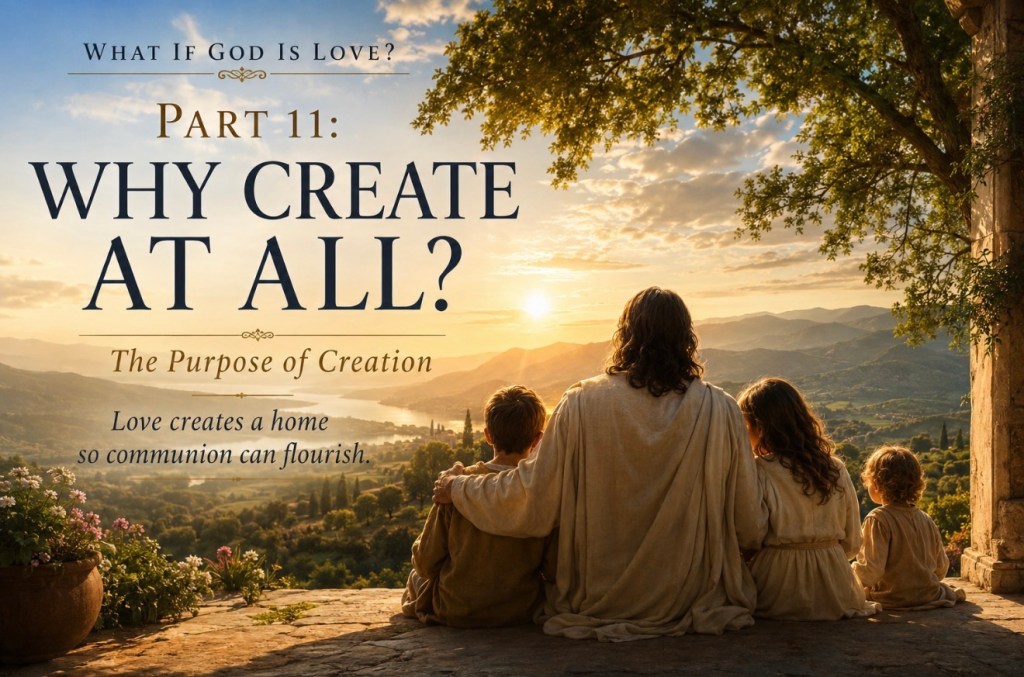
“If God knew creation could reject Him… why create at all?”
If Part 10 answered the question of suffering, then this article asks the question beneath it.
Why create a world capable of suffering in the first place?
Why create beings capable of rejecting their Creator?
Why build a universe that could fracture?
Why begin a story that could end in heartbreak?
These are not merely questions about evil.
They are questions about creation itself.
And they force us to ask something even deeper.
What was God trying to accomplish?
Not simply,
“What did God make?”
But,
“Why did God make anything at all?”
For centuries, Christians have answered by saying God created for His glory.
Others have said He created for worship.
There is truth in both statements. A good Creator will receive glory from His creation, and worship is certainly an appropriate response to God.
But neither answer seems to reach deeply enough.
They can unintentionally make creation sound as though God was seeking something He lacked.
God did not need more glory.
The Father, Son, and Holy Spirit had eternally glorified one another before anything existed.
Nor did God need more worship.
Perfect communion already existed within the Trinity.
Nothing was lacking.
Nothing needed completion.
Nothing was missing.
So why create?
If we have followed this series carefully, perhaps the answer has been quietly unfolding from the beginning.
Because God is Agape.
And Agape does what Agape has always done.
It gives itself.
It shares itself.
It delights in bringing others into communion.
That is not something God decided to become.
It is who God eternally is.
Perhaps creation, then, was never primarily about producing servants.
Perhaps it was always about preparing a home.
The Home Agape Was Building
One of the most misunderstood Hebrew words that is of great importance to the entire biblical narrative is Shabbat. There is an entire stand-alone article on this if you want to explore it more deeply.
Most of us learned that Shabbat means “rest.”
Yet Scripture paints a much richer picture.
Genesis 1 reaches its climax in the Shabbat of Genesis 2:1-4, not because God became tired.
It ends because creation had reached its intended purpose.
The work of ordering had been completed.
The house was ready.
God ceased creating because creation was now prepared for something greater.
Not inactivity but:
Dwelling.
Presence.
Communion.
This comes from an understanding of creation that scholars call the “Cosmic Temple”.
In the ancient world, when a temple was completed, the deity did not simply leave the finished building behind.
The deity entered it.
The completed temple became the place where heaven and earth met.
Genesis presents creation itself in precisely this kind of temple imagery.
The heavens are stretched out.
The earth is prepared.
Life flourishes.
Humanity is placed within it as God’s image bearers.
And then God enters His creation.
Not as a distant observer.
Not as an absentee landlord.
But as the master of the home, the One who intends to dwell with His creation.
Shabbat is not God taking a vacation.
It is God moving into His home.
That changes the way we think about creation.
God was never simply constructing a universe.
He was preparing a place where communion could flourish.
A home where His family could live with Him.
A World Built for Communion
That observation immediately explains something we discussed at the end of Part 10.
The world possesses a remarkable stability.
Fire behaves like fire.
Gravity remains dependable.
The seasons continue.
Seeds become trees.
Children become adults.
We learn.
We remember.
We build.
We cultivate.
We make promises because tomorrow usually resembles today.
This remarkable order is precisely what allows life and relationship to flourish.
Love requires a world stable enough for trust to become meaningful.
Imagine trying to raise a family in a universe where gravity changed every afternoon, where language constantly shifted, where fire warmed one day and froze the next, or where memory disappeared every morning.
No civilization could develop.
No promises could endure.
No relationships could mature.
No home could ever become home.
This is part of what makes the finely tuned character of our universe so philosophically significant. The universe is not merely capable of containing life. Its physical structure permits the kind of stable, intelligible environment in which conscious life, relationship, moral development, and eventually love can emerge.
Agape therefore creates exactly the kind of universe one would expect if its purpose is communion.
Ordered.
Reliable.
Understandable.
Not because order is the goal.
Because communion is.
Order makes communion possible.
The physical structure of creation serves the relational purpose of creation.
The house is built so that life can flourish inside it.
More Than a House
But a house is never the final goal.
Imagine spending years designing a beautiful home.
You choose the land carefully.
Lay the foundation.
Frame the walls.
Plant trees.
Prepare a garden.
Fill every room with beauty.
Then, when everything is finished, you lock the front door forever.
No laughter.
No meals around the table.
No children running through the hallways.
No stories.
No memories.
No family.
The house would be complete.
Its purpose would not.
Homes exist to be lived in.
They exist because relationship exists.
They exist because love desires a place where communion can grow.
Genesis describes exactly that kind of creation.
God prepares the home before introducing the family.
Light.
Sky.
Land.
Vegetation.
Animals.
Everything necessary for flourishing.
Only then does humanity appear.
Creation itself reflects the wisdom of a loving parent.
Prepare the home.
Then welcome the children.
Why Children?
But this raises another question.
If God desired communion, why not simply create mature sons and daughters already sharing His life?
The answer returns us to one of the central themes of this series.
Love cannot be manufactured.
Character cannot simply be installed.
Faithfulness cannot be programmed.
Communion cannot be forced.
Earlier we argued that freedom exists for formation.
Now we can see why.
God was not merely creating beings capable of existing.
He was creating beings capable of becoming.
Genesis tells us humanity was created in God’s image.
The rest of Scripture calls humanity toward God’s likeness.
Image is given.
Likeness is grown into.
That distinction changes everything.
God was never merely interested in creating people who obeyed Him.
He desired sons and daughters who could freely mature into people capable of sharing His own life, creativity and home.
That journey requires time.
Experience.
Formation.
Wisdom.
Patience.
Exactly as every healthy family already understands.
A newborn is no less loved than an adult child.
But no loving parent expects maturity on the first day of life.
Growth is not a flaw in the design.
Growth is the design.
The purpose of childhood is not perpetual dependence.
It is maturity.
The purpose of creation is the same.
God is raising a family.
Not assembling machines.
Why Not Simply Program Love?
Perhaps an illustration helps.
Imagine someone builds the world’s most sophisticated humanoid robot.
It speaks beautifully.
It smiles.
It says,
“I love you.”
It obeys every instruction perfectly.
It never argues.
Never disobeys.
Never surprises its creator.
Would anyone truly call that love?
Or would we recognize that every action simply reflects the programming placed within it?
The machine cannot choose generosity.
It cannot choose forgiveness.
It cannot choose courage.
It cannot become faithful.
It merely performs exactly as it was designed to perform.
The robot has not become good.
It simply cannot be anything other than what it was programmed to be.
Now imagine instead a child.
A child who learns.
Who struggles.
Who sometimes fails.
Who surprises their parents with creativity.
Who gradually discovers compassion.
Who freely chooses honesty when lying would be easier.
Who forgives.
Who sacrifices.
Who eventually becomes the kind of person who genuinely loves.
The difference is immeasurable.
One merely performs programmed goodness.
The other becomes good.
One is simply an extension of the settled will of its maker.
The other is a person capable of genuine communion with the one who gave it life.
Agape was never looking for perfect automation.
Agape was seeking children capable of freely sharing in its own life.
That kind of family cannot be manufactured.
It must be formed.
A Family Built for Communion
Perhaps a human analogy can help us see why this matters.
My wife and I have experienced a small version of this ourselves.
After we had been married for a few years, we bought a piece of land and began dreaming about building what my wife called our “forever home.” We already had two young children, but they were only three and two years old. Our family was growing, and we knew we needed more space.
But we were not simply building a larger house for the family we already had.
We were building a home for the family we hoped to have.
We dreamed about having more children.
We wanted our children to have room to grow.
We wanted bedrooms where they could sleep and play.
We wanted a kitchen where we could prepare meals together.
We wanted a table where the entire family could gather.
We had already welcomed foster children into our family, and we hoped to continue doing so. Part of building that larger home was therefore making room not only for the children we already had and the children we hoped to have, but also for children who might someday need a place in our family.
We were preparing a home before we knew exactly who would one day live in it.
And we dreamed about what that home might become.
We imagined birthdays.
Christmas mornings.
Family traditions.
Meals around the table.
Children growing from toddlers into teenagers and eventually into adults.
We imagined future spouses sitting around that same table and becoming part of the family.
We imagined grandchildren someday running through the house.
But perhaps most of all, we imagined that our children, even after growing up and establishing families of their own, would still want to come home.
We imagined holidays when everyone would return.
Grown children sitting around the same table.
Laughter.
Stories.
Old traditions.
New traditions.
Friendships that began in childhood continuing throughout adulthood.
We imagined our children loving one another.
We imagined them enjoying being together.
We imagined them knowing that no matter how old they became or how far they traveled, there would always be a place for them at home.
We were not merely imagining a building.
We were imagining communion.
We were imagining our forever home.
And yet, when we began building that home, we had absolutely no guarantee that any of those dreams would come true.
We could not know what our children would become.
We could not know what choices they would make.
We could not know what relationships they would have.
We could not know whether they would remain close to us or to one another.
We could not even know who all the children would eventually be.
Yet that uncertainty did not make building the home an unloving decision.
Quite the opposite.
The very reason we built the home was love.
We were creating a place where people could flourish together.
We were making room for relationships that did not yet exist.
We were preparing a home because we hoped that those who entered it would one day freely choose to call it home.
That is what loving parents do.
They do not create a family because they have guaranteed the outcome.
They create a family because they hope.
They hope their children will flourish.
They hope they will love one another.
They hope they will love them.
They hope their children will become mature adults who freely choose to maintain the relationships formed in childhood.
They hope that one day, when their children no longer need the home, they will still want to return to it.
They hope the family will become more than people who happen to share an address.
They hope it will become a community of people who genuinely love one another.
And perhaps that gives us a glimpse into what God was doing in creation.
God was not merely constructing a universe.
He was preparing a forever home.
A home in which His children could grow.
A home in which they could learn to love.
A home in which they could develop wisdom, character, creativity, faithfulness, and compassion.
A home in which they could eventually become mature enough to share in the responsibility of caring for and ruling the creation they had been given.
Just as we could not know exactly what our children would become, God did not need to create humanity as a collection of predetermined outcomes.
He could create persons.
Real persons.
Persons capable of becoming.
Persons capable of freely responding to His love.
Persons capable of rejecting it.
The point was not to guarantee the outcome.
The point was to create the possibility of genuine communion.
That distinction is crucial.
If God creates only those whom He already knows will freely remain in communion with Him, then creation begins to look less like an act of open-handed love and more like the construction of a predetermined family.
But if God creates because He genuinely desires every person to share His life, then creation itself becomes an act of love.
God prepares the home.
He gives life.
He gives His image.
He gives freedom.
He gives opportunity for growth.
He invites His children into communion.
And He hopes they will freely respond.
Some may reject Him.
Some may wander.
Some may resist the formation for which they were created.
Some may even turn the freedom given for love against love itself.
Yet none of that means God was wrong to create them.
It means genuine relationship was genuinely possible.
The Ancient Home
The analogy becomes even more powerful when we remember the world in which Genesis was written.
Our modern idea of a home is largely centered around family life. In the ancient world, however, the household was much more than a place where people slept and ate together.
It was the center of family identity.
It was where children were raised.
Where work happened.
Where traditions were passed down.
Where inheritance was preserved.
Where authority was exercised.
Where the family’s future was prepared.
Children were not simply guests in the household.
They were being formed to become responsible members of it.
In many ancient families, children would eventually take on the work and responsibilities of the household themselves. They were being prepared to carry the family forward.
That makes the biblical picture of creation even more remarkable.
Genesis presents creation as God’s cosmic temple.
God is not merely building a universe.
He is ordering a cosmic home in which He intends to dwell.
And then, at the climax of creation, God places His image bearers within that home.
They are not merely inhabitants.
They are given a vocation.
They are called to exercise dominion.
They are called to cultivate and care for creation.
They are called to rule within God’s world as His image bearers.
In other words, God does not merely prepare a house and fill it with servants.
He prepares a home and places His children within it.
And He expects those children to grow.
Genesis gives us the image.
The rest of Scripture tells the story of becoming.
Image is given.
Likeness is grown into.
The children are placed within the Father’s house, but they are not finished.
They must learn.
They must mature.
They must develop wisdom.
They must learn what it means to exercise authority without domination.
They must learn what it means to rule creation according to the character of the One whose image they bear.
The goal was never merely that humanity would occupy God’s house.
The goal was that humanity would grow into the kind of family that could faithfully share in the Father’s work.
Becoming the Kind of People Who Can Live in Shabbat
Seen from this perspective, spiritual growth begins to make sense in an entirely new way.
God is not merely preparing people for heaven.
He is preparing people for home.
Shabbat is not simply a location.
It is a way of life.
It is life lived according to the grain of Agape.
It is the flourishing that emerges when every relationship is rightly ordered in love.
Imagine placing someone consumed by greed into a perfectly generous society.
Or someone ruled by hatred into perfect peace.
Or someone incapable of forgiveness into eternal communion.
The environment could be perfect.
But they would not know how to flourish within it.
That is why Scripture consistently speaks of transformation rather than mere relocation.
The Kingdom is not simply somewhere we hope to go someday.
It is the kind of people we are becoming.
Whenever we learn to live in communion, forgiveness, generosity, justice, and love, the Kingdom of heaven begins to come on earth.
Jesus teaches His disciples to pray,
“Your kingdom come, your will be done, on earth as it is in heaven.”
That prayer is not asking God to abandon earth.
It is asking heaven to fill it.
We are learning, even now, how to live in the Father’s house as the people He intended us to become.
This also explains why Jesus constantly speaks the language of household and family. He teaches His disciples to pray, “Our Father.” He speaks of preparing a place. He calls His followers brothers and sisters. The New Testament repeatedly describes believers as sons and daughters, heirs, members of God’s household, and fellow citizens of His Kingdom.
None of those are accidental metaphors.
They point back to the same reality.
The Creator was never merely building a kingdom to rule.
He was preparing a home to share.
Why Love Decides the Risk Is Worth It
Everything we have said so far leads to one final question.
Even if Shabbat is the goal…
Even if creation is a home…
Even if humanity was created to become sons and daughters rather than servants…
Why would Agape decide that such a creation was worth the risk?
After all, God knew what could happen.
His children could reject Him.
They could wound one another.
They could corrupt His good creation.
They could fracture the communion He desired.
If all of that was genuinely possible…
why create at all?
Perhaps the answer has been quietly living inside us all along.
For thousands of years, ordinary men and women have done something remarkable.
They have bought land.
Built houses.
Prepared rooms.
Planted gardens.
Worked long hours.
Made sacrifices.
And then they chose to have children.
Not because they believed everything would go perfectly.
Quite the opposite.
Every parent knows what could happen.
Their child could become sick.
They could be bullied.
They could rebel.
They could make destructive choices.
They could reject everything they were taught.
One day they might even break their parents’ hearts.
Yet loving husbands and wives still look at one another and say,
“Let’s have children.”
Why?
Certainly not because they enjoy the possibility of suffering.
No loving parent desires that.
Nor is it because they have calculated that the rewards outweigh the risks in some cold mathematical equation.
Love does not perform that kind of calculation.
Love desires to share itself.
There is something deep within us that desires someone who comes from us, who bears our image in a unique way and can receive our love in a unique way.
Someone whose laughter fills the home.
Someone we can teach.
Protect.
Encourage.
Delight in.
Someone who may one day freely choose to love us in return.
Parents willingly embrace years of sleepless nights, countless sacrifices, patient instruction, heartache, fear, and long-suffering because they believe one thing.
The child is worth it.
Not because the outcome is guaranteed.
Because love hopes.
And throughout history, even in a fallen world, human beings have continued to prepare homes and welcome children into them.
Why?
Because we were designed for love.
Agape love always hopes.
Love always reaches outward.
Love delights in giving life.
Love expands.
Perhaps this is not merely something humans invented.
Perhaps it is something humans inherited.
Throughout this series we have argued that humanity bears the image of God.
If that is true, then perhaps one of the deepest instincts written into our hearts is this remarkable conviction:
Love is worth the risk.
Perhaps every loving parent who prepares a nursery, every family who builds a home, every couple who welcomes children into the world is unknowingly bearing witness to the very heart of God.
For what are they doing?
They are creating a place where others can flourish.
They are preparing a home before inviting children into it.
They are accepting that genuine love cannot be controlled.
And they are deciding that the possibility of lifelong communion is worth the possibility of lifelong grief.
Is that not exactly what Genesis describes?
Before humanity ever appears, God prepares a world.
Light.
Sky.
Land.
Trees.
Rivers.
Fruit.
Animals.
Everything necessary for flourishing.
Only then does He create His image bearers and place them within the home He has prepared.
Not because He needed servants.
Not because He desired slaves.
But because Agape delights in sharing life.
Shabbat was never simply about God resting.
It was always about God dwelling.
The Creator prepared His home because He desired a family to share it.
That does not mean the risk was imaginary.
It was real.
Creation genuinely could go wrong.
Freedom genuinely could be abused.
Communion genuinely could be fractured.
The story of Scripture proves that it was.
Yet notice something astonishing.
Nowhere does Scripture suggest that God regretted creating because love itself was a mistake.
He grieves.
He laments.
His heart is broken.
But He never abandons His purpose.
Instead, He begins the work of redemption.
Why?
Because Agape does not retreat when communion is threatened.
Agape remains.
Agape restores.
Agape patiently continues building toward the home it intended from the beginning.
And perhaps that explains something about ourselves as well.
Parents whose children wander rarely stop loving them.
Many would gladly sacrifice everything they own, even their own lives, if it meant rescuing their son or daughter.
Why?
Because Agape does not cease to be Agape simply because it has been wounded.
It continues preferring the good of the beloved.
It continues hoping.
It continues waiting.
It continues loving.
If this instinct truly reflects the image of God within us, then perhaps we have finally arrived at our answer.
Why did God create at all?
Because Agape always overflows.
Agape delights in sharing life.
Agape prepares a home.
Agape invites others into it.
And Agape decides that even the genuine possibility of heartbreak is not sufficient reason to withhold the possibility of eternal communion.
Perhaps that has been the answer from the very beginning.
The purpose of creation was never merely existence.
It was never merely worship.
It was never merely service.
It was always communion.
A home.
A family.
Children who could freely grow into the likeness of their Father until all creation enters its intended Shabbat, the flourishing and harmonious communion for which it was created from the beginning.
God did not create because something was missing in Him.
He created because Agape was overflowing from Him.
Creation was a gift born of love.
Not because God had predetermined exactly what every child would choose.
But because Agape always expands in order to share itself.
And if sharing His own life with sons and daughters who could freely grow into His likeness required a world where love, freedom, risk, patience, and long-suffering were all possible…
then Love judged that such a world was worth creating.
 The Logos of Agape